


Enterprise teams are moving past the point where an AI agent is just a prompt wrapped around a tool call. The real design question is no longer whether an agent can call an API. The question is whether the organization can control what happens before, during, and after that call.
That is why choosing an agent framework is not just a developer preference. It is an operating model decision.
A proof of concept can survive with a simple loop: receive a task, call a model, execute a tool, return an answer. A production agent cannot. Production agents need state, policy boundaries, identity context, observability, approval paths, recovery behavior, and a clear model for when deterministic workflow should override model discretion.
The wrong framework choice does not usually fail on day one. It fails when the agent has to resume a workflow, explain a decision, recover from a failed tool call, or prove why it was allowed to touch a system of record.
Why This Matters In Enterprise Practice
Most agent discussions still start with a list of frameworks. That is useful, but it is not enough. A framework list tells you what exists. It does not tell you what your enterprise operating model can absorb.
An internal support assistant, a code remediation agent, a cloud operations copilot, and a procurement workflow agent do not need the same architecture. Some need flexible reasoning. Some need strict workflow control. Some need multi-agent handoffs. Some need durable execution. Some need human approval before anything changes.
A better starting point is not “Which framework is best?”
A better starting point is “What kind of control surface does this agent require?”
The Enterprise Agent Control Surface
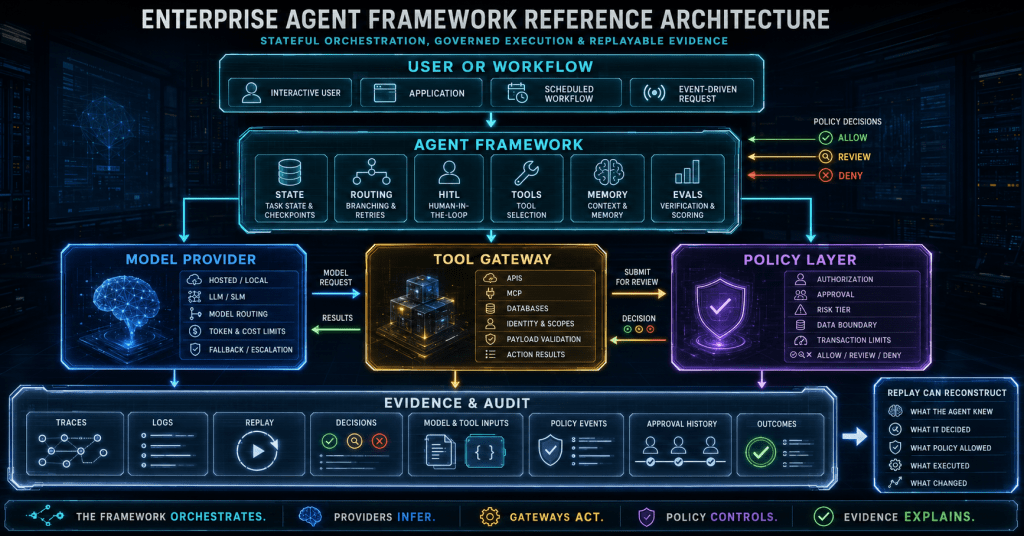
The diagram below shows the design boundary that matters. The model is only one part of the system. The framework sits between model reasoning and enterprise action.

What matters in this diagram is the location of control. If the framework only helps the model call tools, then the surrounding platform must provide the missing governance. If the framework provides state, traceability, approval hooks, handoffs, and evaluation support, then some of the control plane can live closer to the agent runtime.
Neither pattern is automatically wrong. The risk is choosing one without being honest about what the agent is allowed to do.
Framework Choice Should Follow Workload Risk
There are several useful agent frameworks in the market, but enterprise selection should begin with workload risk, not popularity. A lightweight framework may be perfect for an internal knowledge assistant. It may be a poor fit for a long-running operational workflow that changes firewall rules, updates customer records, or opens production pull requests.
Use this decision model before picking a framework.
This is where many teams make the mistake. They evaluate frameworks based on how quickly they can build a demo, not whether the framework can support the operating controls required by the action being automated.
A read-only agent has a different risk profile than a read-write agent. A single-turn assistant has a different risk profile than a long-running workflow. A model that recommends a change is not the same thing as an agent that executes the change.
Matching Framework Patterns To Enterprise Needs
A practical enterprise selection process should separate agent frameworks into capability patterns instead of treating them as interchangeable.
| Pattern | Best Fit | Enterprise Concern |
|---|---|---|
| Graph-based orchestration | Long-running workflows, branching logic, human approval, resumable state | Operational complexity and learning curve |
| Lightweight tool-using SDK | Focused agents with tools, handoffs, guardrails, and tracing | May need external workflow durability |
| Role-based multi-agent coordination | Research, analysis, content, operational triage | Role sprawl and duplicate work |
| Data/retrieval-centered workflow | Knowledge systems, RAG, document-heavy assistants | Retrieval quality and source governance |
| Code-first local agent loop | Local experimentation, private coding assistants, sandboxed workflows | Execution security and permission boundaries |
| Enterprise cloud agent kit | Teams standardized on a hyperscaler ecosystem | Platform coupling and version velocity |
This table is not meant to crown a winner. It is meant to force the right conversation. The question is not whether a framework can build an agent. Most can. The question is whether it matches the control model your workload requires.
The Hidden Problem Is State
State is where agent demos often become production incidents.
A stateless agent can answer a question and disappear. A production agent may need to remember what it has already tried, which approval it received, what tool output it saw, what version of a file it changed, and whether a failed step can be retried safely.
State is not just memory. It is operational evidence.
For enterprise agents, state should answer practical questions:
- What did the agent know when it made the decision?
- Which tools were available at that moment?
- Which identity or service account was used?
- Was human approval required?
- Did the agent continue after an interruption?
- Can the workflow be replayed?
- Can a failed or unsafe action be rolled back?
If the framework cannot answer these questions, the platform around it must.
Governance Should Be Designed Before Autonomy Expands
A common pattern is to start with an advisory agent and gradually give it more authority. That is a reasonable path, but only if governance matures at the same pace.
Do not move directly from “recommend” to “execute.” Insert control stages between them.

This progression gives the team a way to earn autonomy through evidence. It also gives security, operations, and application owners a shared language for deciding when an agent is ready to act.
The framework should support this progression. If it does not, then the surrounding platform must provide approval routing, tool access control, logging, and policy enforcement.
A Practical Policy Example
The following example is intentionally simple. It shows how agent authority can be described outside the prompt. The point is not to use this exact YAML. The point is to treat agent boundaries as configuration that can be reviewed, versioned, and audited.
agent_policy:
  name: service-desk-triage-agent
  allowed_actions:
    - read_ticket
    - summarize_ticket
    - search_knowledge_base
    - draft_response
  restricted_actions:
    - close_ticket
    - change_priority
    - update_customer_record
  approval_required:
    - assign_ticket
    - create_incident
  evidence_required:
    - source_documents
    - tool_outputs
    - confidence_reason
  logging:
    trace_model_calls: true
    trace_tool_calls: true
    retain_days: 90
  rollback:
    required_for_write_actions: true
This type of policy belongs in the architecture discussion before the agent is promoted into production. Prompt wording alone is not an enterprise control.
Operational Implications
Once agents enter production workflows, ownership needs to be explicit.
Engineering may own the framework. Platform teams may own runtime, identity, and deployment. Security may own guardrails and audit requirements. Application teams may own tool behavior. Data teams may own retrieval quality. Operations may own incident response when an agent causes downstream impact.
If those responsibilities are not assigned, the framework becomes a dumping ground for every missing control.
A mature agent platform should define:
- How tools are registered
- How tool permissions are granted
- How approvals are routed
- How traces are retained
- How models are evaluated
- How agent behavior is promoted across environments
- How incidents are investigated
- How unsafe autonomy is revoked
This is why agent framework selection should happen with architecture, security, platform engineering, and operations in the room. It is not just a library decision.
Common Mistakes To Avoid
The first mistake is choosing a framework because it is popular. Popularity can indicate community momentum, but it does not prove fit for your risk model.
The second mistake is confusing multi-agent with mature architecture. Splitting a workflow into several agents can help when roles are real. It can also add coordination overhead, repeated tool calls, and harder debugging.
The third mistake is leaving observability for later. If you cannot trace agent decisions during pilot, production will only make the problem harder.
The fourth mistake is giving agents broad tool access too early. Tool access should start narrow, logged, and reversible.
The fifth mistake is treating human approval as a checkbox. Approval needs scope, evidence, timeout behavior, escalation paths, and accountability.
Conclusion
Agent frameworks are becoming part of the enterprise application platform. That means the selection process needs to look more like architecture review and less like package selection.
The best framework is not the one with the longest feature list. It is the one that matches the workload’s state requirements, tool risk, approval model, observability needs, and operational ownership.
Start with the agent’s authority boundary. Decide what it can read, what it can recommend, what it can draft, and what it can execute. Then choose the framework that supports that boundary with the least amount of custom glue.
That is how agents move from impressive demos to governed enterprise systems.
External References
LangGraph Overview
https://docs.langchain.com/oss/python/langgraph/overview
LangGraph Persistence
https://docs.langchain.com/oss/python/langgraph/persistence
OpenAI Agents SDK
https://openai.github.io/openai-agents-python/
OpenAI Agents SDK Tracing
https://openai.github.io/openai-agents-python/tracing/
Google Agent Development Kit
https://google.github.io/adk-docs/
Google ADK Evaluation
https://google.github.io/adk-docs/evaluate/
Model Context Protocol Introduction
https://modelcontextprotocol.io/docs/getting-started/intro
NIST AI Risk Management Framework
https://www.nist.gov/itl/ai-risk-management-framework
