

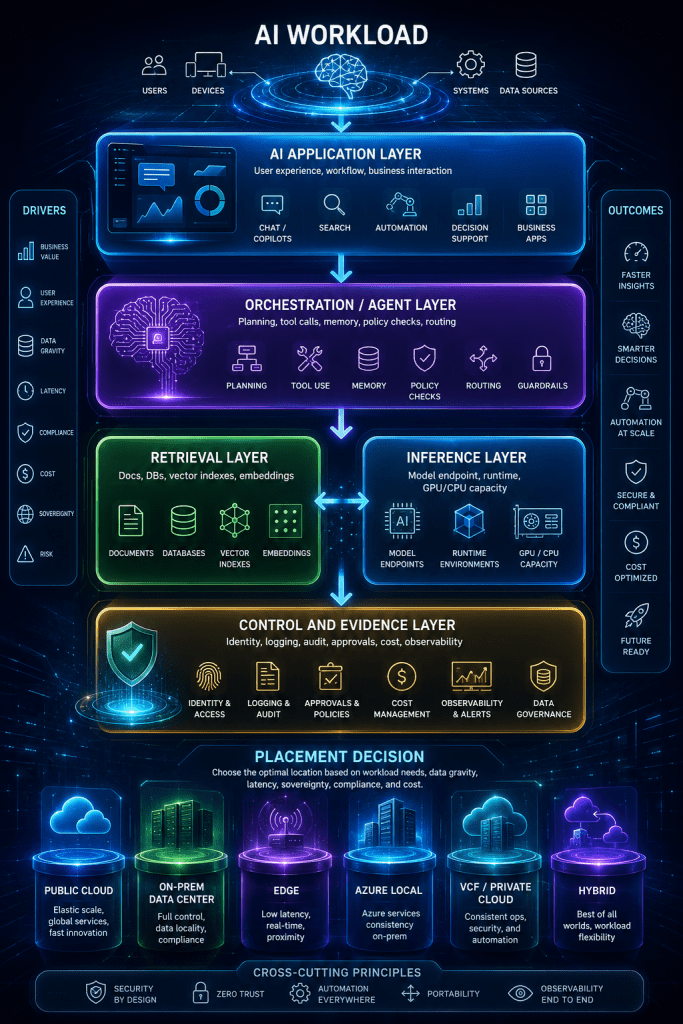

AI placement is becoming a real architecture decision.
For the first wave of generative AI adoption, many organizations could experiment with hosted models, isolated copilots, and proof-of-concept retrieval systems without making hard infrastructure choices. That window is closing. AI is moving from isolated experiments into business workflows, operational systems, and agentic patterns that can retrieve information, make recommendations, and trigger actions.
That shift changes the placement conversation.
The question is no longer simply:
Should AI run in the cloud or on-prem?
A better question is:
Where should inference, retrieval, orchestration, policy enforcement, and audit evidence live so the system can perform, comply, scale, and remain operable?
This is where data gravity becomes an AI architecture input.
Data gravity already shapes where applications, databases, storage platforms, and migration waves should land. For AI, it also shapes where prompts are assembled, where embeddings are generated, where vector indexes live, where agents execute tool calls, and where evidence is retained.
AI does not just consume compute. It consumes context.
The more important that context becomes, the more placement matters.
Why AI Placement Matters Now
Enterprise AI systems are becoming more connected to production workflows.
A basic chatbot may answer a user’s question from a narrow prompt. A production AI system usually needs more than that. It may need to search documents, query databases, inspect telemetry, call internal APIs, reference source code, open tickets, validate policy, or produce an auditable recommendation.
Agentic AI raises the stakes further.
Once an AI system can plan steps, call tools, and take action against business or operational systems, the architecture must account for identity, authorization, blast radius, observability, human approval, and rollback. At that point, model selection is only one part of the design.
The larger question becomes:
Where is the safest and most practical place to run the AI workflow?
For some workloads, managed cloud AI is the right answer. For others, especially context-heavy, latency-sensitive, sovereignty-bound, or cost-sensitive workloads, keeping key AI components on-prem may be the better architecture.
Scope and Assumptions
This article focuses on AI placement decisions for enterprise workloads. It is not arguing that all AI should run on-prem. It is also not arguing that cloud AI is automatically the default.
The practical answer depends on the workload.
This article evaluates placement through four inputs:
| Input | Core Question |
|---|---|
| Data gravity | Where does the useful context already live? |
| Latency | How close must the AI workflow be to the user, data, or action point? |
| Sovereignty | Where is data allowed to be processed, logged, and governed? |
| Cost | Which model creates the most sustainable cost profile at scale? |
The goal is to create a decision framework that helps architects place AI deliberately before a pilot becomes a production dependency.
AI Placement at a Glance
The important thing to notice in the diagram below is that “AI placement” is not only about the model endpoint. Retrieval, orchestration, tool access, and evidence capture are often just as important.

A weak design treats the model as the architecture.
A strong design separates the AI system into layers, then decides where each layer belongs.
Input 1: Data Gravity
Data gravity is the most important placement input for many enterprise AI workloads.
AI systems become useful when they have access to the right context. That context may live in file shares, SharePoint libraries, source repositories, ticketing systems, CMDBs, SQL databases, data warehouses, security tooling, healthcare systems, finance platforms, engineering records, or operational telemetry.
If every useful AI response requires moving large amounts of local context across a network boundary, the architecture is already under pressure.
For AI, data gravity appears in several places:
| AI Component | Data Gravity Question |
|---|---|
| Prompt assembly | Where is sensitive context added to the prompt? |
| Embedding generation | Where are documents chunked, transformed, and embedded? |
| Vector index | Where does the searchable representation of the data live? |
| Retrieval service | Where does the AI system query authoritative context? |
| Agent tools | Which systems can the agent query or modify? |
| Audit logs | Where are prompts, outputs, approvals, and tool calls retained? |
| Evaluation data | Where are test cases, feedback, and quality signals stored? |
| Fine-tuning data | Where does training or customization data reside? |
The strongest on-prem candidates are usually not just sensitive. They are context-heavy.
If the AI workload depends on large, frequently accessed, regulated, or operationally local data, it may be better to keep retrieval, indexing, prompt assembly, and possibly inference close to the source.
That does not always mean the entire AI stack must run on-prem. A hybrid model may keep retrieval local while using a managed model endpoint for approved prompts. The point is to evaluate the data path before deciding where the model belongs.
Input 2: Latency
Latency is often misunderstood in AI architecture.
Teams frequently measure the model call and stop there. That is not the full user experience.
A production AI workflow may include:
- User request
- Identity lookup
- Policy evaluation
- Retrieval from internal systems
- Prompt construction
- Model inference
- Tool execution
- Human approval
- Audit logging
- Response delivery
The user feels the total workflow, not just the inference endpoint.
This matters when the AI system performs repeated retrieval against on-prem systems. A model call may be fast, but the full interaction may still be slow if every step crosses network inspection points, private connectivity paths, data gateways, or API boundaries.
Keep AI closer to the workflow when latency has operational consequences.
| Latency Pattern | Placement Implication |
|---|---|
| Repeated retrieval from local systems | Keep retrieval and indexing local |
| Multi-step agent workflow | Keep orchestration close to tool endpoints |
| Interactive operations assistant | Keep the retrieval path short and predictable |
| Edge or plant-floor support | Keep inference local or near-edge |
| Batch summarization | Cloud inference may be acceptable |
| Low-risk asynchronous analysis | Cloud or hybrid placement may be practical |
Latency is not just a performance metric. It is an architecture signal.
If the AI system must respond quickly, retrieve local context repeatedly, or interact with time-sensitive systems, local placement becomes more attractive.
Input 3: Sovereignty
Sovereignty is broader than region selection.
It includes where data is processed, where logs are retained, who operates the platform, what legal jurisdiction applies, how encryption keys are controlled, whether disconnected operation is required, and whether administrators outside the organization can access any part of the workflow.
For AI, sovereignty questions should be asked at the workflow level:
| Sovereignty Question | Why It Matters |
|---|---|
| Can prompts leave the controlled environment? | Prompts may contain sensitive context |
| Can retrieved data be processed by a managed model? | RAG may expose internal records |
| Can responses be logged outside the local boundary? | Outputs may contain sensitive derived data |
| Can embeddings leave the environment? | Embeddings may represent sensitive source content |
| Can tool calls cross the boundary? | Agents may interact with regulated systems |
| Is disconnected operation required? | Some sites cannot depend on cloud connectivity |
| Who can administer the platform? | Operator access may be a compliance issue |
| What evidence must be retained? | Audit trails must survive review |
A common mistake is treating sovereignty as a yes/no cloud question.
A better approach is to define the allowed processing zones:
| Zone | Example Rule |
|---|---|
| Public cloud allowed | Low-risk data and approved workloads |
| Approved geography only | Sensitive data with regional controls |
| Data zone only | Workloads bound to a defined data zone |
| Customer-owned infrastructure | Data must remain on-prem or in a controlled site |
| Disconnected or air-gapped | No dependency on external connectivity |
Some workloads can use managed cloud AI with the right deployment type, region, identity, logging, and contractual controls. Other workloads require local processing because the requirement is not just data residency. It is local control.
That distinction should be documented before implementation.
Input 4: Cost
AI cost is not only token pricing.
Token cost matters, but it is only one line item. Enterprise AI cost includes data movement, retrieval infrastructure, vector storage, logging, observability, private connectivity, GPU capacity, platform operations, evaluation pipelines, model lifecycle, and governance overhead.
A cloud-heavy AI design may have a clean consumption model, but that does not automatically mean it is cheaper at scale. An on-prem design may avoid repeated data movement, but that does not automatically mean it is economical either.
The real cost question is utilization versus flexibility.
| Cost Area | Cloud-Heavy Pattern | On-Prem / Private Pattern |
|---|---|---|
| Inference | Consumption-based model calls | GPU capacity, platform licensing, or private runtime cost |
| Data movement | WAN, private connectivity, replication, possible egress | Local network and storage traffic |
| Storage | Cloud object storage, managed vector stores, logs | Local storage, private object, databases, vector stores |
| Scaling | Elastic capacity | Capacity planning and resource scheduling |
| Idle capacity | Usually lower | Can be high without shared GPU scheduling |
| Platform operations | Managed service premium | Internal platform engineering effort |
| Governance | Native cloud controls plus policy configuration | Internal control implementation and evidence collection |
| Chargeback | Cloud billing-native | Requires internal showback or chargeback |
The cost argument for keeping AI on-prem is strongest when:
- demand is steady,
- the organization has multiple internal AI use cases,
- local data movement would be expensive or risky,
- GPU capacity can be shared across tenants,
- platform operations are already mature,
- governance requirements favor local evidence and control.
The cost argument for cloud AI is strongest when:
- demand is bursty,
- model choice changes frequently,
- the workload is still experimental,
- the team lacks GPU operations maturity,
- the data already lives in the cloud,
- elasticity is more valuable than capacity ownership.
Cost should not be evaluated at pilot scale only. A proof of concept may look inexpensive because usage is low. Production may look different once retrieval frequency, prompt volume, logging, evaluation, private connectivity, and human review workflows are included.
AI Placement Decision Tree
Use this decision tree before deciding that a workload belongs fully in the cloud, fully on-prem, or somewhere in between.

The first split matters most.
Sensitive data does not automatically force on-prem AI, but it does force a policy decision. Once the policy boundary is clear, the rest becomes an architecture exercise.
When to Keep AI On-Prem
Keep AI on-prem when one or more of these patterns are present.
The Data Is Too Heavy to Move Repeatedly
This is the cleanest data gravity case.
If the AI system needs to retrieve large amounts of internal content for every useful interaction, moving that context repeatedly may create latency, cost, and security problems.
Examples include:
- engineering document assistants,
- internal operations assistants,
- security telemetry summarization,
- regulated claims analysis,
- healthcare or imaging workflows,
- data center operations copilots,
- internal RAG over sensitive repositories.
The AI model itself might still be remote in some designs, but ingestion, chunking, embedding, indexing, and retrieval should be evaluated for local placement.
The Workflow Has a Hard Locality Requirement
Some AI workloads must operate near the point of action.
Examples include manufacturing sites, field environments, hospitals, disconnected branches, logistics hubs, defense environments, and regulated operational facilities.
When connectivity is unreliable, latency is strict, or cloud dependency is unacceptable, the architecture should start with local processing assumptions.
Cloud may still play a role for training, offline evaluation, fleet management, or non-sensitive use cases, but the runtime path should be designed around local continuity.
The Agent Acts Against Internal Systems
Agentic AI changes the placement discussion.
A read-only assistant that summarizes documents has one risk profile. An agent that opens tickets, modifies records, requests firewall changes, triggers workflows, or recommends production changes has another.
Once the AI system can act, placement must account for:
- tool allow-lists,
- identity boundaries,
- approval workflows,
- network segmentation,
- API authorization,
- audit trails,
- rollback procedures,
- blast radius.
If the agent primarily acts against internal systems, keep orchestration and tool control close to those systems. The model endpoint can still be evaluated separately, but the policy engine, tool gateway, and evidence trail should be near the controlled environment.
Sovereignty Requires Local Processing
Some requirements cannot be solved by selecting a preferred cloud region.
If the requirement is local processing, customer-owned infrastructure, disconnected operation, or air-gapped deployment, the design should start with local AI options.
This does not mean every model must be internally trained. It means the production AI workflow must be able to satisfy the control boundary. That boundary may include inference, retrieval, logging, embeddings, tool calls, model storage, and administrative access.
The Cost Model Favors High Utilization of Local Capacity
On-prem AI can make sense when the organization can keep GPU resources busy.
That usually requires more than one use case. A private AI platform should serve multiple teams, apply quotas, track utilization, support showback, and provide a repeatable path for model deployment.
Without that platform discipline, on-prem AI can become expensive shelfware.
The strongest local cost case is not “we bought GPUs.” It is:
We can operate shared AI capacity at high utilization while reducing data movement, meeting governance requirements, and serving multiple internal workloads.
When Cloud AI Is the Better First Move
Cloud AI is often the better starting point when the workload is still uncertain.
Use managed cloud AI first when:
| Condition | Why It Favors Cloud |
|---|---|
| The use case is experimental | Teams need iteration speed |
| Demand is unpredictable | Elasticity avoids idle capacity |
| Model choice changes often | Managed platforms simplify model access |
| Data already lives in the cloud | Data gravity already points there |
| Sensitivity is low | Compliance approval is easier |
| Internal GPU skills are limited | Managed services reduce operational burden |
| The workload is asynchronous | Latency is less critical |
The point is not to avoid cloud AI. The point is to document why cloud placement is acceptable.
For sensitive workloads, that means validating processing geography, deployment type, prompt and response handling, logging, retention, identity, network path, and legal requirements. Assumptions are not enough.
A Practical Hybrid Pattern
Many enterprise AI systems will not be purely cloud or purely on-prem.
A practical hybrid pattern separates the workflow into layers:
| AI Layer | Common Placement Pattern |
|---|---|
| Sensitive source data | Keep in system of record |
| Document ingestion | Local or near source system |
| Embedding generation | Local for sensitive content; cloud for approved content |
| Vector index | Local, cloud, or both depending on retrieval rules |
| Model inference | Cloud, local, private cloud, or mixed |
| Agent orchestration | Close to tool and policy boundary |
| Tool gateway | Near internal systems |
| Audit evidence | Centralized security and compliance logging |
| Evaluation pipeline | Separate from production runtime |
| Human approval | Required for high-impact actions |
The model may be remote, but retrieval and tool control may be local. Or inference may be local while governance reporting is centralized. The design should follow the risk and data path, not a slogan.
Example Placement Policy
A placement policy does not have to start as a complex governance platform. It can begin as a simple artifact that architects, security, legal, and platform teams use before a pilot becomes production.
ai_placement_policy:
  workload_name: "Internal Operations Assistant"
  business_owner: "Infrastructure Operations"
  status: "pre-production"

  data_classification:
    highest_data_level: "confidential"
    regulated_data: false
    pii_present: true
    source_systems:
      - "ITSM"
      - "CMDB"
      - "internal runbook repository"

  placement_inputs:
    data_gravity:
      repeated_large_context_retrieval: true
      preferred_retrieval_location: "on-prem"
      vector_index_location: "on-prem"

    latency:
      interactive_workflow: true
      target_response_seconds: 5
      agent_tool_calls_required: true

    sovereignty:
      cloud_processing_allowed: "approved geography only"
      disconnected_required: false
      prompt_logging_allowed: "restricted"
      embeddings_allowed_outside_boundary: false

    cost:
      expected_daily_requests: 25000
      context_size: "medium-to-large"
      existing_gpu_capacity_available: true
      cloud_data_movement_risk: "medium"

  recommended_pattern:
    source_data: "system of record"
    ingestion: "local"
    embeddings: "local"
    vector_index: "local"
    orchestration: "local"
    model_inference: "hybrid"
    tool_gateway: "local"
    audit_logging: "central security logging"

  required_controls:
    - "identity-aware AI gateway"
    - "approved model list"
    - "prompt and output logging with retention policy"
    - "tool allow-list"
    - "human approval for production-impacting actions"
    - "cost review after 30 days"
    - "security test before production"
    - "rollback plan for agent actions"
This kind of artifact does not replace formal governance. It creates the first layer of architectural discipline.
It forces the team to document why the workload belongs where it belongs.

The placement decision should be made before usage patterns harden around an accidental design.
Practical AI Placement Checklist
Use this checklist during intake.
A good placement decision is not a single sentence. It is a documented position across these questions.
Conclusion
The right AI placement decision is not cloud-first or on-prem-first.
It is architecture-first.
Keep AI on-prem when data gravity, latency, sovereignty, or agent control boundaries make local execution the safer and more practical option. Use cloud AI when managed services, elasticity, model access, and iteration speed outweigh the cost and complexity of private infrastructure.
The most mature design may be hybrid.
Sensitive source data may stay in place. Retrieval may run locally. The model may run in an approved cloud service. Tool access may be controlled through an internal gateway. Audit logs may flow to a central security platform.
That is the real architecture conversation.
Do not decide where AI runs after the pilot succeeds. Decide which placement inputs would allow it to become production.
