

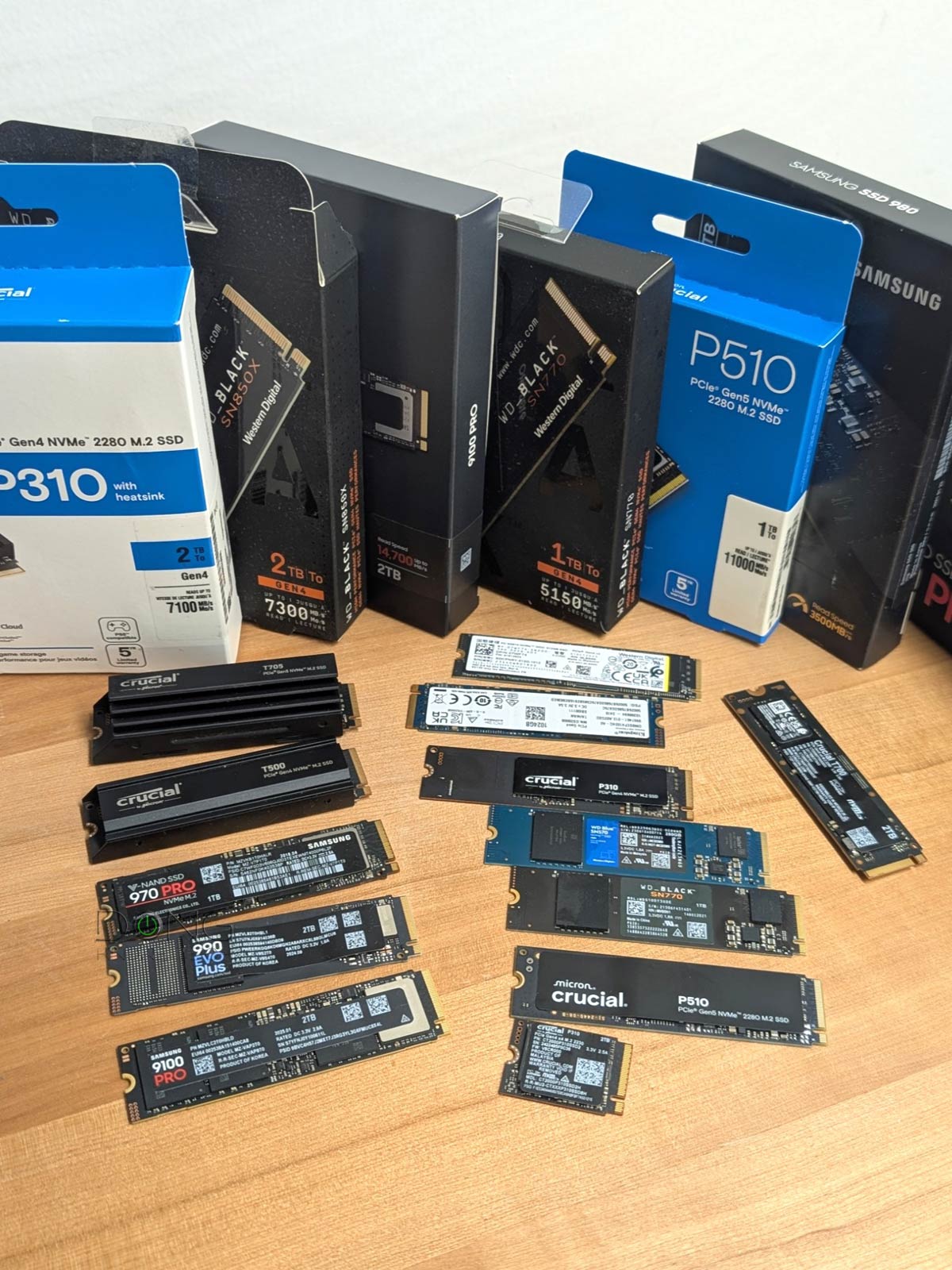

This post includes the best NVMe SSDs among those I’ve reviewed that you can safely bring home today. That is, if you can stomach their recently increased prices due to the component shortage caused by AI.
These are fast internal solid-state drives designed for computers and game consoles that use PCIe Gen 4 or Gen 5 bus speeds — they are the fastest consumer-grade internal storage options. If you’re looking for hard drive replacements, consider this post on the top five SATA drives instead.
Dong’s note: I first published this frequently-revised roundup on April 15, 2025, and last updated it on July 5, 2026, with the latest picks.

Best NVMe SSDs: 2026’s battle-tested list
This list includes the current best NVMe SSDs and their alternatives. It is sorted in recommendation order, with the best options at the top — the numbers indicate the ranking. Scroll down for their performance charts.
Tip
NVMe and SATA are two distinctive internal storage types, with the former being much faster. Currently, the fastest NVMe drives use PCIe 5.0, although PCIe 4.0 and PCIe 3.0 counterparts remain viable options in all cases. All NVMe SSDs can work with motherboards that support all PCIe standards, regardless of revision. Most modern computers come with one or a few M.2 slots to host NVMe SSDs.
The latest drives on this list are mostly PCIe Gen 5, but you’ll find many PCIe Gen 4 options among the alternatives mentioned, all of which were previously among the top five.
1. Micron Crucial P510 (PCIe Gen 5×4)
The Crucial P510 is Micron’s third PCIe Gen 5 SSDs, but the first of the standard designed as a mainstream drive. As such, it currently has the best performance-to-cost ratio. That, plus the omission of excessive heat, makes it an excellent deal.
Alternatives:
Pros
Excellent performance; runs relatively cool
Helpful Crucial Storage Executive software
Comparatively affordable, 5-year warranty
Cons
Capacities cap at 2TB (for now)
2. Samsung SSD 990 EVO Plus (PCIe Gen 5×2)

The Samsung SSD 990 EVO Plus is Samsung’s second attempt at PCIe Gen 5. Like the 990 EVO, it operates as a two-lane drive when running as a PCIe Gen 5 SSD and as a four-lane drive when running as a PCIe Gen 4 SSD. This approach strikes a balance between delivering the necessary performance and reducing unnecessary heat, and it has proven to be a successful approach.
Alternatives from Samsung:
Pros
Excellent performance with PCIe Gen. 4 and Gen. 5
Helpful Samsung Magician software with lots of useful settings and features
Run cool, 5-year warranty
Cons
Only two-lane bandwidth with PCIe 5.0
3. Micron Crucial T710 (PCIe Gen 5×4)
The Crucial T710 is Micron’s third attempt at a high-performance PCIe Gen 5 drive with an effort to reduce the excessive heat exhibited in previous models. And it was a success. The drive delivers top performance while remaining relatively cool to the touch, similar to the case of the Sandisk Optimus GX PRO 8100.
Similar alternatives from Micron:
Pros
Top PCIe Gen 5 performance with a reasonable level of heat
Helpful Storage Executive dashboard software, hardware encryption support
Available in standard and heatsink versions; 5-year warranty
4. Sandisk Optimus GX PRO 81000 (formerly WD Black SN8100) (PCIe Gen 5×4)
The SANDISK Optimus GX PRO 8100 (formerly Sandisk WD Black SN8100) is the first flagship internal SSD from Sandisk after the company’s separation from Western Digital, and it’s indeed significant.
Tip
In March 2025, Western Digital (WD) split off SanDisk as a separate company, which now goes by “Sandisk”. The move means WD retains all hard platter-based products (hard drives), including those with “SanDisk” in their model names. Similarly, Sandisk takes over all NAND-based products — SSDs, memory cards, and so on — including those bearing the “WD” in their model names. In January 2026, Sandisk introduced “SANDISK Optimus” as the new brand for its NVMe SSDs, including existing WD Black and WD Blue NVMe drives.
Supporting PCIe Gen 5, the drive proved to be the fastest SSD on the market upon its release. Most importantly, it does not suffer from the heat issues often prevalent in previous Gen 5 NVMe SSDs.
Pros
Top PCIe Gen 5 performance with manageable heat levels
Helpful Dashboard software
Up to 8TB capacity; standard and heatsink options; 5-year warranty
Cons
No user-accessible features
5. Sandisk Optimus GX 7100 (PCie Gen 4×4)
The Sandisk Optimus GX 7100, represented by the 2230 Optimus GX7100M version, is the only PCIe Gen 4×4 drive on this list. It’s a testament that, when it comes to NVMe, a higher PCIe standard doesn’t necessarily mean better.
Alternative PCIe Gen 4 NVMe SSDs from Sandisk (formerly Western Digital):
Pros
Excellent PCIe Gen 4 NVMe performance
Available in compact 2230 and standard 2280 designs
Helpful dashboard software
Cons
No hardware encryption or user-accessible features.
Best NVMe SSDs: The performance charts


Best NVMe SSDs: The takeaway
Over the past decade, the NVMe SSD has gradually become the standard for internal computer storage. It’s now almost impossible to buy a new laptop, even a desktop, that doesn’t use one as the primary storage unit.
While NVMe drives are not created equal, in most cases, any drive that uses PCIe Gen 4 or later will be fast enough for almost any application. That said, if you’re still using a computer with a SATA SSD (or a hard drive), it’s time to upgrade to a new computer, or at least migrate to an NVMe drive to achieve the best possible performance.
On a budget and can’t decide? I’d say get the one with the lowest cost. I’ve used all of these drives for years (and will continue to use them), and none has died on me — I consider myself a heavy user when it comes to moving data around. With the endurance notion in mind, in most cases, what practically separates these storage devices in real-world consumer-grade applications is their cost.
