

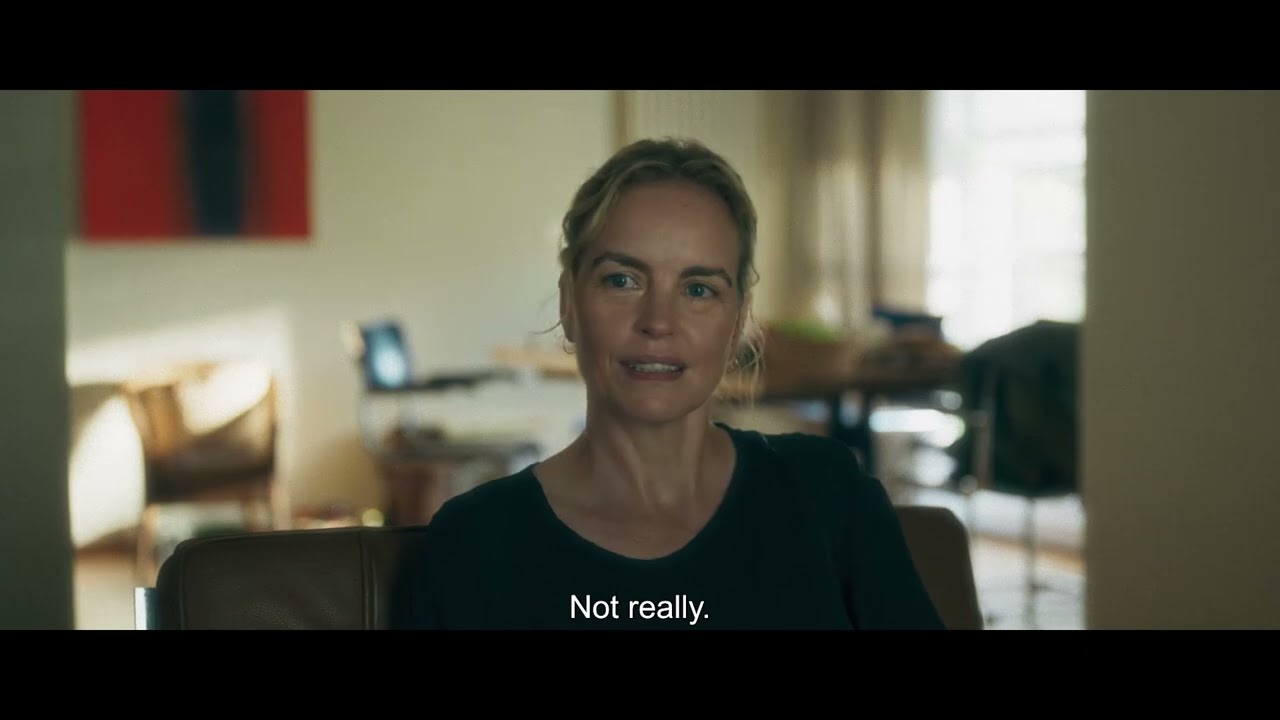

Two women, two lives, everything quietly cracking
Isabell, 48, juggles aging parents, a dissolving childless marriage, and a Berlin real estate career — until Anja, a struggling single mother from the Brandenburg countryside, drifts into her orbit and forces her to confront what she has spent years refusing to see.
Why It Is Trending: German Arthouse Turns the Midlife Crisis Into a Social Portrait
Cicadas arrives at a moment when the sandwich generation — caregiving, marital erosion, deferred ambition — is becoming serious dramatic subject matter in European cinema. Weisse picks apart an intersection of social milieus in small-town Germany, revealing the shared turbulence that hides in the cracks between all parties. Its Berlinale Panorama premiere, with Nina Hoss as both lead and executive producer, gave it instant institutional credibility. Beta Cinema’s acquisition positioned it as a crossover arthouse title with international appeal built on Hoss’s global fanbase.
Elements Driving the Trend: Virtually everything remains open, unresolved, and somewhat mysterious — which works exceptionally well thanks to the outstanding performances of Nina Hoss and Saskia Rosendahl. Weisse casts her own parents as the protagonist’s in a semi-autobiographical move that gives the caregiving scenes unscripted authenticity. Judith Kaufmann’s cinematography matches the film’s emotional restraint frame for frame. The Berlin/Brandenburg class divide — luxury broker vs rural single mother — gives the friendship its structural tension.
Virality: Berlinale word-of-mouth around the Hoss/Rosendahl pairing drove sustained discovery, with the film’s open-ended menace generating strong Letterboxd discussion.
Critics Reception: Cineuropa praised Weisse’s extraordinarily well-paced interrogation of socioeconomic class — not just conflict, but the difficulties of finding solidarity across it. Variety was divided, calling it more confounding than compelling, while acknowledging Hoss’s consistent watchability.
Awards and Recognitions: 3 nominations total including Berlinale Panorama Audience Award and Golden Anchor Award for Best Film. World premiere Berlinale Panorama, February 15, 2025. German theatrical release June 19, 2025 via DCM.
Cicadas lands as audiences seek cinema that names the emotional weight of middle age honestly — caregiving, class anxiety, the gap between the life planned and the life lived. Its refusal to resolve feels true rather than evasive. For the industry, the Hoss/Weisse reunion confirms a productive creative partnership producing distinctive German arthouse with genuine international reach.
What Movie Trend Is Followed: Female Friendship Across Class as Social X-Ray
European arthouse cinema is increasingly using unexpected female bonds across class lines as a lens for social critique — and Cicadas is one of its most precise recent examples. Where the cross-class friendship formula risks sentimentality, Weisse keeps the relationship deliberately ambiguous: admiration, intrigue, possible psychodrama, never fully resolved. The film asks whether solidarity between women of different economic realities is even possible — and refuses to answer cleanly. That refusal is its most honest and most uncomfortable quality.
Trend Drivers: Quiet Menace Over Melodrama The post-pandemic European arthouse wave has moved away from explicit drama toward films where threat accumulates in atmosphere rather than event. Weisse creates a somber and menacing atmosphere consistently — the film becomes the consummation of a voyeuristic relationship with its audience. The casting of non-professional actors alongside Hoss and Rosendahl grounds the social texture in genuine working-class specificity. The Hoss brand — rigorous, international, prestigious — signals the film’s positioning within the top tier of German arthouse.
What Is Influencing Trend: The global conversation around caregiving labour — predominantly female, systematically undervalued — has created an informed audience for films that dramatise it without melodrama. Female-authored slow cinema is finding growing critical and festival support across Europe. The German-French co-production model is enabling ambitious character studies that would struggle for funding in a single national market.
Macro Trends Influencing: Class mobility anxiety and the urban/rural divide are reshaping what German audiences want their cinema to reflect. The ageing population crisis — caregiving costs, institutional failure, family pressure — is a lived reality for millions of European adults with no mainstream cinematic representation. Female friendships as dramatic engines are displacing the romantic couple in European arthouse as the primary vehicle for social and psychological exploration.
Consumer Trends Influencing: The 35–60 audience for this kind of film is underserved and loyal — it attends, recommends, and sustains theatrical runs that younger demographics cannot. Elliptical, open-ended drama is finding a receptive audience that has grown tired of plot-driven resolution. Nina Hoss’s international profile — amplified by Tár — gives the film a commercial hook above its arthouse positioning.
Audience Analysis: German Cinema Regulars, Midlife Audiences, and the Nina Hoss Faithful The core audience is 35–60 — culturally engaged adults who recognise the film’s emotional landscape from lived experience. The class contrast gives it social breadth; the ambiguous friendship dynamic gives it psychological depth. Viewers who accept elliptical, unresolved storytelling will find it rewarding; those expecting clear narrative payoffs will find it frustrating. That divide is reflected in the split between critical reception and audience score.
Cicadas works for audiences willing to sit inside its discomfort — and that willingness is increasingly a marker of the European arthouse viewer it was built for. The trend it represents — slow-burn class drama with a subliminal female friendship at its centre — is one of the most creatively fertile spaces in contemporary European cinema. For the industry, the film confirms that restrained, socially precise character studies can generate sustained critical conversation without genre hooks or plot mechanics.
Final Verdict: Cicadas Is Precisely Observed, Deliberately Opaque, and Quietly Devastating
Ina Weisse delivers a film that is more interested in atmosphere than resolution — and the decision is either the film’s greatest strength or its most frustrating quality, depending entirely on the viewer. The performances are exceptional, the social observation is sharp, and the semi-autobiographical caregiving scenes carry a weight that no amount of scripted drama could replicate. Its critical split reflects a genuine formal ambiguity rather than a failure of execution.
Audience Relevance: For Anyone Who Has Ever Maintained a Life That No Longer Fits Isabell’s existence is financially secure and emotionally hollow — the film’s most universal and least comfortable observation. The audience does not need to share her specific circumstances to recognise the architecture of a life built around avoidance.
Anja’s presence does not solve Isabell’s problems — it simply makes them impossible to ignore any longer.
What Is the Message: The Life You Planned Is Not the Life You Are Living Isabell studied to be an architect and became a property broker instead. Her father was an architect who suffered a stroke. Her marriage is ending without drama or confrontation. Everything has simply not become what it was supposed to be.
The film’s argument is quiet: the distance between ambition and reality is where most adult life actually takes place.
Relevance to Audience: A Friendship That Is Also a Mirror Weisse keeps the relationship between Isabell and Anja deliberately ambiguous — is it admiration, identification, something more psychologically complex? That ambiguity is the film’s most sophisticated formal choice and its most commercially limiting one simultaneously.
Viewers who accept open-ended character studies will find it deeply resonant. Those expecting resolution will leave unsatisfied.
Social Relevance: Caregiving, Class, and the Invisible Labour of Adult Women The film maps the caregiving burden — emotional, logistical, financial — carried almost entirely by Isabell as a daughter, while her father’s narcissism and her husband’s self-absorption go largely unchallenged. That structural observation is the film’s most quietly political gesture.
The class gap between Isabell and Anja is never resolved or sentimentalised — which is what makes it socially honest rather than merely dramatic.
Performance: Hoss and Rosendahl Carry Everything Nina Hoss brings controlled, internalized tension to Isabell — a performance of restraint that accumulates pressure slowly. Saskia Rosendahl’s Anja is more opaque by design, suffering from a less developed arc but delivering genuine enigma.
The real power of the film is in their scenes together — two actors who trust silence more than dialogue and are right to do so.
Legacy: A Quiet but Significant Entry in Contemporary German Drama Cicadas will be remembered as the film that confirmed Weisse as a director of sustained formal intelligence — and deepened one of European cinema’s most productive actor-director partnerships. It belongs in the tradition of slow German drama — Petzold, Ade, Schanelec — that treats restraint as a moral position.
Its legacy is the audience it will find over time, not the one it reached on release.
Success: Berlinale Platform, Critical Divide, Loyal Arthouse Audience 3 nominations including Berlinale Panorama Audience Award. 22 critic reviews with mixed-to-positive consensus. IMDb user rating of 6.4 from early viewers. German theatrical release June 19, 2025. International sales via Beta Cinema.
The critical split between Variety’s scepticism and Cineuropa’s praise reflects a film operating at the edges of what mainstream arthouse audiences will accept — which is also exactly where the most interesting German cinema tends to live.
Insights Cicadas is proof that the most honest films about adult life refuse to resolve what adult life refuses to resolve. Industry: The Hoss/Weisse creative partnership is producing some of the most formally rigorous German arthouse of the decade — and Beta Cinema’s international acquisition confirms the commercial viability of restrained, class-conscious character studies with prestige casting. Audience: The 35–60 audience for slow European drama is underserved, loyal, and willing to sustain theatrical runs that younger demographics cannot — Cicadas is precisely calibrated for them. Social: By mapping caregiving, class anxiety, and marital erosion without melodrama, the film treats the emotional reality of middle-aged women as worthy of serious dramatic attention — which remains rarer than it should be. Cultural: Cicadas places itself firmly in the tradition of restrained German slow cinema — Petzold, Ade, Schanelec — and confirms Weisse as a director building a significant body of work within that tradition.
Cicadas will not please every viewer — but for those who accept its terms, it offers something rare: a film that observes adult life with the patience and honesty it actually deserves.
Summary of Cicadas: Two Women, One Crumbling Life, No Easy Answers
-
Movie themes: Caregiving, class, marital erosion, deferred ambition, and the invisible emotional labour of adult women. A slow-burn portrait of a life that has become its own cage.
-
Movie director: Precise, restrained, formally confident. Ina Weisse — actor turned director — brings philosophical depth and social observation to her third feature, working again with Nina Hoss in a partnership that is becoming one of German cinema’s most distinctive.
-
Top casting: Hoss carries the film with internalized tension; Rosendahl provides genuine enigma as Anja. Together they generate a female dynamic that is simultaneously intimate and psychologically opaque.
-
Awards and recognition: 3 nominations including Berlinale Panorama Audience Award and Golden Anchor Best Film nomination. World premiere Berlinale 2025.
-
Why to watch: For viewers who accept open-ended, elliptical drama — a quietly devastating portrait of midlife self-examination, anchored by two of Germany’s finest actresses at the top of their form.
-
Key success factors: Restraint as a formal and moral position — Cicadas earns its emotional weight through accumulation and atmosphere rather than plot, which is what separates it from the films around it.
-
Where to watch: Released June 19, 2025 in Germany via DCM. International distribution via Beta Cinema. Streaming availability expanding.
