

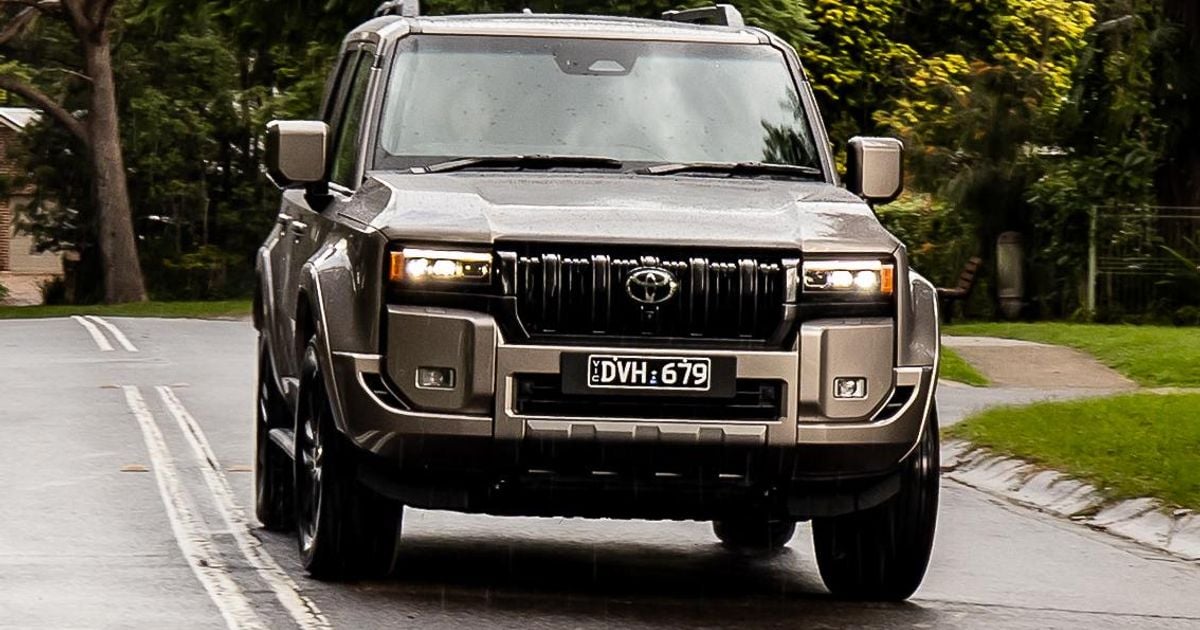

The top-spec version of the Toyota Prado is the Kakadu, which is the model grade we’re testing here.

It’s a practical-looking large off-road SUV and also looks good on paper – diesel, four-wheel drive, seven seats, and loads of equipment.
But given the price tag it would want to be overflowing with standard equipment, so in this review we’ll tell you if it feels like a fitting flagship or not.
How much does the Toyota LandCruiser Prado cost?
Prices recently went up for the Prado range, and the Japanese brand added a new five-seat version of the GXL, too.
| Model | Price before on-road costs |
|---|---|
| 2026 Toyota LandCruiser Prado GX | $73,200 |
| 2026 Toyota LandCruiser Prado GXL five-seat | $79,690 |
| 2026 Toyota LandCruiser Prado GXL seven-seat | $80,690 |
| 2026 Toyota LandCruiser Prado VX | $88,100 |
| 2026 Toyota LandCruiser Prado Altitude | $93,400 |
| 2026 Toyota LandCruiser Prado Kakadu | $100,690 |
On top of these prices you will need to add about $8000 or more for the additional costs of registration, stamp duty and dealer delivery. Maybe even a little bit of Toyota Tax.
But the latest J250-series Prado lineup has heaps more standard tech and spec than the model it replaces. Scroll down to see the breakdown of standard equipment across all grades, and to see if you think it’s worth spending about $110k to put a Kakadu in your driveway…
To see how the Toyota LandCruiser Prado lines up against the competition, check out our comparison tool
What is the Toyota LandCruiser Prado like on the inside?
The flagship variant in the Prado range doesn’t necessarily feel luxurious.
At least not compared to some of its new competitors from China, which really do up the ante when it comes to the opulence factor. And if that’s what you’re looking for then maybe check out one of those.
Find your perfect new car with CarExpert
There’s a starker feeling design here, with black-on-black trimming everywhere that maybe doesn’t give it as much wow factor as others.
Admittedly, it’s all put together well and it looks good, but the Kakadu just doesn’t have any brightwork, woodwork or anything to make it feel like you are driving something that’s a bit more, well, expensive. Because this is a six-figure car.
The technology is decent, though. There is a 12.3-inch digital screen for the driver with an array of different display options and configurability, and it’s easy to read if you prefer to look down at that screen. Otherwise there’s a colour head-up display, which is excellent too.
For media you’ve got another 12.3-inch screen with the expected wireless Apple CarPlay and Android Auto connectivity, as well as sat-nav and a number of vehicle information displays – but it does require a little bit of learning when it comes to the menus and controls.
It’s certainly not as frustrating as some other touchscreen infotainment systems, and will be easy enough to get your head around if you’re new to the digital revolution.
But you don’t have to do everything on the screen.
There’s an array of buttons and dials below to allow you to configure everything from your seat heating and ventilation to your climate control, steering wheel heating, and more.
Further below is a volume dial (weird spot for it!), a camera view button, and a number of connection ports for charging devices, plus a wireless phone charging pad.
To the side you’ll find a mode selector for your day-to-day driving modes, and there’s a multi-terrain select system if you venture off the beaten path. There’s also downhill assist control and crawl control, which work as an off-road cruise control system that will make your adventures a little safer than they might otherwise have been if you just used the pedals.
It does have the low-range transfer case that you might be hoping for, and a centre diff lock as well, but there’s no rear locker and no front locker either, if that matters to you.
The gear selector is a good-sized thing, and nice to hang onto when you’re on a road trip as well, and nearby are the electric parking brake and auto hold switches, too.
Other buttons around the cabin include the engine start/stop button, a tow/haul mode controller, and a dedicated button if you want to turn off the engine idle-stop function, which would negate the fact that you bought a vehicle with 48V mild-hybrid tech.
On the steering wheel there’s an array of simple-to-learn controls, with heaps of buttons and some triggers for volume and different display modes as well.
You’ve got conventional stalks and even more buttons down near the driver’s knee, so don’t go thinking this is a touchscreen-dependent experience.
The driver has an auto-dimming rear-view mirror or a digital camera mirror if they wish to use it that way instead – ideal if you have five faces looking forward at you from those rear seats – plus overhead you’ll find illuminated vanity mirrors. The material on the sunvisors (which aren’t extendable) is quite cheap-feeling.
You’ve got grab handles to help you get in and out, and there are A-pillar handles as well.
Between the seats is a cool box, and that could be a very handy inclusion on longer road trips with your family.
Front seat comfort is good, though it felt like there was a bar at the base of the backrest that just wasn’t comfortable for me. There is adjustable lumbar support but that wasn’t it. There’s electric adjustment for both front seats, and the driver gets extendable leg support as well.
In the second row with the driver’s seat set for me (at 182cm/6’0”), I had enough space to fit comfortably – but not with an excessive amount of space.
Anyone taller might find it to feel a little cramped for legroom, and be aware that the Prado doesn’t offer you the option of sliding the middle-row seats because of the third-row packaging, and that means you might find it a little uncomfortable if you’re trying to haul a number of big bodies with you.
There are good amenities in the back seat including bottle holders in the doors, map pockets on the seatbacks, overhead directional vents, and a climate control system for managing everything in the back – including heating and ventilation for the window seats. Nice!
In between the rear seats in the middle row you will find a flip-down armrest with cupholders, and of course you’ve got ISOFIX child seat anchors in the window seats and top-tethers for all three middle-row positions.
When it comes to getting into the third row, the access is decent, but you have to pick which side you’ll fit a child seat in if you are planning to use the third row all the time and you also have a younger one as part of your clan.
That’s because the middle-row seat is a 60:40-split, with the small portion on the kerbside, which might make it easier for third-row access to be a permanent fixture on that side of the car.
That position allows the seat to fold and tumble forward, but the third row isn’t necessarily the most accommodating experience for adults.
Because those middle-row seats don’t move forward, and the toeroom is quite tight, as is kneeroom and headroom.
But at least the third row has a decent amount of shoulder room, and there are good armrests on the wheel-arches, as well as cupholders for both sides and USB ports to keep devices charged – even right at the back.
Overhead there are grab handles and directional vents, and the view from the back seat is good too thanks to a stadium-style arrangement and reasonably large side glass.
However, it must be said that the usability of the seats is not as good as it could be when you are trying to fold them from the back row. It could be difficult to allow yourself to get out if you’re in the back.
When you’re trying to fold the seats from the boot, the mechanism is not the greatest – it takes a few movements to adjust things. Some rivals have electric seat folding for less money, others have a pull-tab mechanism that will drop the head restraints and the seat, but this one requires you to be able to reach the lever if you’re lifting the seats up (this will be a challenge for shorties!) and you have to adjust the head restraints separately.
Our test car also included the storage box behind the third-row seats, which feels flimsy and looks like an afterthought. But it does allow you a flat load floor area if you want to put things on top of those third-row seats. I wouldn’t go piling really heavy things on the storage box, though.
Beyond that there is also a pair of shopping bag hooks and a 220V (100W) power outlet.
A huge bonus is the opening glass window on the tailgate, which means you’ve got easier access to the cargo space if you can’t easily open the hatch all the way.
And of course, under the boot area you will find a full-size spare wheel.
| Dimensions | Toyota Prado Kakadu |
|---|---|
| Length | 4990mm |
| Width | 1980mm |
| Height | 1925mm |
| Wheelbase | 2850mm |
| Cargo capacity | 182L (all seats up) 906L (third row folded) 1829L (third and second rows folded) |
To see how the Toyota LandCruiser Prado lines up against the competition, check out our comparison tool
What’s under the bonnet?
In Australia, all Prado vehicles use the same diesel engine – a carryover four-pot with 48V mild-hybrid tech and a new transmission.
| Specifications | Toyota Prado Kakadu |
|---|---|
| Engine | 2.8L 4cyl turbo-diesel with 48V MHEV |
| Battery | 4.3Ah li-ion |
| Motor generator power | 8.4kW |
| Motor generator torque | 65Nm |
| Total system power | 150kW @ 3000-3400rpm |
| Total system torque | 500Nm @ 1600-2800rpm |
| Transmission | 8-speed automatic |
| Drive type | Full-time 4WD |
| Fuel economy (claimed) | 7.6L/100km |
| Fuel economy (as tested) | 10.2L/100km |
| CO2 emissions (claimed) | 200g/km |
| Fuel tank | 80L main tank 30L sub tank 17.4L AdBlue |
The 48V system means the engine uses a smart alternator and clever idle-stop system supported by a 48-volt battery, but it can’t boost power or use the battery to drive. However, it will take away the strain of running ancillary functions, to a degree. On test, it still kicked the engine to life with the air-con set to cool the car down on a 30-degree day.
And here are the details on the Kakadu specifically when it comes to weights and capacities:
| Specifications | Toyota Prado Kakadu |
|---|---|
| Kerb weight | 2535kg |
| Payload | 615kg |
| Braked towing capacity | 3500kg |
| Gross vehicle mass (GVM) | 3150kg |
| Gross combination mass (GCM) | 6600kg |
Do the maths and make sure you don’t go over your payload if you plan to tow. We didn’t get a chance to tow this time around, but check out our earlier Prado Altitude review to read our verdict on that.
To see how the Toyota LandCruiser Prado lines up against the competition, check out our comparison tool
How does the Toyota LandCruiser Prado drive?
There’s a lot to like about the drive experience in the Prado Kakadu.
From expert reviews to the right deal
CarExpert brings together reviews, research tools and trusted buying support, guiding you from research to delivery with confidence.
But one of the things I don’t like is the amount of engine noise at lower speeds – especially when the engine is cold.
This diesel engine has been around for a long time now, and while the mild-hybrid technology helps out a little bit to quieten things down at times, it is otherwise pretty rough and vocal when you are motoring at lower speeds.
At higher speeds it is more hushed because there are other noises to contend with – such as wind noise around the mirrors and windscreen.
But the engine is up to the task – don’t get me wrong. It just makes a lot of noise when it’s doing its thing.
Thankfully the transmission does a pretty good job of managing proceedings as well, with eight gears to choose from – which is maybe too many, at times! – but it is a smooth-shifting operator for the most part.
At times you might notice when you’re going down a hill, riding the brakes, that it will downshift to try and arrest some of your momentum, by using engine braking to slow you down. It works pretty well. But, again, it can be very noisy when it does that.
I might sound like a well-beaten drum here, but in a model at this price – even though it has a load of features – the Prado doesn’t quite feel as refined as it could in terms of noise.
But otherwise the drive experience is mostly very agreeable.
The steering is predictable and accurate with nice weighting, and it’s easy to park too. The surround-view camera helps out in that regard, and it has parking sensors front and rear that will trigger the camera if it thinks that you’re getting too close to something.
The ride comfort isn’t bad either, as the Prado coasts over lumps and bumps in the surface relatively smoothly. It rides well at low and high speeds too, but can feel a bit wallowy if you don’t have any weight over the rear axle. And it can pick up on some of the sharper edges at urban speeds because of the wheel sizes on this grade.
The safety technology is largely very agreeable. At times you might get a warning or two for not paying attention to the driver monitoring camera, but thankfully it is largely very easy to get along with.
And that sort of sums it up. The Prado is easy to get along with, it’s just that it’s a bit loud when you are getting on with day-to-day jobs.
To see how the Toyota LandCruiser Prado lines up against the competition, check out our comparison tool
What do you get?
Here’s a rundown of the range and what you get as standard as you climb your way up the ladder. Which rung would you find yourself stopping at?
2026 Toyota Prado GX equipment highlights:
- Five seats
- 18-inch dark grey alloy wheels
- Front grille with ‘TOYOTA’ lettering
- LED headlights
- LED daytime running lights
- Folding body-coloured mirrors
- Darkened front and rear bumpers, side sills, wheel-arches
- Manual tailgate
- Fabric seat upholstery
- Rubber floor mats
- Six-way manual driver’s seat adjustment
- 7.0-inch multi-function driver’s instrument display
- 12.3-inch touchscreen infotainment system
- 10-speaker sound system
- Wired and wireless Apple CarPlay, Android Auto
- Four USB-C ports
- Embedded satellite navigation
- DAB+ digital radio
- Toyota connected services
- Dual-zone climate control
- Downhill assist control
- Crawl control with five speed settings
Moving up to the GXL adds:
- Five- or seven-seat layout
- Roof rails
- Rear privacy glass
- Silver front and rear bumper trim
- Power tailgate
- Synthetic leather seat upholstery
- Heated and ventilated front seats
- Eight-way power-adjustable driver’s seat
- Leather-accented steering wheel and gear knob
- Auto-dimming rear-view mirror
- Wireless phone charging pad
- Rear climate control
- Two extra USB-C charging ports
On top of the GXL, the VX adds:
- 20-inch dark metallic alloy wheels
- Bi-LED headlights with dynamic auto-levelling
- Adaptive high-beam assist
- Body-coloured front and rear bumpers
- Over-fender (wheel-arch) mouldings
- Rear guard trim
- Leather-accented seat trim
- Power lumbar and memory function for driver’s seat
- Four-way power-adjustable passenger’s seat
- Power-adjustable steering wheel
- Carpet floor mats
- Refrigerated centre console (Cool Box)
- 12.3-inch digital instrument cluster
- 14-speaker JBL sound system
- Adaptive Variable Suspension
- Five drive modes
- Multi-terrain select
- Multi-terrain monitor
Over the VX, the Altitude adds:
- Five seats instead of seven
- 18-inch matte-grey alloy wheels with all-terrain tyres
- Locking rear differential
- ‘Stabiliser disconnect mechanism’ (in place of Adaptive Variable Suspension)
- Black door handles and tailgate trim
- Black wheel-arch moulding
- Sunroof
- Two-tone colours available
- Digital rear-view mirror
- Heated steering wheel
- Head-up display
The flagship Kakadu includes (over the VX):
- Reverts to seven-seat layout
- Panoramic sunroof
- Illuminated side steps
- Heated and ventilated rear seats
- Heated steering wheel
- Adjustable driver’s seat thigh support
- Digital rear-view mirror
- Head-up display
- Torque-sensing limited-slip rear differential
To see how the Toyota LandCruiser Prado lines up against the competition, check out our comparison tool
Is the Toyota LandCruiser Prado safe?
The Toyota LandCruiser Prado was awarded the maximum five-star ANCAP safety rating based on 2024 testing.
| Category | Toyota Prado |
|---|---|
| Adult occupant protection | 85 per cent |
| Child occupant protection | 89 per cent |
| Vulnerable road user protection | 84 per cent |
| Safety assist | 82 per cent |
It comes as standard with the following safety features:
- Autonomous emergency braking
- Pedestrian detection
- Cyclist detection
- Junction detection
- Backover prevention
- Stability control with active traction control
- Adaptive cruise control
- Lane trace assist (lane-centering)
- Blind-spot monitoring
- Rear parking support brake (stops the car if a static object is detected)
- Front and rear parking sensors
- Speed sign recognition
- Driver attention monitoring camera
- Trailer sway control
- Trailer pre-wiring harness
- 360-degree camera
The VX, Altitude, and Kakadu grades gain tyre pressure monitoring.
All Prado models have nine airbags – dual front, driver’s knee, passenger’s knee, front centre, front side, and full-length curtain coverage with head protection for third-row occupants in models with seven seats.
To see how the Toyota LandCruiser Prado lines up against the competition, check out our comparison tool
How much does the Toyota LandCruiser Prado cost to run?
The LandCruiser Prado is covered by Toyota Australia’s five-year, unlimited-kilometre new-vehicle warranty.
| Servicing and Warranty | Toyota Prado |
|---|---|
| Warranty | 5 years, unlimited kilometres |
| Roadside assistance | $99 or $139 per year, depending on chosen plan |
| Service intervals | 6 months or 10,000km |
| Capped-price servicing | 5 years, $395 each |
| Total capped-price service cost | $3950 |
If you maintain your Prado by the logbook, you can extend the powertrain warranty out to seven years – and it doesn’t need to be serviced by Toyota, either. The electrified components of the powertrain will also be covered for up to 10 years if you do service with Toyota.
However, the brand has continued with shorter six-month/10,000km service intervals for the 250 Series, unlike rivals which have 12-month/15,000km intervals – or longer.
You also have to pay at least an extra $99 per year for roadside assistance, and while the Prado has Connected Services, you will only get one year of free data included at purchase, after which you’ll get roped into paying an additional subscription fee.
The capped-price service plan covers five years or 100,000km due to those short intervals, and the average cost per visit is $395 at the time of publication.
To see how the Toyota LandCruiser Prado lines up against the competition, check out our comparison tool
CarExpert’s Take on the Toyota LandCruiser Prado Kakadu
With new rivals from China knocking on its door and offering more gear for less money, and more advanced new-generation electrified powertrains… the Prado is suddenly feeling a little less appealing than it did.
There’s no doubt the Prado is going to remain the go-to guy for many Australian families, especially those who need diesel power.
No, we didn’t venture off-road for this review. But so many mums and dads who drive Prados don’t either. Just go to your local school at pickup time, and you’ll see the evidence as clear as day.
That said, we know the Prado has the off-road chops to match the likes of, say, the Ford Everest. But during my time in this vehicle, I couldn’t quite come at the idea of it costing $110,000 to park in my driveway. And for that reason, I’d buy something else and save some change for fuel…!
Interested in buying a Toyota LandCruiser Prado? Let CarExpert find you the best deal here
Click the images for the full gallery
