

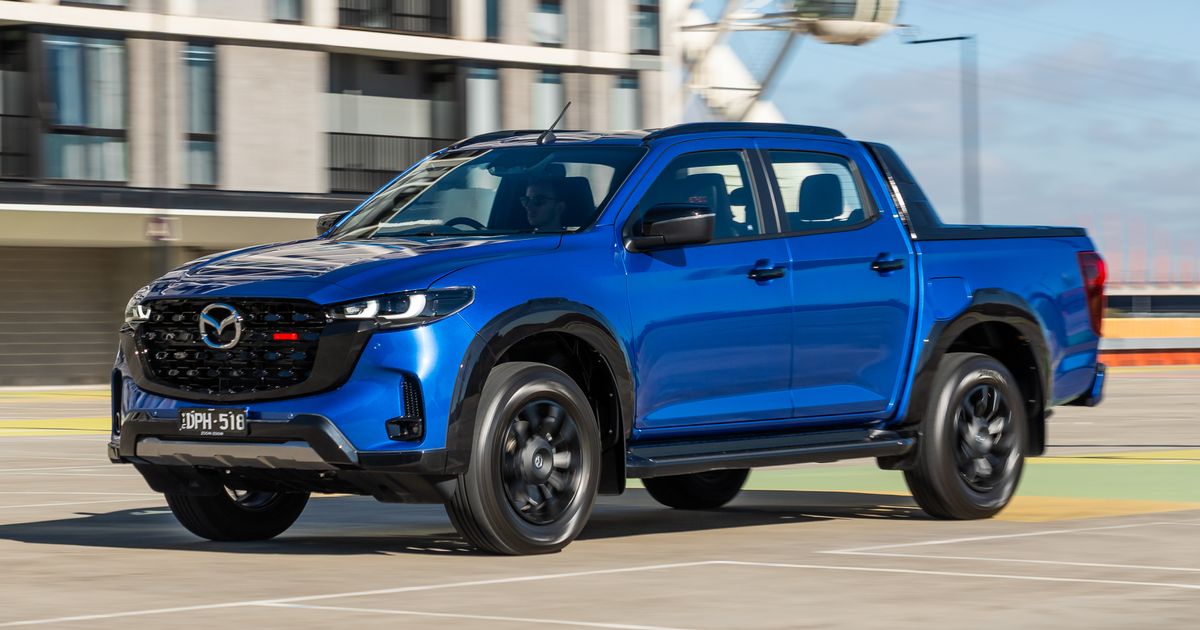

Mazda doesn’t usually occupy the top end of town, but that’s exactly where the BT-50 SP tested here resides.

Ignoring full-size American pickup trucks and a few other oddballs, the SP is among the priciest mid-size dual-cab 4×4 utes you can buy right now, with an asking price of $73,490 before on-road costs.
That’s nearly twice as much as you’ll pay for an entry-level BT-50 single-cab/chassis. To put it differently, this BT-50 commands top-spec Kia Tasman and Toyota HiLux money.
So, what do you get for the hefty spend? Well, the upgrades are mostly cosmetic, bar the introduction of a manual roller tonneau cover. As such, the SP is set up to win worksite beauty contests, rather than the Dakar Rally.
Still, there’s a market for ‘lifestyle’ utes in 2026, and Mazda knows a thing or two about design, both exterior and interior.
Isuzu running gear ensures it retains relevance as a workhorse, too.
Nevertheless, I question the value in dressed up dual-cabs like this SP. But perhaps a week behind the wheel will change my mind.
How much does the Mazda BT-50 cost?
The Mazda BT-50 ute lineup has expanded for 2026, with the Thunder returning and a new Boss grade joining the range.
|
Model |
Price before on-road costs |
|---|---|
|
2026 Mazda BT-50 XS 2.2L 4×2 single-cab/chassis |
$38,400 |
|
2026 Mazda BT-50 XT 3.0L 4×2 single-cab/chassis |
$40,900 |
|
2026 Mazda BT-50 XT 3.0L 4×2 Freestyle cab/chassis |
$44,500 |
|
2026 Mazda BT-50 XS 2.2L 4×2 dual-cab pickup |
$47,210 |
|
2026 Mazda BT-50 XT 3.0L 4×2 dual-cab/chassis |
$48,110 |
|
2026 Mazda BT-50 XT 3.0L 4×4 single-cab/chassis |
$48,750 |
|
2026 Mazda BT-50 XT 3.0L 4×2 dual-cab pickup |
$49,710 |
|
2026 Mazda BT-50 XT 3.0L 4×4 Freestyle cab/chassis |
$52,500 |
|
2026 Mazda BT-50 XS 2.2L 4×4 dual-cab/chassis |
$53,620 |
|
2026 Mazda BT-50 XS 2.2L 4×4 dual-cab pickup |
$55,220 |
|
2026 Mazda BT-50 XTR 3.0L 4×2 dual-cab pickup |
$55,780 |
|
2026 Mazda BT-50 XT 3.0L 4×4 dual-cab/chassis |
$56,120 |
|
2026 Mazda BT-50 XT 3.0L 4×4 dual-cab pickup |
$57,720 |
|
2026 Mazda BT-50 Boss 3.0L 4×4 dual-cab pickup |
$60,220 |
|
2026 Mazda BT-50 XTR 3.0L 4×4 dual-cab/chassis |
$61,600 |
|
2026 Mazda BT-50 XTR 3.0L 4×4 dual-cab pickup |
$64,740 |
|
2026 Mazda BT-50 GT 3.0L 4×4 dual-cab/chassis |
$65,020 |
|
2026 Mazda BT-50 GT 3.0L 4×4 dual-cab pickup |
$68,160 |
|
2026 Mazda BT-50 SP 3.0L 4×4 dual-cab pickup |
$73,490 |
|
2026 Mazda BT-50 Thunder 3.0L 4×4 dual-cab pickup |
$78,400 |
On test here is the up-spec SP, which is now $1540 more expensive than before. This steeper price is due to the inclusion of a standard surround-view camera for MY26.
However, Mazda is currently offering 2025-plated examples of the SP for $68,990 drive-away – a discount totalling more than $10,000 all up.
To see how the Mazda BT-50 stacks up against its rivals, use our comparison tool
What is the Mazda BT-50 like on the inside?
Generous lashings of dark suede and terracotta vinyl jazz up the cabin of this otherwise traditional dual-cab.
But how jazzy does a ute really need to be? And I’m not sure that suede – a material often associated with performance – fits the vibe of the not-so-sporty BT-50. As such, I don’t see this ‘premium’ upholstery combination as an upgrade over the black leather found in the standard GT.
Find your perfect new car with CarExpert
And, materials aside, there’s nothing else inside to separate the two variants, which are priced more than $5000 apart.
Still, you’re getting all the best interior bits Mazda has to offer, including a 9.0-inch infotainment touchscreen, 7.0-inch driver’s instrument display, and lots of tactile switchgear.
I’d expect a bit more for the money, though, especially when you consider the BT-50 was updated just last year.
The centre screen is small and fuzzy by 2026 standards, and offers very little in the way of modern functionality aside from wireless smartphone mirroring. You can say the same about the digital instrument cluster, and there’s no head-up display.
This ‘fancy’ version of the BT-50 doesn’t even have a wireless phone charger, just a pair of USB-C outlets under the centre stack, plus a 12-volt power outlet. A third USB outlet intended for dash cameras can be found behind the rear-view mirror.
Sure, all the tech in the BT-50 is functional and uncomplicated, but that’s not quite enough for buyers at this end of the market. Rather, they deserve the levels of gadgetry and wow-factor you get in rival pickups such as the Tasman, MG U9, and even the new HiLux.
Having said that, I do prefer how the inside of the BT-50 is laid out, with its traditional gear selector, physical handbrake, simple climate control panel, and central drive mode buttons. There’s not much learning required here, even for those coming out of much older utes.
The BT-50 also makes a decent case from a comfort perspective. Both front seats offer ample rib and thigh support, as well as a wide range of electric adjustment and three-stage heating for chilly winter mornings. In a similar vein, the steering wheel tilts and telescopes to suit just about any driving position.
Cabin storage also gets a pass mark. The door bins and armrest compartment are relatively shallow, while dash-mounted cupholders are absent altogether. However, most servo-sourced beverages fit in the centre cupholders, and more valuable items can be stored in a ‘hidden’ (but not lockable) compartment above the glovebox.
Moving back, there’s room for two full-sized adults to co-exist comfortably in the second row – this six-one tester found headroom to be in strong supply, while outboard passengers are also afforded an impressive amount of legroom.
At the same time, the rear bench is plush enough to keep fussy travellers happy over longer journeys.
They won’t, however, appreciate having to fight over a single USB-C outlet when their phones run flat.
Other rear amenities include twin air vents, bottle-shaped door bins, wide map pockets on the seatbacks, and a centre armrest with integrated cupholders.
Tub space is arguably more important to the average buyer, and the BT-50 defies its compact dimensions by offering one of the longest load areas of any mainstream ute (1571mm).
The tub is easily accessible too, courtesy of hydraulic tailgate struts, and Mazda has optimised its packaging to minimise wheel-arch intrusion.
Beyond just space, SP buyers can expect a neatly lined tub as well as a standard tow bar, manual roller tonneau cover, and sports bar.
|
Dimensions |
Mazda BT-50 SP |
|---|---|
|
Length |
5460mm |
|
Width |
1870mm |
|
Height |
1810mm |
|
Wheelbase |
3125mm |
|
Tub length |
1571mm |
|
Tub width |
1530mm (maximum), 1120mm (between wheel-arches) |
|
Tub depth |
490mm |
To see how the Mazda BT-50 stacks up against its rivals, use our comparison tool
What’s under the bonnet?
There are two four-cylinder turbo-diesel engines available across the BT-50 range – a recently introduced 2.2-litre engine and this trusty 3.0-litre turbo-diesel – both sourced from Isuzu.
|
Specifications |
Mazda BT-50 SP |
|---|---|
|
Engine |
3.0L 4cyl turbo-diesel |
|
Power |
140kW |
|
Torque |
450Nm |
|
Transmission |
6-speed automatic |
|
Drive type |
Four-wheel drive |
|
Fuel economy (claimed) |
7.8L/100km |
|
Fuel economy (as tested) |
8.9L/100km |
|
CO2 emissions (claimed) |
204g/km |
|
Fuel tank |
76L |
|
Weight |
2176kg |
|
Payload |
924kg |
|
Braked towing capacity |
3500kg |
|
Gross vehicle mass (GVM) |
3100kg |
|
Gross combination mass (GCM) |
6000kg |
To see how the Mazda BT-50 stacks up against its rivals, use our comparison tool
How does the Mazda BT-50 drive?
Upgrades for the SP don’t extend to its running gear, nor any of its mechanicals. In other words, this specced-up variant drives like any other 3.0-litre BT-50.
The positive take on that assessment is that the SP inherits all the strengths of its stablemates, namely approachability and ease of operation.
Some modern utes (I’m looking at you, Kia Tasman) have grown so big that they’re somewhat inconvenient to pilot around town, but not the BT-50. Rather, it feels compact and manoeuvrable, courtesy of a relatively short bonnet and narrow body, and heavily assisted steering.
Understandably, this mightn’t register with rural buyers. Urban buyers, on the other hand, are more likely to see value in the BT-50’s ability to comfortably navigate tight city streets and busy Bunnings carparks.
The BT-50 is also considerably lighter than the equivalent Ford Ranger, HiLux and Tasman, making it less tiresome to drive in stop-start suburban situations.
Further to that, both pedals have been expertly calibrated, so it’s easy to find a rhythm with your right foot. Having said that, red lights don’t represent an opportunity to lift off the brake pedal, as the BT-50 doesn’t come with auto-hold – a handy and widespread convenience feature.
Sitting in heavy traffic can also trigger phantom warnings from the front proximity sensors – a strange and annoying quirk of the BT-50.
My misgivings don’t end there, either. Next cab off the rank is the BT-50’s engine.
Now, don’t get me wrong, the 3.0-litre four-cylinder turbo-diesel engine found in both the BT-50 and its Isuzu D-Max donor vehicle is a serviceable and reportedly very reliable lump. It’s just not that refined, neither is it particularly potent.
Firing to life after a long, lumpy crank, the beating heart of this Mazda settles into an audible clatter that refuses to subside. Turbo-diesel dual-cabs aren’t exactly known to be smooth operators, but the BT-50 still feels (and sounds) quite agricultural compared to the Ranger and Tasman, let alone the wave of new PHEVs sweeping through the local ute market.
The engine only grows louder under load, and there’s not enough payoff in the form of performance. While not necessarily underpowered, the BT-50 is under-torqued for a vehicle that promises 3.5-tonne towing, especially given its relative lack of mass.
It also feels a little underdone from a suspension standpoint, as the ride is quite busy over imperfect surfaces. At the same time, the rear-end is prone to excessive see-sawing at low speeds when the tub is empty. As such, the Tasman, Ranger and Navara are better options if comfort on the road is a priority.
The ride does improve at higher speeds, but motorways and highways expose further drawbacks to the BT-50.
For one, it remains loud – wind gathers around the large side mirrors, and there’s a constant clang from under the bonnet.
Then there’s its advanced driver assist systems (ADAS).
Don’t get me wrong, there’s plenty of fresh safety tech to be found in this ute, but some of it doesn’t quite work as intended. For example, the adaptive cruise control system is slow to react to changes in traffic flow, so slow that it sometimes forces driver intervention to prevent an accident. That’s not very safe.
Further, the inaccuracy of the BT-50’s lane-centring function discourages its use. What’s the point of a semi-autonomous driving system that’s not even remotely trustworthy?
You can trust the BT-50 to fulfil its promises off-road, though.
All 4×4 variants now come standard with a rear differential lock as well as Rough Terrain Mode, which helps with low-speed traction on loose surfaces. And beyond those recent additions, the BT-50 already boasted a wide range of drive modes including low-range 4WD, and high-range two-wheel drive (2H) and four-wheel drive (4H). However, there’s no automatic 4H mode as in top-spec Rangers.
|
Off-road dimensions |
Mazda BT-50 SP |
|---|---|
|
Track front and rear |
1570mm |
|
Ground clearance |
240mm |
|
Approach angle |
27.0 degrees |
|
Departure angle |
17.9 degrees |
|
Ramp breakover angle |
24.3 degrees |
|
Wading depth |
800mm |
To see how the Mazda BT-50 stacks up against its rivals, use our comparison tool
What do you get?
The SP no longer sits at the top of the BT-50 tree, as the Thunder has been reintroduced to steal its… thunder.
From expert reviews to the right deal
CarExpert brings together reviews, research tools and trusted buying support, guiding you from research to delivery with confidence.
2025 Mazda BT-50 XS equipment highlights:
- 17-inch steel wheels
- LED headlights
- Black cloth upholstery
- Vinyl floor covering
- Air-conditioning
- Power windows
- Rain-sensing wipers
- 7.0-inch instrument cluster screen
- 8.0-inch infotainment touchscreen
- Wired and wireless Apple CarPlay, Android Auto
BT-50 XT adds:
- 17-inch alloy wheels
- Rear air vents (pickup only)
- Tailgate assist
- Rough terrain mode (4×4 only)
- Locking rear differential (4×4 only)
BT-50 XTR adds:
- 18-inch machined alloy wheels
- LED front fog lights
- Auto-levelling LED headlights with daytime running lights (DRLs)
- Power-folding exterior mirrors
- Side steps
- Tow bar with receiver, tongue and wiring harness (pickup only)
- Tub liner (pickup models only)
- Leather-wrapped steering wheel
- Leather-wrapped gear selector
- Dual-zone climate control
- 9.0-inch infotainment touchscreen
- Satellite navigation
- Advanced keyless entry
BT-50 Boss adds (over XT):
- Gloss-black door and tailgate handles, exterior mirrors
- Black steel sports bar
- Side steps
- Tub liner
- ‘Boss’ decals
BT-50 GT adds:
- Heated mirrors
- Black leather seats
- Eight-way power-adjustable driver’s seat
- Heated front seats
- Remote engine start
BT-50 SP adds:
- 18-inch gloss-black alloy wheels
- Gloss-black exterior highlights
-
- Sail plane sports bar
- Side steps
- Wheel-arch flares
- Roof rails
- Mirror caps
- Door and tailgate handles
- Manual roller tonneau cover
- Black and terracotta ‘Maztex’ and suede upholstery
BT-50 Thunder adds (over GT):
- Single hoop bull bar
- Lightforce Beast driving lights
- Reinforced anti-slip side steps
- Gloss-black door handles
- ‘Thunder’ decals
- Long-legged steel sports bar
- Manual roller tonneau cover
To see how the Mazda BT-50 stacks up against its rivals, use our comparison tool
Is the Mazda BT-50 safe?
The Mazda BT-50 was awarded a five-star ANCAP safety rating in 2022, based on tests conducted on the related Isuzu D-Max.
|
Category |
Mazda BT-50 |
|---|---|
|
Adult occupant protection |
86 per cent |
|
Child occupant protection |
89 per cent |
|
Vulnerable road user protection |
67 per cent |
|
Safety assist |
84 per cent |
The utes were reassessed despite having already received five-star ratings in 2020, as the D-Max and BT-50 received a design change to the driver’s knee airbag and instrument panel.
Standard safety equipment includes:
- Autonomous emergency braking (AEB)
- Adaptive cruise control with stop and go
- Blind-spot monitoring
- Driver attention monitoring
- Lane-departure warning
- Lane-keep assist
- Rear cross-traffic assist
- Front parking sensors (GT and SP only)
- Rear parking sensors (pickup only)
- Reverse camera
- Traffic sign recognition
- Trailer sway control
- Turn assist
To see how the Mazda BT-50 stacks up against its rivals, use our comparison tool
How much does the Mazda BT-50 cost to run?
The Mazda BT-50 is covered by the Japanese brand’s five-year, unlimited-kilometre warranty, which includes roadside assistance for the same period.
|
Servicing and Warranty |
Mazda BT-50 SP |
|---|---|
|
Warranty |
5 years, unlimited kilometres |
|
Roadside assistance |
5 years, unlimited kilometres |
|
Service intervals |
12 months, 15,000km |
|
Capped-price servicing |
5 years |
|
Average annual capped-price service cost |
$520.20 |
|
Total capped-price service cost |
$2601 |
For context, the first five services for an Isuzu D-Max cost $469 each, totalling $2345 over five years. This is the same for both powertrains.
Ford offers significantly cheaper servicing for the Ranger, with the first five services available for $1596 under a pre-paid plan.
Similarly, the first six services for a new HiLux are capped at $395, but given the Toyota has shorter six-month, 10,000km intervals, that works out to a total of $2370 over just three years.
To see how the Mazda BT-50 stacks up against its rivals, use our comparison tool
CarExpert’s Take on the Mazda BT-50 SP
My thinking hasn’t changed – while the BT-50 is a solid and dependable dual-cab that’s unlikely to let you down, the MY26 SP doesn’t present much value.
At around $80,000 on the road, it just doesn’t quite stack up to similarly priced versions of the Ford Ranger, Kia Tasman and Volkswagen Amarok in key areas like powertrain refinement, ride comfort and tech integration.
Regardless, some may decide they’re set on the Mazda. If so, the standard GT represents a far better deal, as most of the SP upgrades are cosmetic rather than functional.
Still want the admittedly attractive SP? Save stacks of cash and grab a runout MY25 example sans surround-view camera for $68,990 drive-away.
CarExpert can save you thousands on a new Mazda BT-50. Click here to get a great deal
Click the images for the full gallery
