
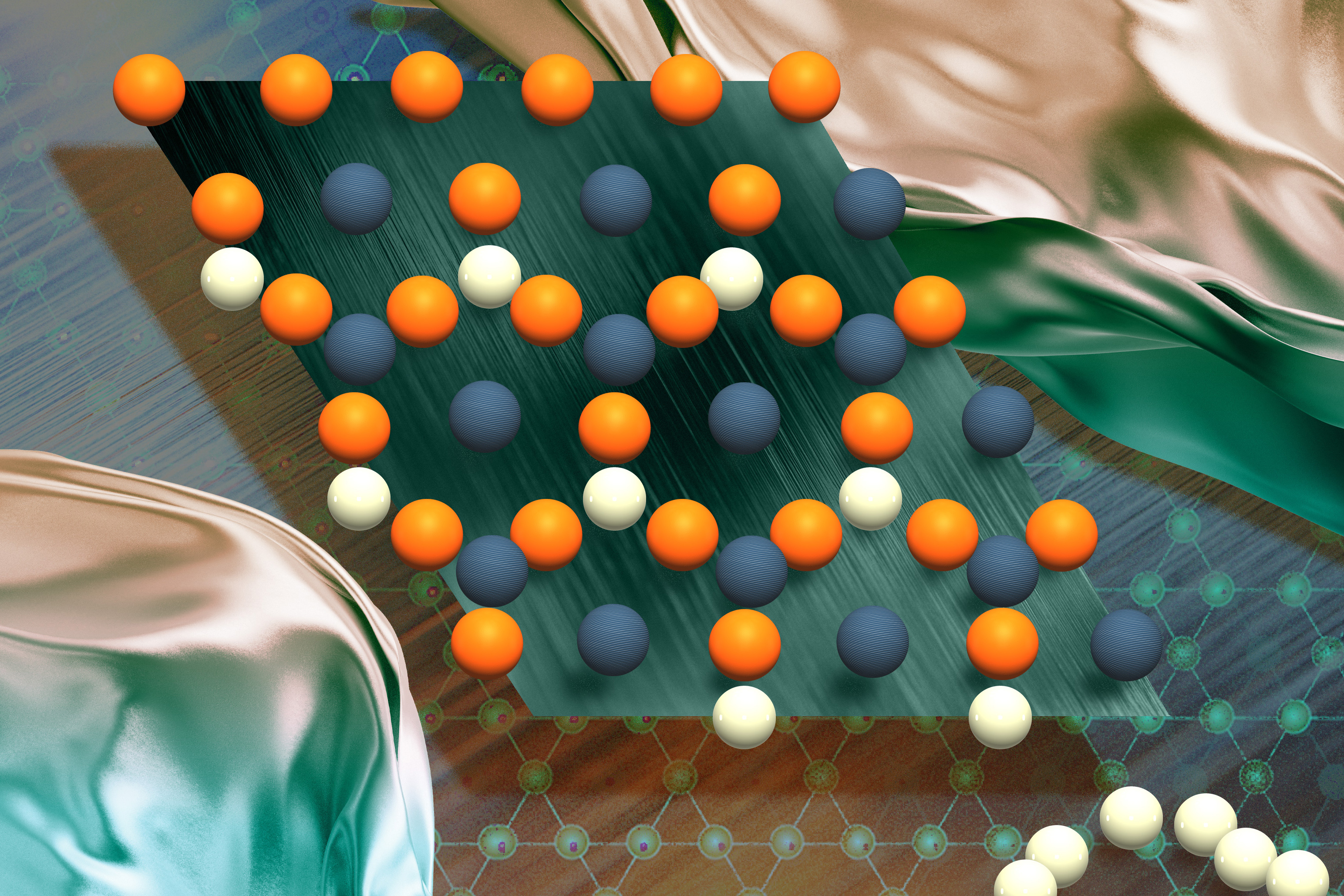


The artificial intelligence models that turn text into images are also useful for generating new materials. Over the last few years, generative materials models from companies like Google, Microsoft, and Meta have drawn on their training data to help researchers design tens of millions of new materials.
But when it comes to designing materials with exotic quantum properties like superconductivity or unique magnetic states, those models struggle. That’s too bad, because humans could use the help. For example, after a decade of research into a class of materials that could revolutionize quantum computing, called quantum spin liquids, only a dozen material candidates have been identified. The bottleneck means there are fewer materials to serve as the basis for technological breakthroughs.
Now, MIT researchers have developed a technique that lets popular generative materials models create promising quantum materials by following specific design rules. The rules, or constraints, steer models to create materials with unique structures that give rise to quantum properties.
“The models from these large companies generate materials optimized for stability,” says Mingda Li, MIT’s Class of 1947 Career Development Professor. “Our perspective is that’s not usually how materials science advances. We don’t need 10 million new materials to change the world. We just need one really good material.”
The approach is described today in a paper published by Nature Materials. The researchers applied their technique to generate millions of candidate materials consisting of geometric lattice structures associated with quantum properties. From that pool, they synthesized two actual materials with exotic magnetic traits.
“People in the quantum community really care about these geometric constraints, like the Kagome lattices that are two overlapping, upside-down triangles. We created materials with Kagome lattices because those materials can mimic the behavior of rare earth elements, so they are of high technical importance.” Li says.
Li is the senior author of the paper. His MIT co-authors include PhD students Ryotaro Okabe, Mouyang Cheng, Abhijatmedhi Chotrattanapituk, and Denisse Cordova Carrizales; postdoc Manasi Mandal; undergraduate researchers Kiran Mak and Bowen Yu; visiting scholar Nguyen Tuan Hung; Xiang Fu ’22, PhD ’24; and professor of electrical engineering and computer science Tommi Jaakkola, who is an affiliate of the Computer Science and Artificial Intelligence Laboratory (CSAIL) and Institute for Data, Systems, and Society. Additional co-authors include Yao Wang of Emory University, Weiwei Xie of Michigan State University, YQ Cheng of Oak Ridge National Laboratory, and Robert Cava of Princeton University.
Steering models toward impact
A material’s properties are determined by its structure, and quantum materials are no different. Certain atomic structures are more likely to give rise to exotic quantum properties than others. For instance, square lattices can serve as a platform for high-temperature superconductors, while other shapes known as Kagome and Lieb lattices can support the creation of materials that could be useful for quantum computing.
To help a popular class of generative models known as a diffusion models produce materials that conform to particular geometric patterns, the researchers created SCIGEN (short for Structural Constraint Integration in GENerative model). SCIGEN is a computer code that ensures diffusion models adhere to user-defined constraints at each iterative generation step. With SCIGEN, users can give any generative AI diffusion model geometric structural rules to follow as it generates materials.
AI diffusion models work by sampling from their training dataset to generate structures that reflect the distribution of structures found in the dataset. SCIGEN blocks generations that don’t align with the structural rules.
To test SCIGEN, the researchers applied it to a popular AI materials generation model known as DiffCSP. They had the SCIGEN-equipped model generate materials with unique geometric patterns known as Archimedean lattices, which are collections of 2D lattice tilings of different polygons. Archimedean lattices can lead to a range of quantum phenomena and have been the focus of much research.
“Archimedean lattices give rise to quantum spin liquids and so-called flat bands, which can mimic the properties of rare earths without rare earth elements, so they are extremely important,” says Cheng, a co-corresponding author of the work. “Other Archimedean lattice materials have large pores that could be used for carbon capture and other applications, so it’s a collection of special materials. In some cases, there are no known materials with that lattice, so I think it will be really interesting to find the first material that fits in that lattice.”
The model generated over 10 million material candidates with Archimedean lattices. One million of those materials survived a screening for stability. Using the supercomputers in Oak Ridge National Laboratory, the researchers then took a smaller sample of 26,000 materials and ran detailed simulations to understand how the materials’ underlying atoms behaved. The researchers found magnetism in 41 percent of those structures.
From that subset, the researchers synthesized two previously undiscovered compounds, TiPdBi and TiPbSb, at Xie and Cava’s labs. Subsequent experiments showed the AI model’s predictions largely aligned with the actual material’s properties.
“We wanted to discover new materials that could have a huge potential impact by incorporating these structures that have been known to give rise to quantum properties,” says Okabe, the paper’s first author. “We already know that these materials with specific geometric patterns are interesting, so it’s natural to start with them.”
Accelerating material breakthroughs
Quantum spin liquids could unlock quantum computing by enabling stable, error-resistant qubits that serve as the basis of quantum operations. But no quantum spin liquid materials have been confirmed. Xie and Cava believe SCIGEN could accelerate the search for these materials.
“There’s a big search for quantum computer materials and topological superconductors, and these are all related to the geometric patterns of materials,” Xie says. “But experimental progress has been very, very slow,” Cava adds. “Many of these quantum spin liquid materials are subject to constraints: They have to be in a triangular lattice or a Kagome lattice. If the materials satisfy those constraints, the quantum researchers get excited; it’s a necessary but not sufficient condition. So, by generating many, many materials like that, it immediately gives experimentalists hundreds or thousands more candidates to play with to accelerate quantum computer materials research.”
“This work presents a new tool, leveraging machine learning, that can predict which materials will have specific elements in a desired geometric pattern,” says Drexel University Professor Steve May, who was not involved in the research. “This should speed up the development of previously unexplored materials for applications in next-generation electronic, magnetic, or optical technologies.”
The researchers stress that experimentation is still critical to assess whether AI-generated materials can be synthesized and how their actual properties compare with model predictions. Future work on SCIGEN could incorporate additional design rules into generative models, including chemical and functional constraints.
“People who want to change the world care about material properties more than the stability and structure of materials,” Okabe says. “With our approach, the ratio of stable materials goes down, but it opens the door to generate a whole bunch of promising materials.”
The work was supported, in part, by the U.S. Department of Energy, the National Energy Research Scientific Computing Center, the National Science Foundation, and Oak Ridge National Laboratory.
