


It’s hard to keep up with the ever-changing trends of the fashion world. What’s “in” one minute is often out of style the next season, potentially causing you to re-evaluate your wardrobe.
Staying current with the latest fashion styles can be wasteful and expensive, though. Roughly 92 million tons of textile waste are produced annually, including the clothes we discard when they go out of style or no longer fit. But what if we could simply reassemble our clothes into whatever outfits we wanted, adapting to trends and the ways our bodies change?
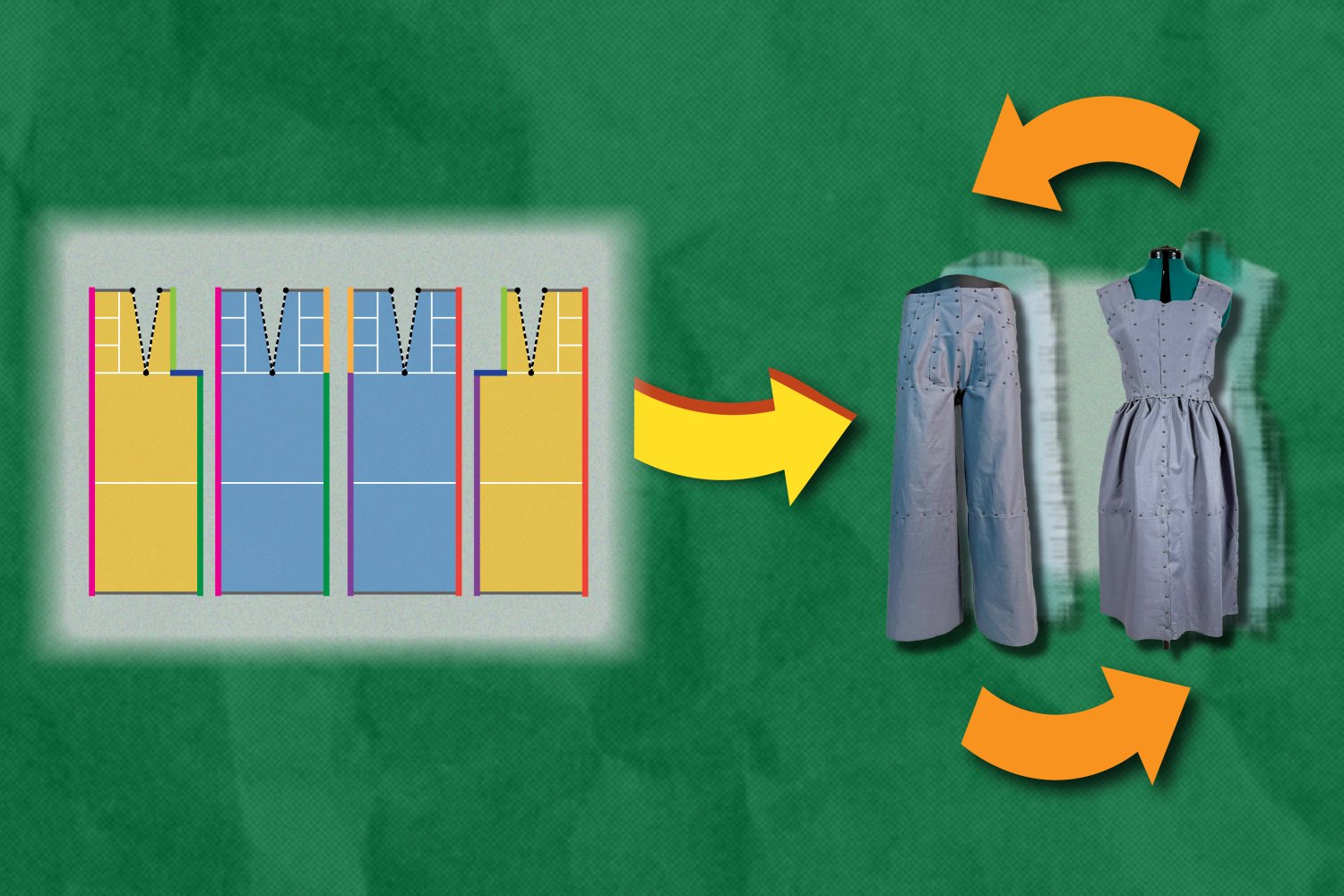
A team of researchers at MIT’s Computer Science and Artificial Intelligence Laboratory (CSAIL) and Adobe are attempting to bring eco-friendly, versatile garments to life. Their new “Refashion” software system breaks down fashion design into modules — essentially, smaller building blocks — by allowing users to draw, plan, and visualize each element of a clothing item. The tool turns fashion ideas into a blueprint that outlines how to assemble each component into reconfigurable clothing, such as a pair of pants that can be transformed into a dress.
With Refashion, users simply draw shapes and place them together to develop an outline for adaptable fashion pieces. It’s a visual diagram that shows how to cut garments, providing a straightforward way to design things like a shirt with an attachable hood for rainy days. One could also create a skirt that can then be reconfigured into a dress for a formal dinner, or maternity wear that fits during different stages of pregnancy.
“We wanted to create garments that consider reuse from the start,” says Rebecca Lin, MIT Department of Electrical Engineering and Computer Science (EECS) PhD student, CSAIL and Media Lab researcher, and lead author on a paper presenting the project. “Most clothes you buy today are static, and are discarded when you no longer want them. Refashion instead makes the most of our garments by helping us design items that can be easily resized, repaired, or restyled into different outfits.”
Modules à la mode
The researchers conducted a preliminary user study where both designers and novices explored Refashion and were able to create garment prototypes. Participants assembled pieces such as an asymmetric top that could be extended into a jumpsuit, or remade into a formal dress, often within 30 minutes. These results suggest that Refashion has the potential to make prototyping garments more approachable and efficient. But what features might contribute to this ease of use?
Its interface first presents a simple grid in its “Pattern Editor” mode, where users can connect dots to outline the boundaries of a clothing item. It’s essentially drawing rectangular panels and specifying how different modules will connect to each other.
Users can customize the shape of each component, create a straight design for garments (which might be useful for less form-fitting items, like chinos) or perhaps tinkering with one of Refashion’s templates. A user can edit pre-designed blueprints for things like a T-shirt, fitted blouse, or trousers.
Another, more creative route is to change the design of individual modules. One can choose the “pleat” feature to fold a garment over itself, similar to an accordion, for starters. It’s a useful way to design something like a maxi dress. The “gather” option adds an artsy flourish, where a garment is crumpled together to create puffy skirts or sleeves. A user might even go with the “dart” module, which removes a triangular piece from the fabric. It allows for shaping a garment at the waist (perhaps for a pencil skirt) or tailor to the upper body (fitted shirts, for instance).
While it might seem that each of these components needs to be sewn together, Refashion enables users to connect garments through more flexible, efficient means. Edges can be seamed together via double-sided connectors such as metal snaps (like the buttons used to close a denim jacket) or Velcro dots. A user could also fasten them in pins called brads, which have a pointed side that they stick through a hole and split into two “legs” to attach to another surface; it’s a handy way to secure, say, a picture on a poster board. Both connective methods make it easy to reconfigure modules, should they be damaged or a “fit check” calls for a new look.
As a user designs their clothing piece, the system automatically creates a simplified diagram of how it can be assembled. The pattern is divided into numbered blocks, which is dragged onto different parts of a 2D mannequin to specify the position of each component. The user can then simulate how their sustainable clothing will look on 3D models of a range of body types (one can also upload a model).
Finally, a digital blueprint for sustainable clothing can extend, shorten, or combine with other pieces. Thanks to Refashion, a new piece could be emblematic of a potential shift in fashion: Instead of buying new clothes every time we want a new outfit, we can simply reconfigure existing ones. Yesterday’s scarf could be today’s hat, and today’s T-shirt could be tomorrow’s jacket.
“Rebecca’s work is at an exciting intersection between computation and art, craft, and design,” says MIT EECS professor and CSAIL principal investigator Erik Demaine, who advises Lin. “I’m excited to see how Refashion can make custom fashion design accessible to the wearer, while also making clothes more reusable and sustainable.”
Constant change
While Refashion presents a greener vision for the future of fashion, the researchers note that they’re actively improving the system. They intend to revise the interface to support more durable items, stepping beyond standard prototyping fabrics. Refashion may soon support other modules, like curved panels, as well. The CSAIL-Adobe team may also evaluate whether their system can use as few materials as possible to minimize waste, and whether it can help “remix” old store-bought outfits.
Lin also plans to develop new computational tools that help designers create unique, personalized outfits using colors and textures. She’s exploring how to design clothing by patchwork — essentially, cutting out small pieces from materials like decorative fabrics, recycled denim, and crochet blocks and assembling them into a larger item.
“This is a great example of how computer-aided design can also be key in supporting more sustainable practices in the fashion industry,” says Adrien Bousseau, a senior researcher at Inria Centre at Université Côte d’Azur who wasn’t involved in the paper. “By promoting garment alteration from the ground up, they developed a novel design interface and accompanying optimization algorithm that helps designers create garments that can undergo a longer lifetime through reconfiguration. While sustainability often imposes additional constraints on industrial production, I am confident that research like the one by Lin and her colleagues will empower designers in innovating despite these constraints.”
Lin wrote the paper with Adobe Research scientists Michal Lukáč and Mackenzie Leake, who is the paper’s senior author and a former CSAIL postdoc. Their work was supported, in part, by the MIT Morningside Academy for Design, an MIT MAKE Design-2-Making Mini-Grant, and the Natural Sciences and Engineering Research Council of Canada. The researchers presented their work recently at the ACM Symposium on User Interface Software and Technology.
