


AMD declined to comment on the record, and Intel didn’t respond to questions sent by email. In the past, both chipmakers have said that their respective TEEs are designed to protect against compromises of a piece of software or the operating system itself, including in the kernel. The guarantees, the companies have said, don’t extend to physical attacks such as Battering RAM and Wiretap, which rely on physical interposers that sit between the processor and the memory chips. Despite this limitation, many cloud-based services continue to trust assurances from the TEEs even when they have been compromised through physical attacks (more about that later).
Intel on Tuesday published this advisory. AMD posted one here.
Battering RAM
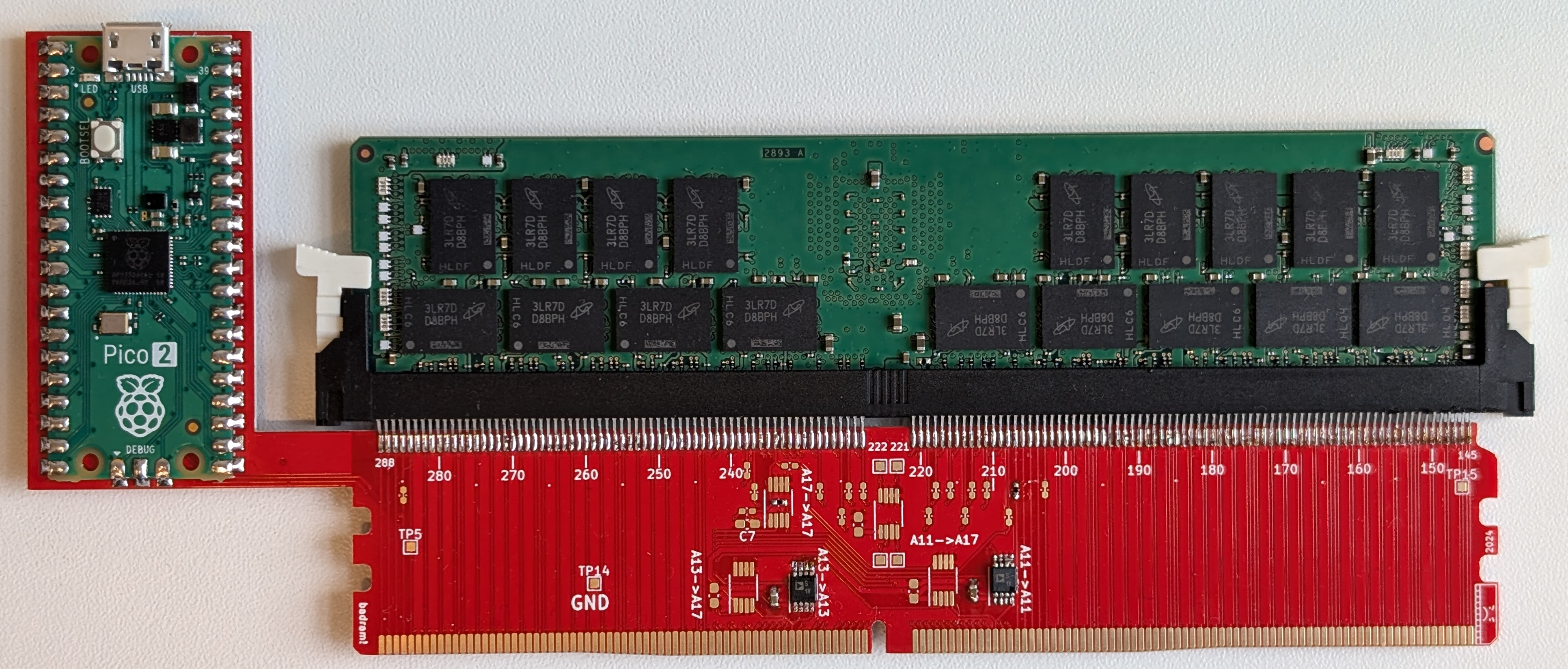
Battering RAM uses a custom-built analog switch to act as an interposer that reads encrypted data as it passes between protected memory regions in DDR4 memory chips and an Intel or AMD processor. By design, both SGX and SEV-SNP make this ciphertext inaccessible to an adversary. To bypass that protection, the interposer creates memory aliases in which two different memory addresses point to the same location in the memory module.
Credit:
De Meulemeester et al.
The Battering-RAM interposer, containing two analog switches (bottom center), is controlled by a microcontroller (left). The switches can dynamically either pass through the command signals to the connected DIMM or connect the respective lines to ground.
Credit:
De Meulemeester et al.
“This lets the attacker capture a victim’s ciphertext and later replay it from an alias,” De Meulemeester explained. “Because Intel’s and AMD’s memory encryption is deterministic, the replayed ciphertext always decrypts into valid plaintext when the victim reads it.” The PhD researcher at KU Leuven in Belgium continued:
When the CPU writes data to memory, the memory controller encrypts it deterministically, using the plaintext and the address as inputs. The same plaintext written to the same address always produces the same ciphertext. Through the alias, the attacker can’t read the victim’s secrets directly, but they can capture the victim’s ciphertext. Later, by replaying this ciphertext at the same physical location, the victim will decrypt it to a valid, but stale, plaintext.
This replay capability is the primitive on which both our SGX and SEV attacks are built.
In both cases, the adversary installs the interposer, either through a supply-chain attack or physical compromise, and then runs either a virtual machine or application at a chosen memory location. At the same time, the adversary also uses the aliasing to capture the ciphertext. Later, the adversary replays the captured ciphertext, which, because it’s running in the region the attacker has access to, is then replayed as plaintext.
