
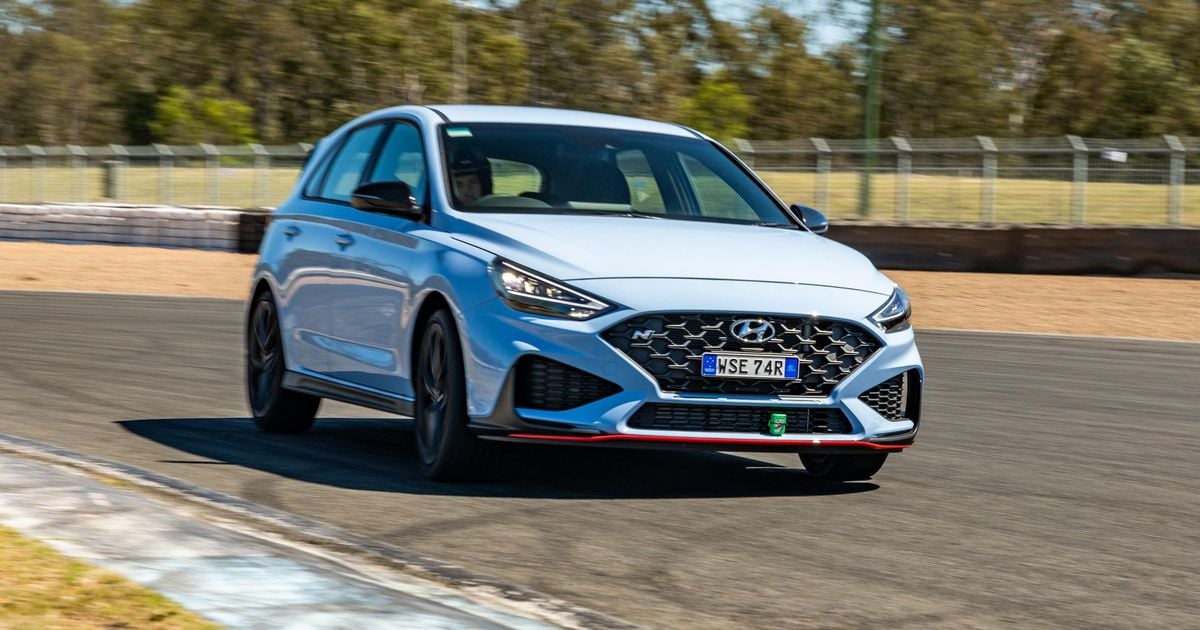

Hyundai Australia won’t kill off its high-performance N models despite increasing pressure from the Federal Government’s New Vehicle Efficiency Standard (NVES).
Speaking with CarExpert, Hyundai Australia chief operating officer Gavin Donaldson said that tightening emissions caps under the NVES regulations add pressure and potential penalties, but the Korean brand has no plans to pull petrol-powered N cars like the i20 N and i30 N as Hyundai Europe has.
“We think there’s a place for a high-performance ICE engine [in our lineup],” said Mr Donaldson.
CarExpert can save you thousands on a new car. Click here to get a great deal.

“Our N products were probably about $5.1 million in penalties, and you know if we take that out, we’re in credit… I don’t know [competitors’] strategies, but for us we were in a deficit [against NVES] purely because we have a brand that we want to keep in Australia.”
Earlier this week, the Australian Government released the first results under its New Vehicle Efficiency Standard (NVES), with around two-thirds of brands beating their emissions targets.
Type 1 vehicles (passenger cars and SUVs) had a headline limit of 141g/km of carbon dioxide (CO2) emissions for 2025, with Type 2 vehicles – including utes, vans, and large off-road SUVs like the Ford Everest – having a headline limit of 210g/km.
Hyundai Motor Company posted an ‘interim emissions value’ of 84,563 units, meaning it’ll need to trade credit units with another company by December 31, 2027 or risk a penalty in February 2028 of $50 multiplied by their final emissions value.
For reference, the Hyundai i20 N quotes a combined CO2 emissions figure of 157g/km even with Euro 6-homologated powertrain systems, while the larger i30 Hatch N quotes 197-199g/km with its Euro 5-certified powertrain.
This year, NVES CO2 caps lower to 117g/km for Type 1 vehicles, meaning the petrol-powered N range will be subject to even greater penalties – though the all-electric Ioniq 5 N and incoming Ioniq 6 N can offset these somewhat with their zero-emissions powertrains with enough volume.
In September, Hyundai detailed its plans to expand its lineup by 2030 at its 2025 CEO Investor Day, including bringing the N division lineup to seven models including its first hybrid.
Currently, the Hyundai N range comprises several distinct models globally, including the i20 N, i30 Hatch N, Elantra N (i30 Sedan N here), Ioniq 5 N and Ioniq 6 N. The former Veloster N available in South Korea and North America has been discontinued.
A new-generation Elantra N/Avante N/i30 Sedan N is understood to be in the works as part of the next-gen sedan’s range – potentially due for reveal later this year – while the sixth and seventh nameplates due to receive the N treatment remain unknown.
There have long been rumours of an N-branded SUV, potentially based on the Tucson, while the compact Kona crossover offered an N version in its previous generation.
Another potential candidate for the Hyundai N treatment is the upcoming Ioniq 3 compact EV, which was shown as the Concept Three at last year’s Munich motor show.
Let us know in the comments if you’re happy that Hyundai is committing to the N range in Australia!
