

Why you can trust TechRadar
We spend hours testing every product or service we review, so you can be sure you’re buying the best. Find out more about how we test.
GL.iNet Slate 7: 30-second review
GL.iNet has a good reputation for router technology, and its mainstream home-office products, like the Flint 3, are widely revered. Alongside the Flint 3, GL.iNet has the Slate 7, a travel router that takes the best aspects of its larger brother and condenses them into an easy-to-carry portable access point.
If that seems like a security nightmare, the Slate 7 offers options for WireGuard VPN or OpenVPN, protecting your systems from local intrusions. The firmware on the Slate 7 is OpenWRT 23.05 (customised), which supports up to 5,000 plugins, allowing you to tweak the router for specific purposes.
Where most travel routers aren’t suitable for wider applications, the Slate 7, with its dual 2.5GbE LAN ports, could be a quick fix for a small office that needs WiFi, as it can easily connect to a cable router and the internal network without compromising the speed of either.
The limitations of this design are that it doesn’t support 6GHz bandwidth, which is part of the full WiFi 7 experience, and it can’t work as a MESH router with the Flint 3.
But unless those technologies are part of your network plans, then the Slate 7 is an inexpensive solution that ticks plenty of other useful boxes, making it an obvious candidate for our best Wi-Fi routers collection.

GL.iNet Slate 7: price and availability
- How much does it cost? $170/£151/€174
- When is it out? Available now
- Where can you get it? You can get it directly from GL.iNet, and it is also available from Amazon and other online retailers.
Direct from the maker, the GL.iNet Slate 7 costs only $169.99/£150.99/€173.99, and is currently offering a bundle deal if you buy it alongside the Flint 3 router in Europe or the USA. That bundle costs $358.99 in the USA, and €347.98 across Europe.
Alongside the Slate 7, GL.iNet has a travel pouch for the router that’s only £11.99 in the UK, and a SIMPoYo uFi (SP-N150C4) Plug & Play 4G USB Dongle for just €23.52/£21.89, but that’s not offered in the USA.
It can be bought via Amazon.com and other online retailers, and the prices are remarkably close to those of the maker. However, GL.iNet is currently offering the Slate 7 on Amazon.co.uk for only £117.29, which is a fantastic deal.
For those buying in bulk from GL.iNet, some cost reductions can be had. As an example, buy ten of these, and you can get a 6% saving, and smaller discounts are available for 3 and 5 packs.
Considering the cost of some travel routers that only offer Wi-Fi 6, the Slate 7’s price seems reasonable, especially since it can operate as a standard AP, a wireless bridge, repeater or a wired bridge.
However, TP-Link has released the remarkably similar TL-WRR3602BE portable travel router, which sells for $99 on Amazon.com. But that router only offers a single 2.5GbE LAN port, and its second port is only 1GbE.
Netgear also offers the Nighthawk M7 Pro Mobile Hotspot, which provides 5G or 4G LTE service, but it costs £900 in the UK and, while cheaper in the USA, doesn’t work with all 5G or 4G carriers.
Overall, there are cheaper options, especially if you reduce expectations by using WiFi 6, but for a Wi-Fi 7 solution, the Slate 7 can justify its asking price.
GL.iNet Slate 7: Specs
|
Feature |
Specification |
|---|---|
|
Model |
GL-BE3600 (Slate 7) |
|
CPU |
Qualcomm Quad-core @1.1GHz |
|
RAM |
1GB DDR4 |
|
Storage |
512MB NAND Flash |
|
WiFi Bands |
688 Mbps (2.4GHz) |
|
2882 Mbps (5GHz) |
|
|
WiFi Standard |
IEEE 802.11a/b/g/n/ac/ax/be (Wi-Fi 7) |
|
Ethernet Ports |
1x WAN 2.5GbE |
|
USB Port |
1x USB 3.0 |
|
Antennas |
2x Foldable External Antennas |
|
Operating System |
OpenWRT 23.05 (customised) |
|
VPN Support |
WireGuard (490 Mbps) & OpenVPN-DCO (395 Mbps) |
|
Modes |
Routing, AP, Wireless Bridge, Wired Bridge |
|
Power Input |
5V/3A, 9V/3A, 12V/2.5A over USB-C |
|
Power Consumption |
Less than 8W (without USB demands) |
|
Dimensions |
130 x 91 x 34 mm |
|
Weight |
295g |
GL.iNet Slate 7: design
- Simple but elegant
- Highly portable
- Lots of useful modes
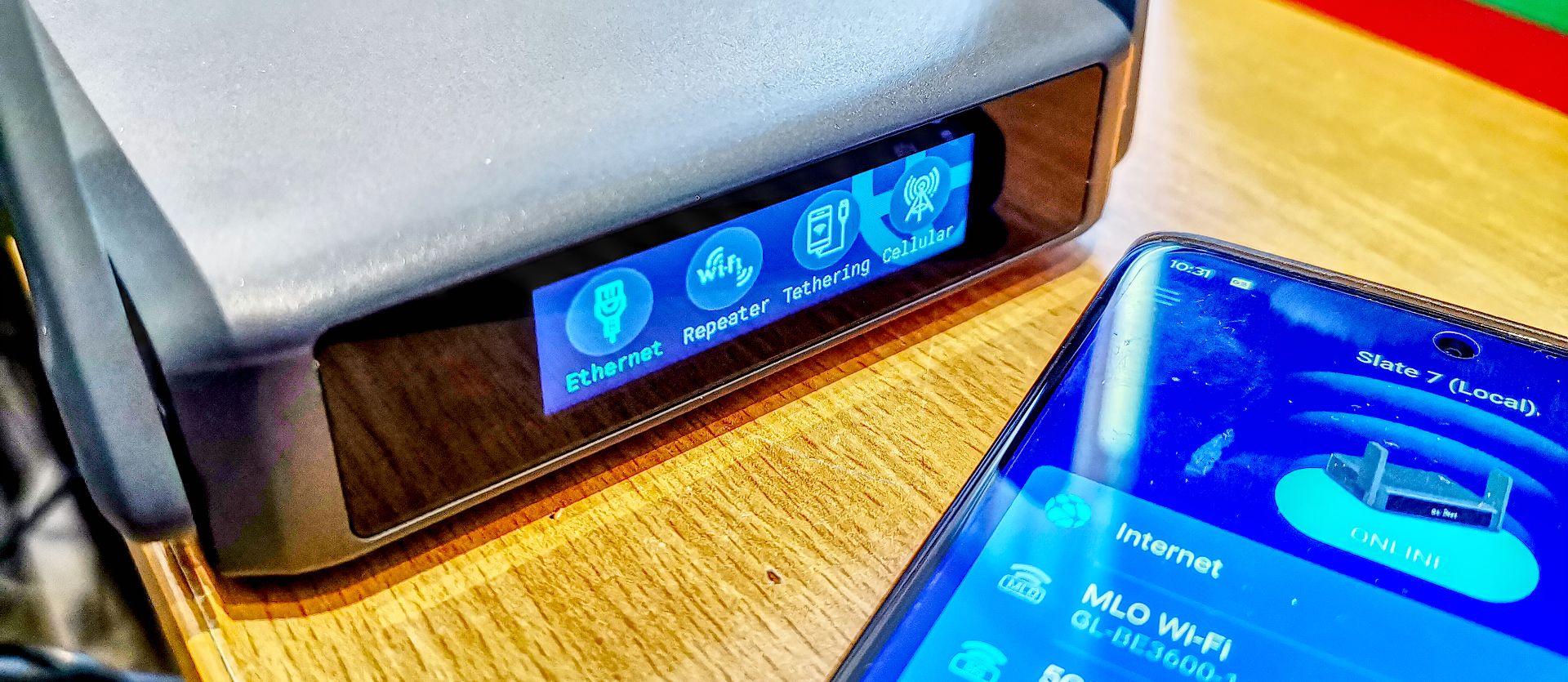
We’ve seen other Wi-Fi hardware makers go to extremes to make their products stand out in a remarkably competitive market. But the GL.iNet stuck firmly to the practicality proposition with the Slate 7, making it effectively a small 130 x 91 x 34 mm box with a gullwing antenna at either side and all the ports on the rear. The front has a small touchscreen that you can use to navigate a basic menu and view the router’s status.
Power comes via USB-C, and it can be powered by a laptop since it draws only about 8W when no USB devices are attached. A small 30W PSU is included in the box, and on the EU model, adapters for four different power outlets are included: USA, UK, Europe, and Australia.
Since this PSU is similar in spec to those most people use for phones, a hardcore traveller could reduce the number of these devices they carry. Even with the PSU, this solution is less than 400g, and can easily fit alongside a laptop in hand luggage.
On the rear of the Slate 7 are two 2.5GbE LAN ports, and these, combined with the wireless capabilities, allow it to be an access point, a bridge, a Wi-Fi repeater, or even a controlled failover between two broadband providers.
There is also a USB 3.0 port, though I never got the full 5Gbps performance I expected when connecting storage to it. What this port is useful for is adding a 5G or 4G dongle, expanding the capability to include distributing a mobile comms connection to multiple devices. When you consider how expensive some dedicated 5G routers are, and how inexpensive a 5G dongle can be, this might be the optimal combination.
From a hardware perspective, the only thing missing here is a battery, as we saw on the Puli AX, also by GL.iNet. But, as the designers chose to power this using USB-C, it can steal power from a laptop, a phone or a small power station easily.
One clever, but almost hidden feature is that when you push the antennas into their upright position, underneath the left one is a ‘Mode’ button, which you can set to toggle VPN services or other network functions quickly. That’s far more convenient than having to open up a phone or computer to switch modes. That’s something that some users will be doing on a regular basis, and the button could become a massive time saver.
Design score: 4/5
GL.iNet Slate 7: In use
- Easy install
- OpenWRT
- No Mesh
Using the device is purely a matter of plugging in the power and any Ethernet connections you need, if any, and selecting the mode you want from the touchscreen. Once the router is configured, the screen can display QR codes for phones, tablets, and laptops to connect without having to enter complicated passwords. It’s exactly as straightforward as you might expect, and there is a phone app if you want to be taken through the configuration process with some support.
Like the Puli AX and Flint 3, this router is built on a customised version of OpenWRT, a Linux project for embedded devices. This tailored version of OpenWRT 23.05 with support for over 5,000 plug-ins makes it ideal for advanced users who want granular control over routing, VPNs, and network behaviour.
The only blot on this landscape is that you can’t install vanilla OpenWRT on this router, as the firmware has been configured specifically for this hardware platform, making it markedly less Open in the process.
What this firmware does offer is the ability to failover in various ways, enabling the two 2.5GbE ports (one each of WAN and LAN) to support two broadband services to handle the failure of one of them. In addition, although I didn’t test this, I’m confident it can failover to a 4G or 5G service via a USB dongle if the wired connection goes down. Many of these features are normally on desktop routers but rarely on travel hardware.
Internet access is also possible via a Wi-Fi repeater mode with an existing service, or via USB tethering to a phone or laptop with mobile comms capability.
And, like the Flint 3, this router doesn’t mesh with other GL.iNet routers. This was a complaint I made about the Flint 3, and the Slate 7 has exactly the same problem.
If you don’t think this is a big deal, consider a common scenario: you have a Flint 3 or another router running most of your Wi-Fi, but you use the Slate 7 to create a local hotspot in your office. In an ideal world, the two would Mesh, so that devices would seamlessly move between them as you moved around the building, but that’s not an option.
Then, if you took the Slate 7 on a road trip, it wouldn’t impact the local Wi-Fi network, and it would slot back in when you returned. Why GL.iNet didn’t implement Mesh on these devices is a mystery, and it would be a huge story for those covering Wireless networking if they fixed this.
According to resources, OpenWRT does support mesh via 802.11s or batman-adv, but this isn’t implemented in the GL.iNet interface. This isn’t a new issue, as neither the original Slate AX or Beryl AX had Mesh either, and the Flint 3 also lacks it.
GL.iNet Slate 7: Performance
- Lacks 6GHz
- Lacklustre USB 3.0
Performance results are consistent, and present the Slate 7 as a workmanlike travel router that makes the most of the technology stuffed in it.
On 5GHz, real-world wireless speeds reach a limit of about 2.1 Gbps, which is strong for a travel router, given the theoretical bandwidth of 3400 Gbps across all bands.
If you use a VPN, that amount can be significantly reduced, with as little as 100 Mbps on OpenVPN, but WireGuard VPN throughput typically sits just above 500 Mbps, a trade-off that most travellers would live with to be safe on the road.
The performance of WireGuard and OpenVPN channels on routers is heavily determined by the SoC’s speed. Many desktop routers built around OpenWRT 23.05, but with a more powerful SoC, can hit 1,000MB/s or better. But, since this router might be battery-powered, the chip in it was chosen for power efficiency and not breakneck WireGuard performance.
This hardware supports Multi-Link Operation (MLO), but since it lacks support for the 6GHz band, using it doesn’t tend to provide much in the way of speed gains, though it does enhance stability somewhat. Those operating this router in a hotel room wouldn’t notice the difference, I’m confident.
There is a good argument that selling the Slate 7 as a Wi-Fi 7 router when it doesn’t support 6GHz is, at best, overselling and, at worst, misleading. I’d temper that position by saying that this platform does support 4K QAM and Multi-Link Operation (MLO) for improved efficiency and speed over older standards, though if this router had a 6GHz band, it would be rated much higher than the BE3600 that it is currently.
One place it doesn’t perform well is with the USB 3.0 port, which doesn’t deliver the bandwidth it should. File transfers from storage devices stalled at 132MB/s in my tests, even with external SSDs rated for 1,000MB/s or higher.
Since USB 3.0 should be at least 500MB/s, being a 5Gbps technology, but on this hardware, it looks like it’s capped at closer to 1Gbps, which is disappointing. It’s worth saying that I’ve reviewed desktop routers with ‘Blue’ USB 3.0 ports and discovered they only support USB 2.0 transfer speeds (40MB/s), so the performance on this router is better than some.
Overall, the Slate 7 performs well with Wi-Fi 5 and 6 clients, but without 6GHz support, it can’t match the performance of a proper Wi-Fi router.
GL.iNet Slate 7: Final verdict
I like the Slate 7 more than some other products I could mention, mostly because it focuses on its core functionality and offers the features and flexibility that frequent travellers are looking for.
Being easy to carry and deploy is important for those on the move, and by using WireGuard VPN, you can keep communication secure even if the local hotel network is compromised.
If this design has weaknesses, many of them are the same that I noticed on the Flint 3, and as they share a firmware platform, that’s not a huge surprise. Ironically, if the Flint 3 supported Mesh, so would this router, and that would be a major selling point for both. For whatever reason, GL.iNet didn’t include Mesh, and it makes the Slate 7 slightly less useful for those who want to use one in the office to extend their network. You can still use it as a range extender, but that’s not the same as the smooth handover connections that Mesh can give you.
Of the eight travel routers GL.iNet currently sells, this is the one I’ve been most impressed with so far. However, I’ve yet to see the Mudi 7 (GL-E5800). a 5G NR Tri-band Wi-Fi 7 Travel Router, as it’s only due to be released later this year,
There are cheaper options around that work perfectly well, but the thinking and functionality that’s in this one make it worth the extra cost when you are far from the office and need equipment that works.
Should I buy a GL.iNet Slate 7?
|
Attributes |
Notes |
Rating |
|---|---|---|
|
Value |
Agressively priced for the specification of this small device |
4/5 |
|
Design |
Compact, solid build with handy touchscreen |
4/5 |
|
In Use |
Easy to use and highly flexible but lacks Mesh |
3.5/5 |
|
Performance |
Strong on 5GHz & WireGuard; ‘Wi-Fi 7’ branding oversells it |
3.5/5 |
|
Overall |
Best-in-class travel router with a few caveats |
4/5 |
Buy it if…
Don’t buy it if…
For more connectivity solutions, we’ve reviewed the best business routers
