

The use of ChatGPT and other AI language models has skyrocketed. Everyone from marketers to website owners, students, and researchers are using them. However, there’s a big question regarding the content generated by these tools.
Is it AI-plagiarism free? While you might be hoping yes, the actual answer is a resounding “No!” AI-generated content commits two forms of plagiarism: (1) typical plagiarism and (2) AI plagiarism.
This article will run through each one, enlightening you about the importance of checking ChatGPT-generated content for any forms of copying. It will also show you the best tools to check for plagiarism in content created by ChatGPT.
Without further ado, let’s dive in.
Do You Really Need To Check ChatGPT Content for Plagiarism?
We can’t stress this enough: whoever you are, if you use ChatGPT for content creation, you must check the output for plagiarism.
Here are four reasons why it really does matter.
1. So you can ensure originality
Academics don’t consider ChatGPT content as original. Stanford University has gone as far as to name it “CheatGPT,” with an article on the university’s website stating the use of ChatGPT for content creation ‘clearly violates academic integrity.’
The university also believes it doesn’t encourage learning, with ChatGPT content reflecting the algorithm’s knowledge, not the writer’s, so it’s best to avoid using ChatGPT for any assignment and, instead, pen your own ideas.
Moreover, if an institute found AI plagiarism in your work, they could consider it a violation of academic integrity, getting you in real trouble. Even if you use ChatGPT for inspiration, always ensure the finished article is your own work.
2. So you avoid serious repercussions
Beyond lacking originality, the use of ChatGPT in academic work is widely regarded as cheating, the consequences of which can be extremely serious. In the best case, your professor may ask you to edit only the plagiarized sentences.
On the other hand, the university could expel you. Even if you’re only posting AI content on your website, you’re breaking Google’s guidelines on content creation, especially the EAT (expertise, authoritativeness, and trustworthiness) rule.
This could cause a significant drop in your website’s search ranking. Worse, it could cause you to lose all organic traffic. So rather than running yourself into trouble, why not just check your content for plagiarism?
Doing so will preserve your Google ranking and keep you within your institute’s guidelines.
3. So you protect your reputation
If you’re found guilty of plagiarism, your reputation will crumble overnight. The only way to avoid this happening is by learning to use ChatGPT as a writing aid, but don’t let it become ‘the writer.’
Working this way will ensure your content is free from typical and AI plagiarism, bringing you all the benefits of ChatGPT without endangering your reputation.
4. So you’re never caught out
ChatGPT doesn’t plagiarize its sources, but someone might still question the originality of your work. But if a plagiarism checker has given you the green light, at least you can prove you’re content is unique.
You’ll have a report to prove it, which can be a solid defense against plagiarism allegations. Moreover, checking for plagiarism gives you a chance to address signs of it before you publish any work.
This will help you protect your reputation and avoid potential repercussions, but how exactly do you check ChatGPT content for plagiarism?
These are the best ways to do just that.
Tools to Check for Plagiarism in AI Content
Various tools claim to be able to detect plagiarism in AI-generated content, but some are better than others.
Below are the best ones to use to detect plagiarism in AI content.
ChatGPT Itself
Many think that ChatGPT can only create content. However, the tool also remembers the content it generated, so you can use ChatGPT to check the originality of a piece of work.
For example, if a student wrote an assignment with ChatGPT, their professors could share the assignment (or a few of its sentences) with ChatGPT and ask if the AI wrote it.
ChatGPT would immediately admit if it did, as shown below:
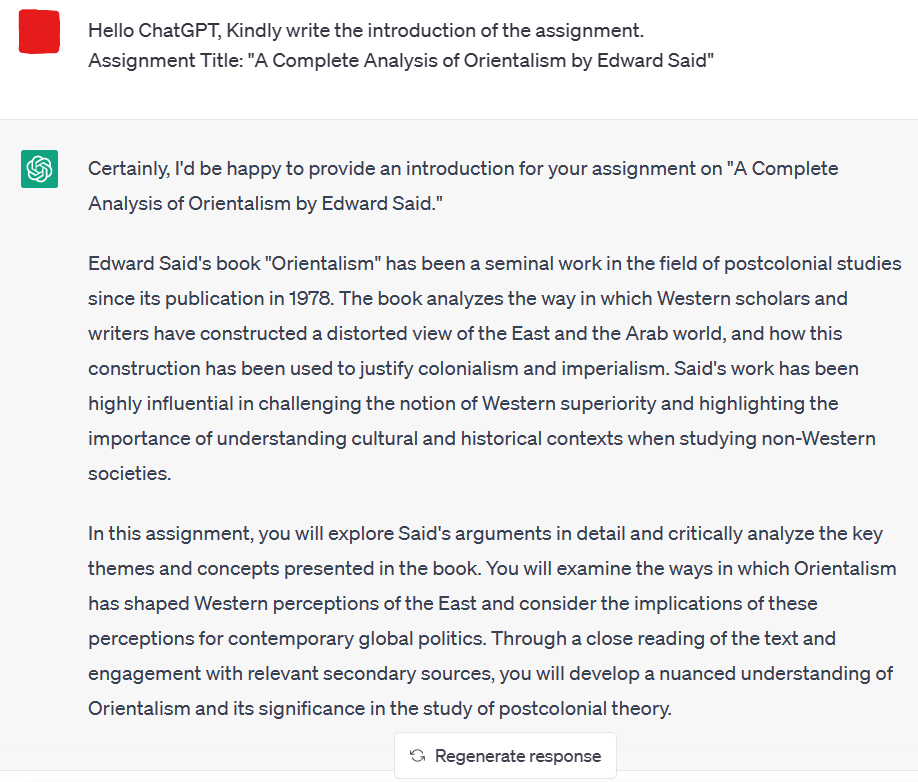
The above is ChatGPT’s response to a prompt regarding creating an introduction to an assignment. If someone then copied this and asked ChatGPT if it was written by ChatGPT, it would tell them the truth.
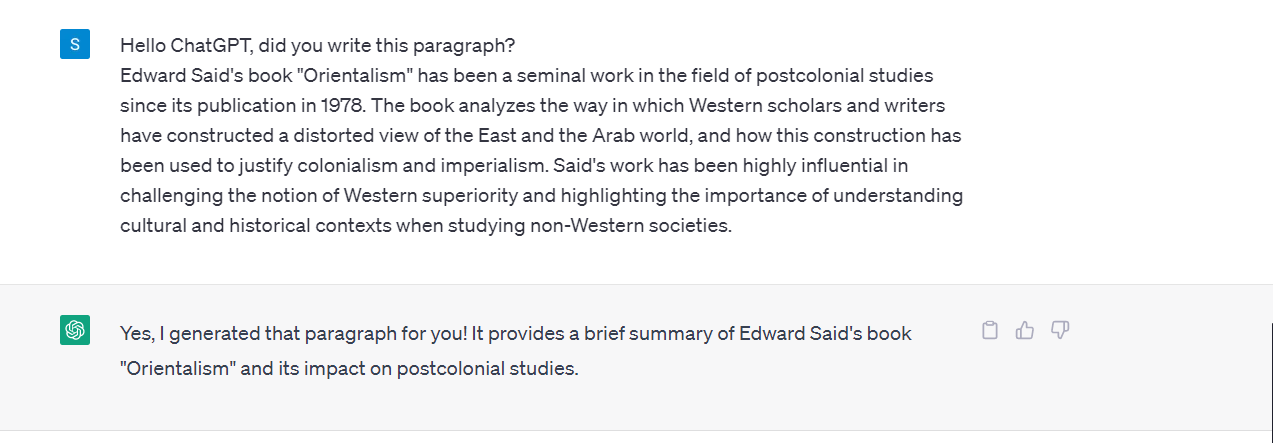
I put this to the test using my personal laptop and ChatGPT login to create the original text before sending it to another person to check on their own device using a separate login and a different IP address.
Here’s what they found:
A study by Cornell University shows ChatGPT has an accuracy of up to 92% when checking for plagiarism, which is way higher than other tools, showing why generating content with ChatGPT and claiming it as your own is so risky.
PlagiarismDetector
After ChatGPT itself, users have another reliable and advanced plagiarism detector that they can use to perform a plagiarism check and find out the originality of the content. That plagiarism checker is plagiarismdetector.net.
The plagiarism checker uses two techniques for locating plagiarism in any text.
- First, it compares the content with its database of billions of web pages.
- Second, it uses advanced methods to search for similar intent with different words, which allows it to detect plagiarism in paraphrased content.
This lets it locate every instance of plagiarism in any content, helping users know whether to submit content as-is.
Or make modifications to ensure originality.
AI Text Classifier by OpenAI
Following the development of ChatGPT, a question arose: is copying or stealing the content of something plagiarism?
One definition of plagiarism calls it the act of copying someone else’s work and claiming it as your own, with no mention of claiming something else’s work (say, that of a machine learning or AI model).
That’s why academic circles are rethinking the definition of plagiarism entirely. In fact, this is where the term ‘AI plagiarism’ came from, and some tools are great at detecting this type of plagiarism.
AI Text Classifier from OpenAI is certainly one of the best. And it’s helping universities, academics, and others detect AI plagiarism in content, so those who want to know if something was written by AI can now check.
While it’s not 100% accurate, it’s better than most tools, not least because the company behind ChatGPT built it. Moreover, it can determine which sections were created by AI and which were written by humans.
Tips to Avoid Plagiarism in AI Content
Now you know the importance of checking AI content for plagiarism, alongside the tools to use, now’s the time to learn how to avoid plagiarism in ChatGPT content.
Here’s what you should do.
1. Source Ideas from ChatGPT, Not the Actual Words
ChatGPT is a great writing tool. It can help all writers, even seasoned ones. Simply use it to generate ideas, create outlines, and write first drafts.
The problem is that too many content creators rely on ChatGPT to do all the work, writing a prompt and copying the output. This is, effectively, plagiarism. Which is why you should always avoid copy-pasting anything from ChatGPT.
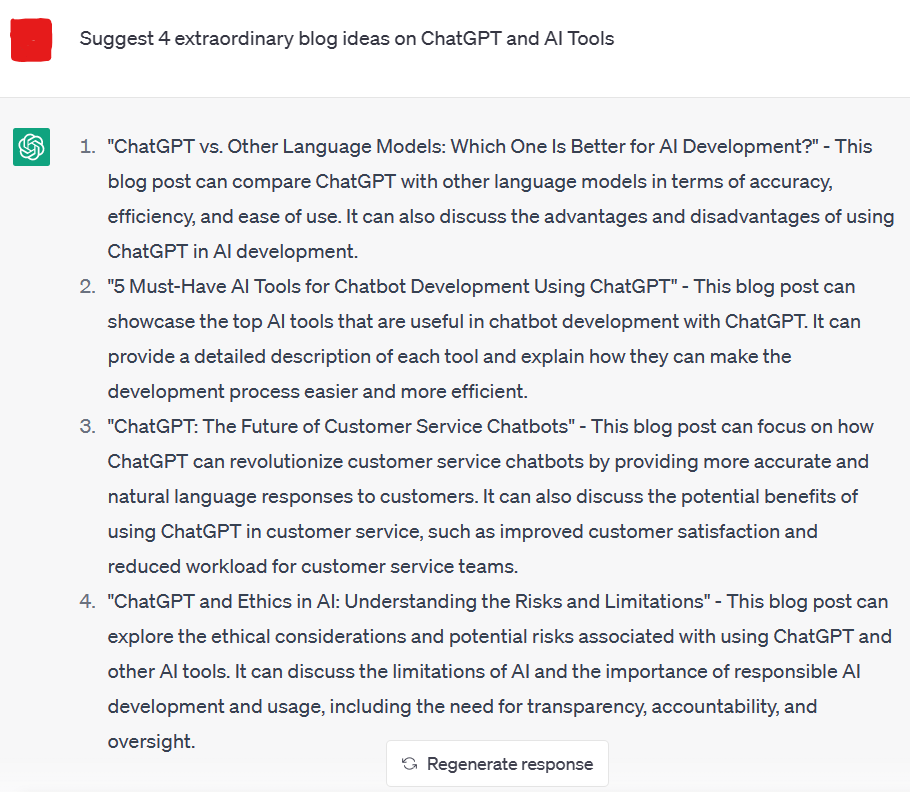
Use it for ideas (as we’ve done in the prompt below), and see how the combination of artificial and natural intelligence is a match made in content heaven.
2. Find and Cite Your Sources
If you write content with the help of ChatGPT, you should find and cite the sources of information; to do this, simply pick a line from the content and search it on Google.
You’ll find many credible sources, which you can cite in your articles to make your work more authentic. This technique also makes your work look well-researched, ultimately leaving a better impression on readers.
3. Maintain Authenticity by Fact-Checking
ChatGPT has a tendency to make things up. It uses Machine Learning and Natural Language Processing to generate content, so the information it provides can be outdated, misrepresented, or outright fabricated.
As such, if you blindly trust everything it writes, you might create something fanciful, meaning you best use a tool like Google’s Fact Check Explorer to make sure everything you say is true.
Takeaway: Use ChatGPT Wisely, And You’ll Write Well
ChatGPT is a great writing assistant, but it has its limitations.
Therefore, writers must check the ChatGPT content for both AI and traditional plagiarism. That’s how you can make sure the content is original and ready to publish.
However, if a plagiarism checker finds any signs of copying, remove them and make your content unique. Lastly, do not blindly trust the AI’s data.
Always check the facts and cite your sources where you can.
And if you plan to use the power of AI in your business and integrate GPT into your system, contact us.
