


# Introduction
Over three years of mentoring data science students across more than a thousand sessions, one question comes up before anyone writes a line of code: where do I start with AI? Students arrive motivated but without a map. They read about machine learning engineers, research scientists, and data scientists, and assume the titles describe the same work. They don’t. That assumption sends people chasing the wrong skills for the wrong role, and it usually costs them months.
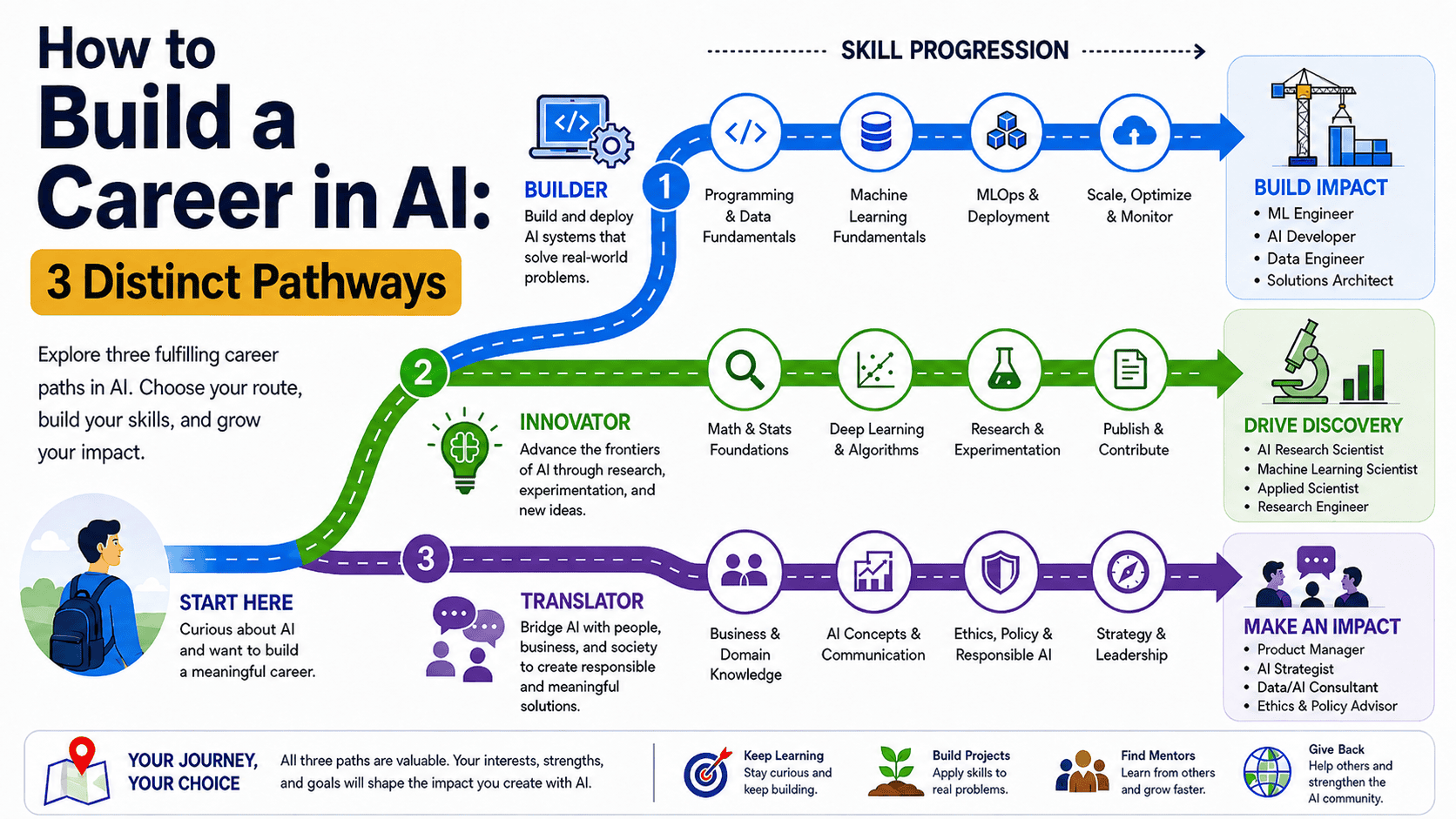
AI is not one profession. It spans mathematical research, software engineering, and applied problem solving, and each area rewards a different starting point. Below are the three pathways I point students toward, the roles inside each, and the mistake I watch people make most often on the way in. Read these as a way to locate yourself, not as a ranking. No path is more legitimate than the others.
# Understanding What “A Career in AI” Really Covers
Before diving into the three pathways, it’s worth understanding why the space is so confusing in the first place.
The phrase “a career in AI” hides enormous variety. One job titled “AI Engineer” means adapting large language models (LLMs). Another means connecting API calls into a product. A third means building recommendation systems from statistical baselines. Companies attach the same titles to wildly different jobs, so students end up optimizing for a fictional average role and landing nowhere in particular. Before committing to any learning plan, figure out which of three orientations matches your background, your goals, and your tolerance for depth versus breadth.
With that in mind, let’s walk through each pathway.
# Pathway 1: The Builder (Engineering and Deployment)
Builders take working models and make them run reliably at scale. The work centers on writing clean code, managing data pipelines, and keeping systems stable when large numbers of users depend on them. If you enjoy logical puzzles and seeing a direct result from what you ship, this is the path for you.
Common roles on this path:
- Machine learning engineer: scales predictive models into live applications such as recommendation engines.
- Data engineer: builds the pipelines that collect, clean, and format the data that models depend on.
- AI developer: integrates external AI APIs (like LLMs or vision tools) into products people use.
You might wonder whether this path requires deep expertise in the underlying algorithms. In most cases, it doesn’t, and that’s where the most common mistake happens. People imagine this path is about inventing algorithms. It’s mostly software engineering. I worked with a mentee who had excellent benchmark accuracy but had never versioned a model, monitored drift, or written a data validation layer. He was surprised to learn that interviews test those skills just as heavily as modeling itself. Solid engineering foundations are what this path is built on.
Good starting points: Python, then scikit-learn and PyTorch, plus one cloud platform.
# Pathway 2: The Innovator (Research and Science)
If the Builder path is about making AI systems work in production, the Innovator path is about pushing those systems forward — figuring out what’s possible next.
Innovators work at the frontier, trying to invent new methods rather than apply existing ones. This is the most mathematically demanding of the three paths, built on linear algebra, probability, and optimization.
Common roles on this path:
- Research scientist: invents new learning methods at industry labs or universities, a role that usually requires a Ph.D.
- Data scientist: analyzes complex data to find patterns and trains the early models that engineers later deploy.
- Deep learning specialist: concentrates on neural network architectures, often within natural language processing (NLP) or computer vision.
Here’s where things get counterintuitive. Unlike the Builder path, where enthusiasm for engineering is enough to get started, this path has a much steeper on-ramp. Romanticizing research without checking the entry bar is the most common mistake I see. Last year, three students told me they wanted to go into research because the concepts fascinated them. When I asked about their linear algebra, probability, and optimization backgrounds, all three had significant gaps. Fascination is necessary, but it’s not sufficient. This path rewards people who are comfortable with uncertainty and ready to invest in graduate study or a research role inside a major lab.
To test your appetite, work through the DeepLearning.AI Machine Learning Specialization and fast.ai.
# Pathway 3: The Translator (Product, Strategy, and Ethics)
There’s a third orientation that often gets overlooked, and it’s the one most people are actually best positioned for.
Translators connect what the technology can do with what an organization needs it to do. You don’t have to write production code here, but you do need technical literacy: how AI works, where it fails, and what it risks.
Common roles on this path:
- AI product manager: owns the product vision, balancing user needs, business goals, and technical limits.
- AI governance or ethics lead: keeps systems fair, compliant, and safe, and asks whether something should be built at all.
- Prompt engineer: designs and refines the inputs given to LLMs to produce accurate, safe outputs.
You might be thinking this sounds like a consolation prize. That’s a cultural bias worth naming directly. There’s a tendency in this field to reward building models over using them well, and students absorb it. But the most valuable work in most organizations right now is knowing which problems AI can actually solve, choosing the right tools, and communicating results to the people who must act on them. When a nurse came to me chasing machine learning engineering for the salary figures, an honest conversation made something clear: her clinical background wasn’t a disadvantage. It was an edge a new graduate couldn’t match.
If this path fits you, the Hugging Face LLM Course builds solid practical fluency with modern tools.
# Choosing the Path That Fits You
The most consistent mistake across those thousand sessions is picking a path because it sounds impressive rather than because it fits. AI career content tends to show the destination, not the route, so people work backward to a plan without honestly accounting for where they’re starting.
Work through this before you commit:
- Name your strongest existing background: engineering, mathematics, or domain expertise.
- Read actual job postings for each path and compare what they ask for day to day.
- Talk to people doing the work, not only to creators describing it from the outside.
- Check your timeline honestly before choosing a path that needs years of preparation.
- Pick one path and build a coherent skill map around it instead of sampling broadly.
- Revisit the choice after six months of focused work, not six weeks.
Here’s how the three compare at a glance:
| Pathway | Fits People Who… | Typical Background | Skill Focus |
|---|---|---|---|
| The Builder | Enjoy building and shipping systems | Computer science, software engineering | Python, PyTorch, cloud platforms |
| The Innovator | Love math and open problems | Graduate study in math, statistics, or CS | Linear algebra, probability, optimization |
| The Translator | Communicate and think strategically | Business, law, design, or a domain field | Product sense, user experience, domain expertise |
# Final Thoughts
Across those sessions, I’ve watched students succeed on all three paths, but only after they stopped treating them as one interchangeable option. Each path rewards a different strength and asks for different preparation. Once you identify which orientation fits you, the learning path gets much clearer: you stop chasing a fictional average and start building toward something real.
Your choice matters less for how impressive it sounds and more for how well it fits where you stand and where you want to go. You can build the engine, design the fuel, or steer the car. Pick one, then commit long enough to get good.
Vinod Chugani is an AI and data science educator who bridges the gap between emerging AI technologies and practical application for working professionals. His focus areas include agentic AI, machine learning applications, and automation workflows. Through his work as a technical mentor and instructor, Vinod has supported data professionals through skill development and career transitions. He brings analytical expertise from quantitative finance to his hands-on teaching approach. His content emphasizes actionable strategies and frameworks that professionals can apply immediately.
