


The simply-named Z is doing a lot of heavy lifting for Nissan in 2026.

Previously positioned below the Japanese manufacturer’s halo GT-R supercar, the Z Coupe now serves as Nissan’s sole sports car offering.
That’s a heavy burden to carry, especially for an understudy with roots dating back to the first iPhone.
Nissan is clearly aware of the challenges facing the Z, as concerted efforts have been made to enhance its appeal.
Arriving in September, the updated 2027 range will be headlined by a new Nismo manual flagship, adding a stick-shift option to the more focused variant, along with minor design changes as well as chassis and interior technology upgrades.
That’s not all, though, because Nissan also wants to send off the pre-facelift Z with a bang.
Enter the Heritage Edition.
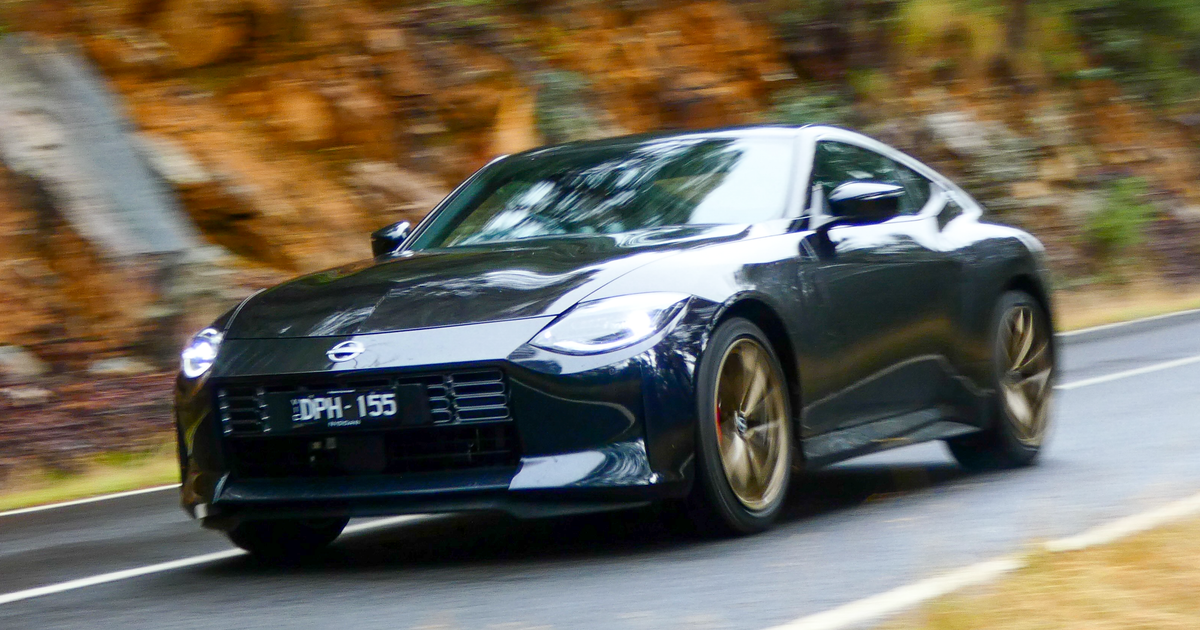
Finished in colour-shifting Midnight Purple paint, this runout special taps into two streams of Nissan nostalgia.
First and foremost, it celebrates seven generations of the Z spanning nearly six decades.
Simultaneously, the Heritage borrows a hero colour made famous by the Skyline GT-R – a performance icon, particularly Down Under. It looks magnificent, too, even if this interpretation of Midnight Purple is less striking than some that came before it.
Supply is extremely limited, with just 10 examples to be sold in Australia.
Should you be hassling your nearest Nissan dealer for an allocation? Read on to find out.
How much does the Nissan Z cost?
Priced at $77,410 before on-road costs, the Heritage Edition commands just a $1250 premium over the pre-update Z on which it’s based.
| Model | Price before on-roads |
|---|---|
| 2026 Nissan Z | $76,160 |
| 2026 Nissan Z Heritage Edition | $77,410 |
| 2026 Nissan Z Nismo | $94,065 |
The table above relates to the pre-facelift Z, which is set to be superseded by an updated range next month.
From September, the standard Z will start at $76,800 before on-roads, an increase of $640. The MY27 Nismo – now available with a manual transmission – is listed at $95,000 plus ORCs, up $395.
As before, the price is the same regardless of whether you specify the six-speed manual or nine-speed automatic.
Key changes for the 2027 Z include a revised front bumper and grille design, as well as a new design for the 19-inch alloy wheels. Updated Nismo monotube dampers also claim to improve handling and ride comfort for the Z.
New for the updated range is the Unryu Green hero exterior paint, while returning to the options list is Boulder Grey with a contrasting black roof.
Inside, all models get a new wireless phone charger, while the standard Z Coupe is available with a tan interior as a no-cost option.
Rounding out the enhancements are a frameless auto-dimming rear-view mirror, as well as a new start-up animation in the instrument cluster and a new key design.
To see how the Nissan Z lines up against the competition, check out our comparison tool
What is the Nissan Z like on the inside?
Is it possible for the interior of a new car to go from dated to retro-cool within a matter of years? If so, I’d argue that’s exactly what’s happened with the Z.
When the latest Z was first launched back in 2022, many criticised its heavy recycling of components including switches, dials and door handles (not to mention its rear-wheel drive Nissan FM platform that dates back to 2001) from the 350Z and 370Z, the use of which made the new car feel like a bit of a parts bin special.
However, those very bits now carry the sweet smell of nostalgia, giving the Z an old-school feel that sets it apart from rivals.
And more broadly, the cabin is the antithesis of everything that’s wrong with new cars today. It features screens, but isn’t dominated by them, and all the key controls are right where you expect them to be, including a traditional trio of rotary dials for climate adjustments.
So, if you’re thinking of upgrading from just about any sports car built this century, there’s little to learn.
There aren’t really any physical barriers to owning a Z, either, as it feels far more roomy inside than the now-defunct Toyota Supra, not to mention the diminutive Mazda MX-5.
Ford’s Mustang is more comparable in this regard, and has the Nissan beat for comfort. That’s because while the driver’s seat in the standard Z is generously adjustable, it’s still a tight squeeze for wider types like myself.
At the same time, I found myself being thrown around a bit during spirited driving, which suggests there isn’t quite enough lateral support.
For that reason, the manually-adjustable Recaro buckets fitted to the Nismo are a massive upgrade.
It’s hard to fault the ergonomics, though. The Z lets you sit nice and low, there’s plenty of steering wheel reach and tilt adjustment, and the manual shifter falls naturally to hand.
Decent materials ensure the key touch points are pleasant to interact with, too. The steering wheel and gear shift knob are finished in smooth synthetic leather that feels premium enough for the price tag, while the seats feature suede centre panels for visual variety and extra grip.
Indeed, both materials feature heavily throughout the cabin – including where your knees naturally rest – further justifying Z values.
Having said that, there’s nothing inside to set the Heritage Edition apart from a standard Z. No plaque, no embroidery, no purple stitching… nothing. I’d feel shortchanged as a customer, and the interior could really use a splash of colour.
Good thing there are some interesting design elements, then. Three analogue gauges displaying boost pressure, turbocharger speed and battery voltage sit proudly atop the dash, paying homage to the original Datsun 240Z, while circular air vents are uniquely integrated into each door card. Several Z badges are dotted around the place, bolstering an already strong sense of identity.
All serve as a welcome distraction from the infotainment technology, which is average… at best. The central 8.0-inch touchscreen is dated in just about every way, with ordinary graphics, slow software, and no built-in satellite navigation or connected services. The reversing camera is a bit of a relic, too.
Smartphone mirroring is there to save you from the native interface, but it still requires a wired connection – another reminder that those in the market for an everyday sports car might be better off buying a Mustang.
The large digital instrument display fares better, helping to modernise the cabin with crisp visuals and several layouts. In its default setting, though, it looks much like what you’ll find in mainstream Nissan SUVs such as the X-Trail and Qashqai. Switching into the Sport display brings up a central tachometer and useful temperature readouts for spirited driving, but I’d still happily trade the second screen for a set of analogue gauges.
No need to trade the eight-speaker Bose sound system though, as it makes up for a lack of pure oomph with impressive clarity.
It’s also hard to fault the cabin storage available. There’s a useful compartment beneath the centre armrest, a phone-sized tray at the base of the centre stack, and a proper glovebox.
Drinks are best kept in the door bins, as the cupholder situation is unconvincing. One is hidden beneath the armrest lid, while the other is positioned far enough forward that taller containers can interfere with gearshifts.
More usefully, there are carpeted storage areas behind both seats, each large enough for a backpack.
Best that be the case, because rear cargo capacity is in short supply.
Accessing the space is simple enough, given the Z’s practical liftback design, although the storage area itself is shallow, not especially deep, and pinched by the rear wheel-arches.
Sure, there’s enough room for a single suitcase or a handful of soft duffle bags, but the Mustang, BMW 2 Series and Honda Prelude are better companions for a weekend away.
That’s especially true considering the Z doesn’t offer a second row of seating. Then again, it’s a driver’s car, first and foremost.
| Dimensions | Nissan Z Heritage |
|---|---|
| Length | 4380mm |
| Width | 1845mm |
| Height | 1315mm |
| Wheelbase | 2550mm |
| Cargo capacity | 241L |
To see how the Nissan Z lines up against the competition, check out our comparison tool
What’s under the bonnet?
All versions of the Z are powered by a 3.0-litre twin-turbo petrol V6, with drive sent to the rear wheels through either a nine-speed automatic transmission or, in this case, a six-speed manual.
| Specifications | Nissan Z |
|---|---|
| Engine | 3.0L V6 twin-turbo petrol |
| Power | 298kW @ 6400rpm |
| Torque | 475Nm @ 1600-5600rpm |
| Transmission | 6-speed manual |
| Drive type | Rear-wheel drive |
| 0-100km/h (claimed) | 4.5 seconds |
| Weight | 1600kg |
| Fuel economy (claimed) | 10.8L/100km |
| Fuel economy (as tested) | 12.3L/100km |
| Fuel tank capacity | 62L |
| Fuel requirement | 95-octane premium unleaded |
| CO2 emissions | 250g/km |
| Emissions standard | Euro 5 |
In its base tune, the boosty six produces 298kW of power and 475Nm of torque, while the Nismo flagship ups outputs to 309kW and 520Nm.
As previously mentioned, the 2027 Nissan Z range will be headlined by a new Nismo manual flagship featuring a “short-stroke, six-speed gearbox with an exclusively tuned drive mode”.
To see how the Nissan Z lines up against the competition, check out our comparison tool
How does the Nissan Z drive?
Like an ice-cold beverage on a sweltering summer’s day, the Z is wonderfully refreshing.
Ready to buy? We’ll help you get a great deal.
If this is the car for you, we’ll compare offers from trusted dealers, handle the back and forth and manage your purchase from enquiry to delivery.
Refreshing in the sense that it’s simple and stripped-back, free of all the fluff that dilutes most modern sports cars.
Drive modes? Who needs them. In the Z, your hands and feet alone set the tone.
And sure, there’s the option of an automatic transmission, but this Heritage feels made for the six-speed manual. After all, there’s no better way to celebrate the past than by shifting gears yourself.
Doing so is a novelty in 2026, yet the connection it builds between car and driver is irreplaceable, even if the shift action itself isn’t especially slick.
Throws are relatively long, there’s some uncertainty between second and third, and the gearbox generally responds best to a slightly ham-fisted approach.
The clutch, at least, is easier to negotiate thanks to its predictable bite point and approachable weighting.
Automatic rev-matching is one of the manual Z’s few driver aids, neatly blipping the throttle on downshifts. Purists can switch it off, but it makes the gearbox easier to master.
And it’s worth mastering, given the performance payoff.
Under throttle, the Z is an absolute weapon. All 475Nm of torque arrives from just 1600rpm, catapulting you towards the horizon with authority, and there’s plenty of mid-range shove to sustain the rage.
So much, in fact, that short-shifting is a strong play. Stay patient, though, and the boost keeps building towards a 7000rpm redline – a thrill that’s only worth chasing up to second gear if you value your licence.
Just don’t expect much aural reward, as the biggest drawback of Nissan’s twin-turbo V6 is the noise it makes – or really, the lack thereof.
The Z Heritage is quiet inside and out, with a vacuum cleaner-like engine note and a reserved exhaust sound that stubbornly refuses to burble, pop or crack.
Most of what you do hear from the driver’s seat is actually artificial in nature, shamelessly piped into the cabin through the speakers.
Fitment of the fruitier Z Nismo exhaust would add some much-needed theatre, albeit at the expense of cruising refinement.
That’s an important caveat, because the Heritage does a convincing impression of a grand tourer when you’re not driving it hard.
Road noise is kept under control at highway speeds, while adaptive cruise control (minus lane-centring) is on hand to take some of the strain out of less exciting stints behind the wheel.
The Z rides well for such a sporty-looking thing, too, despite sitting on a fairly serious chassis setup comprising passive double-wishbone front and multi-link rear suspension, 19-inch forged wheels, and staggered Bridgestone Potenza S007 rubber measuring 255/40 up front and 275/35 at the rear.
It can be fidgety over imperfect surfaces, but there’s enough compliance to take the sting out of sharp bumps and potholes. More broadly, the Z just feels more substantial and settled on the road than a Toyota GR86/Subaru BRZ.
The newer Honda Prelude still has the edge for outright comfort though, helped by its adaptive dampers. A Mustang GT can also be optioned with MagneRide.
But that’s swiftly forgotten once you find a twisty stretch of tarmac. Because while the Z isn’t always an easy car to drive fast, it’s comfortably among the most fun.
Its weight and width alone dictate that narrow country roads – such as Victoria’s Reefton Spur, pictured here throughout – pose a greater test than if you were driving an MX-5. Just ask the lane-keep assist.
However, the Z still changes direction with surprising enthusiasm. The steering is light – even by segment standards – and relatively short on feedback, but the front-end responds promptly to driver requests. And while there’s some body roll through faster bends, the Z remains tighter and more eager than a ‘Stang.
At the same time, it’s equally sensitive to provocation. With 475Nm being sent exclusively to the rear wheels, hard throttle inputs can overwhelm the tyres in first and second gears. That’s in the dry; wet conditions demand considerably more restraint.
Traction control steps in quickly to prevent wild oversteer, but there’s no doubting the Z’s ability to get sideways. In a controlled environment, of course.
Strong brakes help to keep things civilised, a firm pedal providing reassuring stopping power when you need to rein everything back in.
Nevertheless, the Z demands the driver’s full attention at all times, plus a degree of skill – qualities that set it apart from so many modern performance cars designed to flatter rather than challenge.
To see how the Nissan Z lines up against the competition, check out our comparison tool
What do you get?
A fresh lick of paint and bronze alloys are all that distinguishes the Heritage from a standard Z.
2026 Nissan Z equipment highlights:
- Mechanical limited-slip differential
- Launch control
- 19-inch alloy wheels
- Tyre pressure monitoring
- Automatic LED headlights
- Automatic high-beam
- 12.3-inch digital instrument cluster
- 8.0-inch touchscreen infotainment system
- Wired Android Auto and Apple CarPlay
- 1 x USB-A outlet
- 1 x USB-C outlet
- 8-speaker Bose sound system
- Heated seats
- 4-way power-adjustable front seats
- Leather-accented upholstery
- Leather-wrapped steering wheel
- Tilt and telescopic steering wheel adjustment
- Active Noise Control
- Active Sound Enhancement
Nissan Z Heritage adds:
- Midnight Purple paint
- RAYS 19-inch bronze forged alloy wheels
Nissan Z Nismo adds (over standard Z):
- Nismo exterior and interior styling enhancements
- Larger front brake rotors (+25mm)
- Gloss-black Rays 19-inch wheels
- Dunlop SP Sport Maxx GT600 tyres
- Enhanced engine cooling
- Sport+ drive mode
- Nismo-tuned Launch Control
- Nismo-tuned Active Sound Control
- Nismo leather and Alcantara Recaro seats
-
- Removes heating
- Removes power adjustment
- Leather and Alcantara-wrapped steering wheel
To see how the Nissan Z lines up against the competition, check out our comparison tool
Is the Nissan Z safe?
The Nissan Z hasn’t been tested by ANCAP or Euro NCAP.
Standard safety equipment includes:
- AEB with pedestrian detection
- Adaptive cruise control
- Blind-spot monitoring
- Lane departure warning
- Rear cross-traffic alert
- Driver attention alert
- Traffic sign recognition
- Front and rear parking sensors
- Reversing camera
To see how the Nissan Z lines up against the competition, check out our comparison tool
How much does the Nissan Z cost to run?
The Z boasts the longest warranty of any new sports car in Australia, provided it’s serviced within the Nissan dealer network.
| Servicing and Warranty | Nissan Z |
|---|---|
| Warranty | Up to 10 years or 300,000km (service-activated) |
| Roadside assistance | 5 years |
| Service intervals | 12 months or 10,000km |
| Capped-price servicing | 5 years, $499 per service |
| Total capped-price service cost | $2495 |
Annual maintenance is capped at a reasonable $499 per visit for the first five years, so it’s hardly like Nissan is using the temptation of an extended warranty to gouge customers, either.
Having said that, a five-year service pack for the Mustang EcoBoost costs just $1290. The four-cylinder Ford will be better on fuel, too.
To see how the Nissan Z lines up against the competition, check out our comparison tool
CarExpert’s Take on the Nissan Z Heritage
Get one while you can… if you can.
The ultra-limited Z Heritage is a fitting, sensibly priced tribute to Nissan’s greatest hits, and one of the last surviving analogue sports cars.
Objectively, as my ‘Good’ rating implies, it’s not perfect. You can look to any of the engine, gearbox or interior for reasons why.
However, with the Toyota Supra out of the picture, the Z doesn’t need to be. It just needs to exist, providing passionate drivers with a Japanese-flavoured alternative to America’s Mustang and pricier European coupes.
Can’t snap up a Heritage? Don’t sweat it, an updated Z in Unryu Green with a tan interior is one helluva consolation prize.
Interested in buying a Nissan Z? Let CarExpert find you the best deal here
Click the images for the full gallery
