

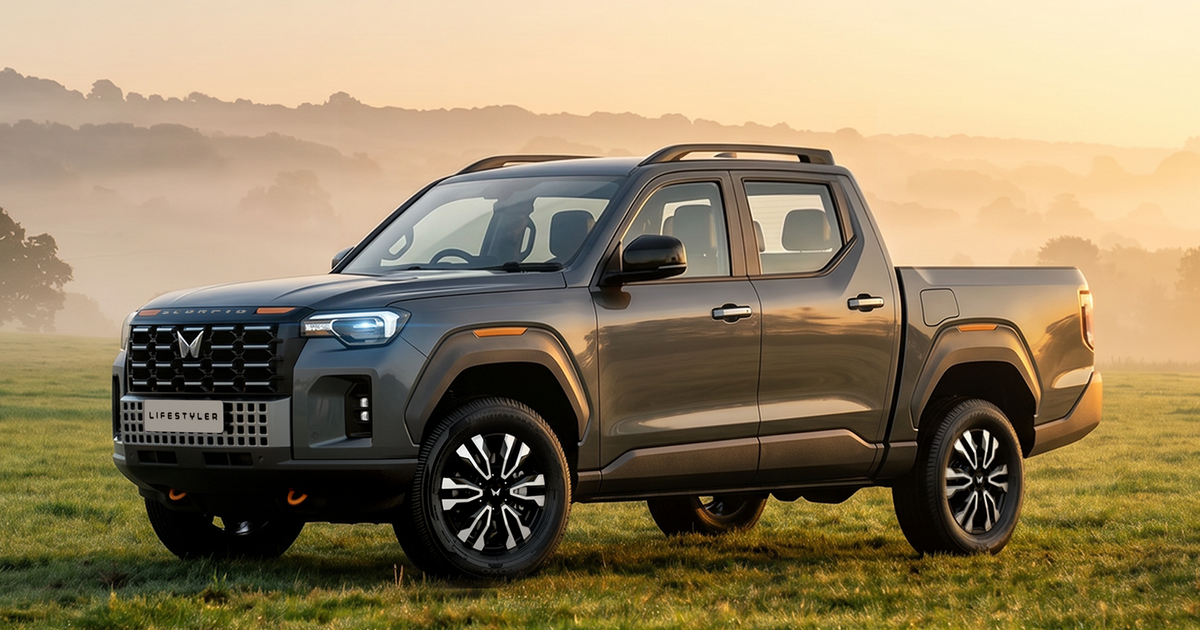

Mahindra has taken the covers off one of its most important new vehicles – the new Mahindra Lifestyler ute – at a massive event in Mumbai, India.
Instead of being a direct replacement for the PikUp work truck, which built a reputation for unrelenting reliability and ruggedness, the Lifestyler instead offers a completely different proposition, being based on the Scorpio SUV (or Scorpio-N, in its home country of India).
The Lifestyler and Scorpio use Mahindra’s new-generation ladder-frame chassis platform, meaning you can expect the new ute to be up for it, with leaf springs and a live rear axle evident at the launch event.
Mahindra didn’t reveal much information on the Lifestyler at the event, and would only confirm to Australian media that it will be called the Lifestyler in our market (not the Scorpio Lifestyler, as in India) and that it will arrive in 2027.

As for the full specs and details, the brand has insinuated it will offer a drip-feed approach about the vehicle, with no information revealed yet on dimensions or capacities, not to mention powertrain options and outputs.
However, Mahindra previously confirmed the 2.2-litre turbo-diesel four-cylinder engine in the Scorpio would feature, but with a torque bump to 450Nm. It is likely that the brand will offer a six-speed manual for some markets, alongside a six-speed auto.
A turbo petrol is also being reported as an option in some markets, though it’s unclear if this will come to Australia.
It’s also unclear whether there’ll be an electrified powertrain of some sort, such as a hybrid.
As with the Scorpio, the Lifestyler features Mahindra’s 4XPlor selectable four-wheel drive system with low-range and shift-on-the-fly capability, not to mention numerous drive modes including Snow, Mud, Sand, Ruts and Normal.
The existing PikUp – which was discontinued in early 2025 – was a success in many developing markets around the world, and in Australia it developed a HiLux-rivalling reputation for reliability.
It was also based on a ladder-frame chassis with leaf-spring rear suspension, and used a less powerful older-generation MHawk diesel engine with the choice of manual and auto gearboxes.
The last model started from just $37,990 drive-away as a dual-cab/chassis, and from $38,500 as a pickup. It’s expected the new model – being based on the Scorpio SUV – will see a substantial price increase. The seven-seat SUV range opens at $43,990 drive-away.
In India, the Scorpio Lifestyler is slated to kick off from less than INR 19.79 lakh, or approximately A$29,300.
You could expect that to increase by about 25-35 per cent, meaning a potential – unconfirmed – start price below $40,000 in Australia.
If that were the case it would be squarely competing with budget utes like the JAC T9, GWM Cannon and LDV T60, all of which come from China.
CarExpert had published images of the close-to-production concept model three years ago, but there have been some noticeable changes made that give the production version a more angular and arguably more aggressive look.
The front end includes reworked headlights and a different grille treatment, and at the rear you can see there are C-shaped tail-lights with the on-trend tailgate with massive ‘mahindra’ (yes, lower-case) branding applied.
That branding continues into the tub area, which includes a liner and tie-down points, and while the brand hasn’t confirmed specifications, it has stated that it wants to meet the market in the ute segment – so a pallet-friendly cargo space with more than 1165mm of space between the wheel-arches seems likely.
The bumpers are boldly squared off with a low step point at the rear, and while the vehicle shown at the event is the popular double-cab body style, imagery from India has suggested the brand will continue to offer a single-cab model as well.
What is evident from the side profile, though, is the rear door appears to be smaller than some other dual-cab utes, with a pronounced glasshouse kick towards the rear. Side steps and alloy wheels with all-terrain tyres also feature, depending on the grade, as well as roof rails for additional practicality.
At the Mumbai event, Mahindra showcased three distinct themes for its new ute, all of which have a distinct connection to vital export markets like Australia and South Africa.
The Reef Edition is all about the surfer lifestyle, with roof rails and a focus on not just the ‘payload’ but also what Mahindra dubs the ‘playload’.
The Trail Edition showed off sturdy rock-bashing side steps, a slimline snorkel and the classic tan paint finish that’ll help it stay inconspicuous in the desert.
Finally, the Valley Edition is aimed to bring a level of sophistication to the ute segment, with distinct design elements and a focus on rural and regional businesspeople.
Unlike its Scorpio sibling, the new Lifestyler scores a completely reworked dashboard and interior design, including a massive portrait-style centre display, similar to the Ford Ranger and Volkswagen Amarok.
Sadly, at the event, the brand decided not to allow the media to access the cabins of the new vehicle, but did showcase the interior design on the big screens for all to see.
What is clear is that Mahindra wanted to make this not just a ute with a big screen, but a cabin that meets the market requirements for tech and usability.
It has a row of physical air-conditioning controls below the display, and a portion of the screen can be used for climate and interior function management, while the top part is available for smartphone mirroring tech and mapping.
There are physical controls between the seats, including for off-road mode selection and the electronic park brake. There’s also a conventional transmission shifter.
The driver has a digital instrument cluster with a centre trip readout flanked by a tachometer and speedometer, and the new-design steering wheel incorporates an array of buttons and switches for media and driving controls.
More information and details are still to be confirmed for the Mahindra Lifestyler in Australia, so stay tuned.
