



TL;DR
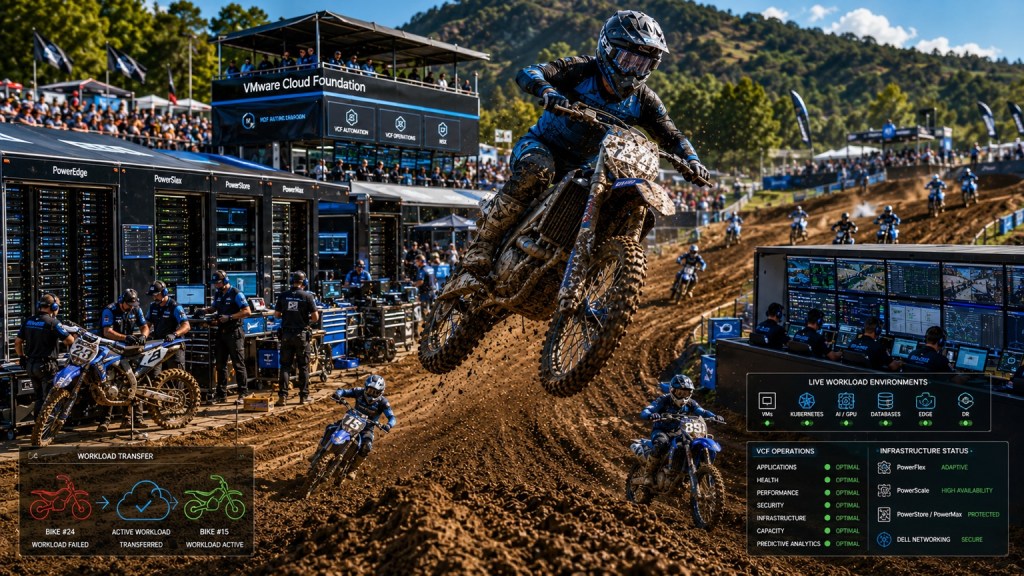
The motocross image captures an important VMware Cloud Foundation principle: private cloud speed does not come from making one infrastructure component faster. It comes from coordinating compute, storage, networking, automation, lifecycle management, security, observability, and workload mobility as one operating system.
VCF Operations acts like race control, VCF Automation becomes the service and provisioning layer, NSX defines the track boundaries, and the underlying Dell infrastructure provides specialized capacity for different workload demands. The workload may be the rider everyone sees, but the platform team, policies, telemetry, and recovery procedures determine whether it finishes the race.
The practical lesson is straightforward. Workload mobility is not a trick performed during an emergency. It is the visible result of architecture decisions, operational readiness, compatibility validation, and rehearsed execution.
Introduction
The most obvious subject in the image is the motocross rider flying over the track.
The more important subject is everything happening around the rider.
Engineers are monitoring infrastructure. Storage systems are supporting different data paths. A platform control tower is tracking health and capacity. Other riders are moving through separate workload lanes. The environment is busy, but it is not uncontrolled.
That is a useful mental model for VMware Cloud Foundation.
VCF is positioned as a private cloud platform that brings compute, storage, networking, security, management, and automation into a coordinated architecture. The value is not simply that these capabilities exist in the same product portfolio. The value comes from using them through a consistent operating model.
The image should not be interpreted as a literal reference architecture. A motorcycle cannot represent every dependency inside a production workload, and a pit lane cannot show every identity, storage, network, or recovery boundary. What the image does well is expose the central operational question:
Can the platform change, recover, rebalance, and move workloads without losing governance?
Speed Is a Property of Coordination
Enterprise infrastructure teams often associate speed with provisioning.
How quickly can a virtual machine be deployed? How quickly can storage be presented? How quickly can a Kubernetes environment become available? How quickly can a host be patched?
Those measurements matter, but they only describe individual laps.
A private cloud operating model must also coordinate:
- capacity and placement
- network and security policy
- service entitlements
- lifecycle sequencing
- identity and access
- application dependencies
- observability and alert ownership
- workload migration
- recovery and rollback
- cost and consumption visibility
A fast provisioning workflow that bypasses network policy is not operationally fast. It is deferred rework.
A workload migration that completes but leaves monitoring, backup, firewall, or DNS dependencies behind is not mobility. It is a partially completed change.
A platform becomes faster when its teams can execute repeatable changes with known prerequisites, predictable controls, measurable outcomes, and tested fallback paths.
Translating the Racetrack into a VCF Mental Model
The visual elements map cleanly to several VCF architecture and operations concepts.
| Image element | VCF interpretation | Operational meaning |
|---|---|---|
| Motocross rider | Application or workload | The service the business actually consumes |
| Motorcycle | Runtime placement | The compute, network, storage, and accelerator resources supporting the workload |
| Track | Infrastructure and policy path | The approved route through clusters, networks, security zones, and services |
| Pit crew | Platform engineering and operations | Teams that maintain, tune, patch, recover, and change the platform |
| Race control | VCF Operations | Health, diagnostics, capacity, cost, lifecycle, and fleet visibility |
| Starting gate | VCF Automation | Controlled service consumption, provisioning, policy, and tenancy |
| Safety barriers | NSX and security controls | Segmentation, routing, firewalling, isolation, and controlled connectivity |
| Equipment bays | Dell infrastructure platforms | Compute, storage, networking, data services, and workload-specific capacity |
| Workload transfer display | Mobility workflow | A governed transition between valid source and target environments |
| Telemetry screens | Observability and evidence | Data used to determine whether the environment is healthy and changes succeeded |
The rider is important, but the rider cannot operate independently of the track, the machine, the pit crew, or race control.
The same is true for an application.
The Coordinated VCF Operating Model
VCF 9 introduced a fleet-oriented model that places VCF Operations and VCF Automation above one or more VCF instances. Individual instances still retain management domains, workload domains, vCenter Server environments, NSX components, clusters, hosts, and storage relationships. Centralization does not eliminate those boundaries. It creates a layer through which they can be governed more consistently.
The following diagram shows the coordination model the image is trying to communicate.
The important point is the feedback loop.
Automation expresses intent. Infrastructure provides resources. NSX enforces connectivity and segmentation. VCF Operations returns health, capacity, lifecycle, and diagnostic evidence. Platform teams then use that evidence to improve placement, policy, and future automation.
Without the feedback loop, automation becomes a ticket accelerator. With it, automation becomes part of a governed operating system.
VCF Operations Is Race Control
The command center in the image represents more than a collection of dashboards.
A mature operations layer should help answer questions such as:
- Is the service healthy from the consumer’s perspective?
- Which dependency is causing degradation?
- Does the target environment have sufficient capacity?
- Are certificates, credentials, binaries, and lifecycle dependencies ready?
- Is the proposed change increasing operational risk?
- Is resource consumption aligned with the service class?
- Did the migration or remediation produce the expected result?
- Who owns the next action?
VCF 9.1 expands the fleet-oriented operations model with centralized management capabilities, management services, lifecycle integration, capacity insights, diagnostics, and operational APIs. These capabilities can reduce the number of separate workflows an operator must navigate, but they do not remove the need for defined ownership and acceptance criteria.
A dashboard showing green indicators is useful.
A dashboard that connects service health to infrastructure dependencies, change history, capacity risk, policy compliance, and accountable owners is far more valuable.
Observability Must Lead to Action
Operational data should result in one of four outcomes:
- Accept: The service and infrastructure remain within defined thresholds.
- Investigate: Evidence suggests degradation, drift, or emerging risk.
- Optimize: Placement, sizing, policy, or resource allocation should change.
- Recover: The platform must execute a known remediation, rollback, migration, or recovery procedure.
If the organization collects telemetry but has not defined those decision paths, the control tower is observing the race rather than managing it.
VCF Automation Is the Controlled Starting Gate
VCF Automation represents the transition from infrastructure availability to governed consumption.
Application teams should not need to understand every host, datastore, VLAN, overlay, or lifecycle dependency. They should consume approved services that have already encoded the necessary constraints.
A useful service definition can include:
- workload type
- placement zone
- availability requirement
- network profile
- security policy
- storage class
- backup requirement
- lifecycle expectation
- cost center
- quota
- expiration or reclamation rules
- approval requirements
The goal is not to hide architecture. The goal is to make the correct architecture repeatable.
VCF Automation supports organizational and project boundaries that can separate tenants or lines of business while allowing controlled consumption of shared capacity. That model becomes particularly valuable when different application teams require different service classes without receiving unrestricted access to the underlying infrastructure.
Self-Service Without Guardrails Is Not Cloud
A catalog item that deploys a virtual machine is not automatically a private cloud service.
The service becomes operationally meaningful when it also handles identity, policy, placement, network connectivity, observability, protection, ownership, and retirement.
The difference is significant:

The second workflow takes more design work. It also prevents the accumulation of unmanaged resources that the operations team must later reverse-engineer.
NSX Defines the Track and Safety Boundaries
The dirt track in the image determines where riders can move, where they can overtake, and where they must slow down.
NSX plays a similar role in a VCF environment.
It provides the logical network and security structures that allow workloads to communicate while preserving segmentation and control. Depending on the architecture, those structures may include:
- overlay networks
- north-south routing
- east-west segmentation
- distributed firewall policy
- gateway services
- workload isolation
- tenant boundaries
- network services
- controlled connectivity between environments
Workload mobility is frequently described as a compute problem. In practice, network readiness is often one of the most consequential dependencies.
Moving compute state is only useful when the application can still reach DNS, identity services, databases, APIs, users, monitoring, backup, and required external systems. The network path and policy model must move with the workload, be recreated at the destination, or be deliberately changed as part of the migration.
A successful mobility plan therefore asks more than, “Can the virtual machine move?”
It asks, “Can the service continue operating inside the target security and connectivity model?”
Workload Mobility Is a Controlled Handoff
The image shows a workload transferring from one motorcycle to another while the race continues.
That is a powerful visual, but it can create an overly simple impression.
There is no single universal workload-transfer operation. The appropriate mechanism depends on the source and target environments, application state, network requirements, storage dependencies, outage tolerance, compatibility, and recovery objective.
Mobility may involve:
- local vMotion
- storage migration
- cross-environment migration
- VCF Operations HCX
- replication and planned cutover
- application-level data movement
- backup and restore
- disaster recovery orchestration
- redeployment from automation
- blue-green application transition
For VCF Operations HCX 9.1, deployment of the managers is only the beginning. Network profiles, compute profiles, site pairing, service mesh deployment, connectivity, and destination validation are part of the preparation required before workload migrations and network extensions can be used.
A realistic mobility workflow looks like this:
The migration tool is one box in the workflow.
Most migration failures originate in the boxes around it.
Dell Infrastructure Represents Specialized Pit Lanes
The image includes PowerEdge, PowerFlex, PowerStore, PowerMax, PowerScale, and Dell networking. That combination communicates infrastructure choice, but it should not be interpreted as though every product serves the same architectural role.
PowerEdge
PowerEdge servers provide the physical compute foundation on which ESX hosts and workload clusters can run. The relevant design decisions include processor compatibility, memory capacity, accelerator requirements, network adapters, firmware baselines, availability, and lifecycle alignment.
PowerFlex
PowerFlex provides software-defined storage capabilities that can support architectures requiring independent scaling and flexible infrastructure consumption. Its exact role must be checked against the applicable VCF version, Dell validated design, protocol, and workload-domain requirements.
PowerStore and PowerMax
PowerStore and PowerMax can provide external enterprise storage options for workloads requiring specific performance, availability, data-service, or operational characteristics. Dell documentation identifies validated VCF designs for these platforms, including principal or supplemental storage roles in supported scenarios.
PowerScale
PowerScale is primarily a scale-out platform for unstructured data. In a broader private cloud or AI architecture, it may support data sets, file services, analytics pipelines, protection workflows, or adjacent application requirements. It should not automatically be treated as interchangeable with block, vSAN, or validated principal-storage designs.
Dell Networking
Physical network design remains the substrate beneath NSX. Switching, routing, MTU consistency, redundancy, bandwidth, telemetry, failure domains, and operational ownership directly affect the behavior of the software-defined layers above them.
The broader lesson is that VCF does not eliminate infrastructure engineering.
It gives infrastructure engineering a consistent platform context.
The motorcycles in the image appear interchangeable. Enterprise workloads rarely are.
A database, AI training pipeline, edge service, general-purpose virtual machine, Kubernetes platform, and disaster recovery copy may all require different combinations of:
- latency
- throughput
- accelerator access
- storage protocol
- data protection
- recovery objectives
- security policy
- scale
- availability
- placement affinity
- operational support
That makes workload classification essential.
| Workload class | Primary design concern | Typical platform question |
|---|---|---|
| General enterprise VM | Reliability and predictable operations | Which standard service class provides the required availability? |
| Transactional database | Latency, consistency, and recovery | Does the target storage and network path meet the tested requirement? |
| Kubernetes platform | Policy, tenancy, and lifecycle | Who owns clusters, namespaces, upgrades, networking, and persistent data? |
| AI or GPU workload | Accelerator availability and data throughput | Can compute, storage, scheduling, and network capacity scale together? |
| Edge workload | Remote operations and constrained connectivity | Can the service remain supportable when central dependencies are unavailable? |
| Disaster recovery workload | Recoverability and evidence | Has the recovery sequence been tested against the stated RTO and RPO? |
A mature platform does not force every workload onto the same bike.
It provides a controlled fleet of service classes and makes the placement decision explicit.
When to Move a Workload and When to Repair in Place
Mobility is useful, but unnecessary movement adds risk.
The decision should be based on service outcomes rather than enthusiasm for the migration technology.
Migration should be selected when it resolves a defined problem, satisfies a business requirement, or reduces measurable risk.
It should not become the automatic response to every alert.
The Operating Model Behind the Image
A VCF platform needs more than product administrators. It needs coordinated capability ownership.
| Capability | Accountable role | Supporting roles |
|---|---|---|
| Fleet governance | Private cloud platform owner | Architecture, security, finance |
| VCF instance lifecycle | VCF instance owner | Virtualization, NSX, storage, hardware |
| Workload-domain operations | Domain owner | Application, network, storage teams |
| Service automation | Platform automation owner | Identity, security, application teams |
| Network and segmentation | NSX or network virtualization owner | Security, application owners |
| Observability and SLOs | Service operations owner | Platform and application teams |
| Workload mobility | Migration service owner | Network, storage, application, security |
| Recovery | Business service owner | Platform, backup, network, application teams |
| Hardware and firmware | Infrastructure owner | Vendor support, platform teams |
The exact team names will vary.
The ownership questions do not:
- Who approves the move?
- Who validates the destination?
- Who owns the application test?
- Who confirms security policy?
- Who decides whether rollback is required?
- Who retains the evidence?
- Who declares the service operational?
A platform that cannot answer those questions is not ready to operate at race pace.
Building the Platform in Practical Phases
The image presents the environment as complete. Real environments reach that state incrementally.
Establish the Foundation
Define the VCF topology, management boundaries, workload domains, physical dependencies, identity model, DNS, time services, certificates, network design, and supported storage architecture.
Do not begin with catalog items.
Begin with the operating boundaries that every catalog item must respect.
Define Workload Service Classes
Create a manageable set of service classes based on real workload requirements.
Each class should specify:
- availability
- placement
- network and security
- storage
- protection
- monitoring
- ownership
- lifecycle
- cost allocation
Avoid creating a unique infrastructure pattern for every application team.
Build the Observability Model
Define service health before building more dashboards.
Connect platform metrics to consumer outcomes, dependency health, capacity thresholds, and accountable owners.
A useful alert should explain what is affected, why it matters, who owns it, and what action is expected.
Automate the Complete Lifecycle
Automate provisioning, but also address:
- registration
- monitoring
- backup
- policy attachment
- tagging
- cost attribution
- expiration
- change
- recovery
- retirement
The end of a deployment workflow should be the beginning of an operational lifecycle.
Create Defined Mobility Lanes
Document which migration tools apply to which source and target combinations.
For each lane, define:
- prerequisites
- supported versions
- network requirements
- storage requirements
- migration method
- validation
- rollback
- ownership
- evidence retention
A generic instruction to “use HCX” is not a migration service definition.
Rehearse Failure
Test the platform when conditions are imperfect:
- unavailable target capacity
- failed network extension
- DNS inconsistency
- expired certificate
- incompatible host or storage configuration
- incomplete monitoring
- application validation failure
- rollback during a maintenance window
The real measure of the platform is not whether the ideal workflow succeeds.
It is whether the team can recognize and control a failed workflow.
Operational Metrics That Matter
The image contains green status indicators, but a production scorecard needs measurements that show more than current component health.
Consider tracking:
| Metric | What it reveals |
|---|---|
| Service provisioning lead time | How quickly an approved service becomes usable |
| Change failure rate | Whether operational velocity is creating instability |
| Placement-policy compliance | Whether workloads remain in approved environments |
| Capacity forecast accuracy | Whether expansion and optimization decisions are evidence-based |
| Migration success rate | Whether mobility workflows are repeatable |
| Rollback readiness | Whether fallback is tested rather than assumed |
| Mean time to identify dependency | Whether observability supports diagnosis |
| Certificate and credential exposure | Whether lifecycle dependencies are being controlled |
| Idle resource reclamation | Whether automation includes retirement |
| Recovery-test completion | Whether resilience claims are supported by evidence |
The goal is not to collect every possible metric.
The goal is to measure whether the private cloud can deliver controlled change without degrading service reliability.
Caveats the Image Cannot Show
The racetrack metaphor is useful, but several production realities must remain visible.
Integration Does Not Mean Automatic Compatibility
VCF, server, storage, networking, firmware, drivers, and optional components have version-specific support boundaries. Validate the applicable Broadcom and Dell documentation before treating a conceptual design as deployable.
Mobility Does Not Eliminate Application Testing
A successful infrastructure migration does not prove that an application is healthy. Application owners must validate transactions, dependencies, performance, security, data integrity, and user access.
Centralized Operations Do Not Remove Local Ownership
Fleet-level visibility improves coordination, but individual VCF instances, workload domains, clusters, networks, and applications still require accountable owners.
Automation Can Reproduce Bad Design Faster
A flawed service definition becomes more dangerous when it can be deployed hundreds of times. Templates, policies, and catalog items require architecture review, version control, testing, and an exception process.
Green Dashboards Are Not Recovery Evidence
Health status describes the current observation. Recovery confidence comes from tested procedures, validated dependencies, documented ownership, and retained results.
Conclusion
The motocross image works because it presents VMware Cloud Foundation as a coordinated operating environment rather than a stack of unrelated products.
The rider represents the workload, but the workload is only successful when compute, storage, networking, security, automation, operations, lifecycle management, and organizational ownership work together. VCF Operations provides the control tower. VCF Automation creates the governed starting gate. NSX defines the approved track. Dell infrastructure provides specialized physical and data capabilities beneath the software-defined platform.
The most important lesson is that workload mobility is an outcome, not a starting point. Before a workload can move safely, the organization must understand its dependencies, validate the target, select the correct migration method, preserve policy, measure success, and maintain a tested fallback.
That is what operating at race pace should mean in a private cloud: not moving recklessly, but executing complex changes quickly because the architecture, controls, telemetry, and teams are prepared.
