



TL;DR
AI gateways are becoming the control point between enterprise applications, AI agents, model providers, tool servers, and internal APIs. They are not just API gateways with a new label. A useful AI gateway has to handle identity, model routing, token controls, prompt and response governance, observability, cost visibility, retries, fallback, and tool access policy.
The practical lesson is simple: if every team connects directly to every model and tool, enterprise AI becomes ungovernable fast. The gateway gives architects and operators a place to enforce policy without forcing every development team to solve identity, logging, cost control, and provider abstraction from scratch.
This first article defines the AI gateway mental model. The next article will go deeper into the operating model: identity, policy, observability, cost management, and ownership.
Introduction
Enterprise AI adoption usually starts with a simple pattern: an application calls a model API. That pattern works for experiments, demos, and isolated internal tools. It breaks down when multiple teams start building copilots, agents, retrieval workflows, automation chains, and model-backed services across the business.
The problem is not only the model. The problem is the traffic pattern around the model.
Once AI usage spreads, architects have to answer harder questions. Which users are allowed to call which model? Which agents can use which tools? How are prompts and responses logged without leaking sensitive data? What happens when a provider throttles requests? How do teams compare token spend by application, department, environment, or workflow? How do operators route requests across multiple model providers without rewriting every application?
That is where the AI gateway becomes important. It gives the enterprise a governed control point between consumers and AI backends. It does not remove the need for good application design, responsible AI governance, or secure data architecture. It gives those concerns a practical enforcement point.
Why AI Gateways Matter Now
Traditional API gateways were designed around predictable service calls. They manage traffic, authentication, routing, rate limits, transformations, observability, and policy enforcement for APIs. AI traffic keeps many of those same needs, but it adds new ones.
A model request may include sensitive business context, user intent, retrieved documents, tool definitions, conversation history, and instructions that influence downstream behavior. A response may contain generated content, structured JSON, tool-call arguments, or a recommendation that triggers another workflow. An agent may not only answer a question; it may decide which tool to invoke next.
That changes the role of the gateway. It is no longer just a reverse proxy for application traffic. It becomes part of the enterprise AI control plane.
Modern AI gateway patterns are emerging across cloud platforms, API management products, edge networks, open-source gateways, and agent platforms. Some focus on LLM traffic, caching, routing, retries, and token analytics. Some extend API management into model and agent governance. Some focus on MCP-style tool exposure so agents can discover and invoke enterprise capabilities in a more controlled way.
The common thread is this: AI needs a governed boundary before it becomes another unmanaged integration sprawl.
The Core AI Gateway Pattern
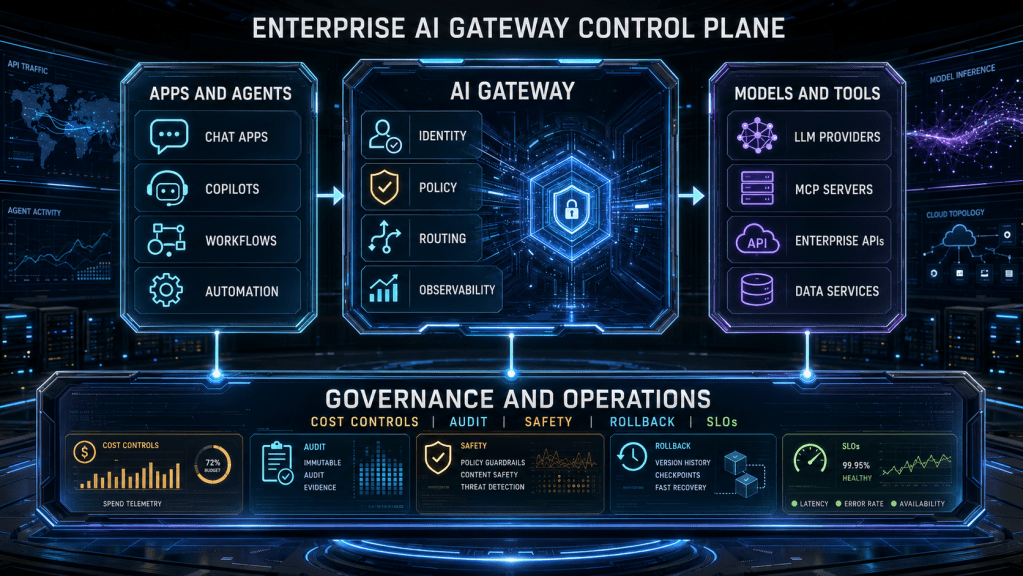
The easiest way to understand an AI gateway is to place it between three groups: consumers, AI backends, and enterprise systems.
Consumers include applications, copilots, agents, scripts, workflows, and automation platforms. AI backends include hosted LLMs, private models, embedding services, image models, speech models, and inference endpoints. Enterprise systems include APIs, data platforms, ticketing systems, SaaS platforms, identity providers, monitoring tools, and workflow engines.
The gateway becomes the place where those interactions are normalized, governed, and observed.

What matters in this diagram is the separation of responsibility. Applications should not need to carry every policy decision locally. Model providers should not become the only place where usage visibility exists. Tool servers should not be exposed to every agent without mediation. The gateway provides a place to enforce consistency across teams.
What Makes an AI Gateway Different From a Normal API Gateway
It is tempting to describe an AI gateway as an API gateway for LLMs. That is partly true, but incomplete.
A normal API gateway usually deals with deterministic request and response flows. An AI gateway has to deal with variable cost, variable output, variable latency, model-specific schemas, tool invocation, streaming responses, prompt injection risk, and context handling. It also needs to understand that the request payload itself may be sensitive and operationally meaningful.
| Capability Area | Traditional API Gateway | AI Gateway Requirement |
|---|---|---|
| Authentication | Validate clients, users, tokens, and service identities | Validate users, apps, agents, model access, and tool access |
| Routing | Route by path, host, method, version, or policy | Route by model, task, cost profile, latency need, region, or fallback policy |
| Rate limiting | Limit requests, connections, or bandwidth | Limit requests, tokens, model calls, tool calls, and spend exposure |
| Observability | Track status codes, latency, throughput, and errors | Track tokens, prompts, responses, model latency, cost, retries, safety events, and tool calls |
| Transformation | Rewrite headers, URLs, payloads, or protocols | Normalize model APIs, redact fields, inject system controls, or structure responses |
| Governance | Enforce API access and usage policy | Enforce model usage, prompt policy, data handling, tool permissions, and audit requirements |
| Resilience | Retry, timeout, circuit break, fail over | Retry model calls, fallback to alternate models, degrade gracefully, and preserve user experience |
The difference is not cosmetic. AI traffic carries business meaning and financial impact inside the payload. A poorly governed endpoint can become a cost leak, a data leak, a reliability problem, or an unsafe automation path.
The Gateway Is Not the Whole AI Control Plane
A gateway is important, but it should not be confused with the entire control plane.
The gateway sits in the traffic path. It can enforce policies, route requests, collect telemetry, manage quotas, and shape request behavior. It cannot replace model evaluation, data governance, application design, human approval workflows, secure software delivery, or incident response.
A better enterprise model is to treat the gateway as one enforcement layer inside a broader AI control plane.
This distinction matters because many organizations buy or build a gateway and then expect it to solve every AI governance problem. That is not realistic. The gateway is where many controls are enforced, but the policies, identities, approvals, and operating procedures still have to come from somewhere.
The Main AI Gateway Capabilities That Matter
An AI gateway should be evaluated by the control problems it solves, not by whether the product page uses the phrase AI gateway.
Identity and Access Control
The first question is who or what is making the request. Is it a human user, a service account, an agent runtime, a scheduled workflow, a developer tool, or another system? Once that identity is known, the gateway should help enforce which models, deployments, tools, and routes that caller can use.
For enterprise AI, identity should not stop at the application. A generic application API key shared across every user gives the organization weak visibility and weak accountability. Mature designs preserve useful user, application, tenant, department, environment, and workload context in the request path.
Model Routing and Provider Abstraction
Teams should not hardcode every model provider, endpoint, and fallback behavior directly into application code. That creates brittle integrations and makes provider changes expensive.
An AI gateway can route traffic by policy. A low-risk summarization request may use one model. A sensitive workflow may require a private model or a specific region. A latency-sensitive chat flow may use a faster model by default and fall back when the provider is degraded. A cost-sensitive batch job may use a cheaper model with stricter quota limits.
The gateway does not remove the need to test model quality. It gives the platform team a place to apply routing decisions consistently.
Token, Quota, and Cost Controls
AI cost behaves differently from normal API cost. Request count alone is not enough. A small number of large prompts can create more cost than many short requests. Tool-heavy agents can multiply calls across planning, retrieval, execution, and verification steps.
A useful AI gateway should make token usage and cost visible by application, user group, route, environment, model, and workflow where possible. It should support quotas and rate limits that reflect AI consumption, not only HTTP traffic.
Prompt and Response Governance
Gateway-level prompt governance should be treated carefully. The goal is not to turn the gateway into a magical safety layer that fixes poor application design. The goal is to enforce baseline controls consistently.
Examples include redacting known sensitive fields, blocking disallowed payload patterns, requiring approved system instruction templates for certain routes, logging policy events, or applying content safety controls before a response reaches a user or downstream workflow.
The gateway should not be the only place where safety exists, but it is a practical place to enforce shared controls.
Observability and Auditability
Enterprise AI needs visibility into more than uptime. Operators need to know model latency, token usage, error patterns, retry behavior, fallback frequency, provider throttling, cache hit rates, tool-call frequency, and policy decisions.
Security and governance teams need audit trails. Application teams need traces that show where failures happen. Finance teams need usage views that map AI consumption to owners. Without this visibility, AI adoption becomes a collection of disconnected black boxes.
Resilience and Fallback
AI services fail in familiar and unfamiliar ways. Providers throttle. Models change behavior. Latency spikes. Streaming responses break. Tool calls timeout. A model may return valid JSON most of the time until it does not.
An AI gateway can help with retries, timeouts, fallback models, circuit breaking, and traffic steering. The important caveat is that fallback must be tested. Switching models blindly can change output quality, safety behavior, schema adherence, and business logic.
A Practical Policy Example
The following simplified YAML shows the kind of policy thinking an enterprise AI gateway should support. This is not tied to one vendor. It is a conceptual pattern that architects can use to separate consumers, routes, models, and controls.
ai_gateway_policy:
  route: support-ticket-summarization
  consumers:
    allowed_applications:
      - service-desk-portal
      - operations-assistant
    allowed_environments:
      - production
      - staging

  identity:
    require_user_context: true
    require_application_identity: true
    block_shared_api_keys: true

  model_routing:
    default_model: enterprise-approved-summarizer
    fallback_model: enterprise-approved-fast-summarizer
    fallback_conditions:
      - provider_timeout
      - rate_limit
      - regional_degradation

  controls:
    max_input_tokens: 12000
    max_output_tokens: 1200
    redact_patterns:
      - employee_ssn
      - payment_card
      - secret_key
    require_system_prompt_template: support-summary-v3
    block_tool_calls: true

  observability:
    log_token_usage: true
    log_policy_decisions: true
    capture_latency_metrics: true
    retain_prompt_body: false
    retain_redacted_prompt_metadata: true

  ownership:
    business_owner: service-desk
    technical_owner: ai-platform-team
    security_reviewer: cyber-governance
The important part is not the syntax. The important part is the operating model behind it. A policy like this forces teams to answer ownership, identity, model selection, safety, observability, and retention questions before the workflow becomes production traffic.
Where AI Gateways Fit in the Enterprise Stack
Most enterprises will not have only one AI gateway pattern. They may have several, depending on platform choices and operating boundaries.
| Gateway Pattern | Best Fit | Watch Item |
|---|---|---|
| API management based AI gateway | Enterprises extending existing API governance into model and agent traffic | Avoid assuming traditional API policies fully cover AI-specific risks |
| Edge or network AI gateway | Teams needing fast onboarding, provider abstraction, caching, rate limiting, and centralized traffic visibility | Confirm data handling, retention, and enterprise identity integration |
| Kubernetes or Envoy based AI gateway | Platform teams building cloud-native AI infrastructure close to workloads | Requires strong platform engineering ownership and policy discipline |
| Agent tool gateway | Agent architectures that need controlled access to tools, APIs, and enterprise systems | Tool authorization, approval, audit, and blast-radius control become critical |
| Application embedded gateway pattern | Smaller environments or early-stage teams centralizing AI calls in a shared service | Can become a bottleneck if it lacks product ownership and operational maturity |
This is why the term AI gateway needs careful handling. One product may be strong at LLM routing and observability. Another may be stronger at API governance. Another may focus on exposing enterprise tools to agents. Another may fit cloud-native teams that want to manage AI traffic through Kubernetes-native infrastructure.
The right question is not, “Which gateway is best?” The better question is, “Which control point are we trying to create, and who will operate it?”
Decision Criteria for Architects
Before selecting or building an AI gateway, architects should define the decision criteria. A useful starting point is:
| Criterion | Why It Matters |
|---|---|
| Identity integration | Determines whether access can be tied to real users, apps, agents, and service owners |
| Model and provider support | Determines whether the gateway can support current and future model strategy |
| Token and cost visibility | Determines whether AI consumption can be governed financially |
| Policy enforcement | Determines whether safety, data, and usage rules can be applied consistently |
| Observability depth | Determines whether operators can troubleshoot and govern production traffic |
| Tool governance | Determines whether agents can safely interact with enterprise systems |
| Deployment model | Determines fit for cloud, hybrid, Kubernetes, edge, or on-premises environments |
| Failure handling | Determines whether retries, fallback, throttling, and degraded modes are manageable |
| Operational ownership | Determines whether the gateway becomes a product or another unmanaged shared component |
The most important criterion is usually ownership. A gateway without an operating team is just another unmanaged choke point.
Implementation Starting Point
The safest starting point is not to gateway every AI workload at once. Start with a production-relevant but bounded use case.
Good first candidates include summarization, internal knowledge assistance, support ticket classification, developer assistant routing, or retrieval workflows that call approved models through a controlled path. These use cases produce real traffic and real telemetry without immediately granting agents broad write access to enterprise systems.
A practical first phase should include:
- one or two approved application teams
- one production route and one non-production route
- one primary model and one tested fallback model
- identity propagation from the calling application
- token and cost logging
- redaction and retention rules
- a simple policy exception workflow
- an owner for gateway configuration and incident triage
That first phase should prove the operating pattern before expanding to agent tool access, multi-provider routing, or broad self-service onboarding.
Operational Implications
The AI gateway will likely sit between several teams. Application teams care about developer experience and reliability. Security teams care about data exposure, tool access, and auditability. Finance teams care about token spend and accountability. Platform teams care about deployment, scaling, configuration, and lifecycle. AI teams care about model quality, evaluation, and prompt behavior.
That means the gateway should be treated as a platform product. It needs documentation, onboarding standards, reference architectures, policy templates, dashboards, SLOs, support boundaries, and a change process.
A strong AI gateway program should answer these operational questions:
- Who can create a new AI route?
- Who approves access to a model?
- Who approves access to a tool?
- What logs are captured, redacted, and retained?
- Who reviews high-cost or unusual usage?
- What happens when a model provider is degraded?
- How are fallback models tested?
- What is the rollback plan when a policy breaks an application?
- How are gateway policies promoted from dev to test to production?
- How does the organization prove that controls are working?
Those questions matter more than the product label.
Conclusion
AI gateways are becoming a required enterprise architecture pattern because AI traffic is no longer just another API call. It carries context, cost, user intent, model behavior, tool access, and governance risk in ways that traditional application integration patterns were not designed to handle alone.
The gateway gives the enterprise a practical control point. It can centralize model routing, quota management, observability, policy enforcement, safety controls, retries, fallback, and tool access governance. But it only works when paired with a real operating model.
The right starting point is not to chase every AI gateway feature at once. Start by defining the control boundary, the first production use case, the policy owners, the observability requirements, and the cost accountability model. From there, the gateway can evolve from a traffic proxy into a durable part of the enterprise AI control plane.
The next article in this series will go deeper into the AI gateway operating model: identity, policy, observability, cost control, and ownership.
