



TL;DR
NSX is easiest to understand when it is viewed as an operating system for network connectivity and security rather than as a collection of virtual switches, routers, and firewalls. Segments connect workloads, Tier-0 and Tier-1 gateways establish routing and service boundaries, the Distributed Firewall enforces policy close to workloads, and telemetry provides the feedback needed to operate the environment.
The nervous-system metaphor is useful, but it must not be interpreted too literally. NSX Manager does not process every packet, gateways are not involved in every east-west flow, and telemetry does not automatically improve policy without governance, analysis, and controlled automation. A healthy NSX design depends on keeping the distributed data path efficient while building a disciplined feedback loop between intent, enforcement, observation, and operational response.
Introduction
Traditional network diagrams tend to reduce the datacenter to boxes and links. They show switches, routers, firewalls, VLANs, and uplinks, but they often fail to communicate how the environment behaves as a coordinated system.
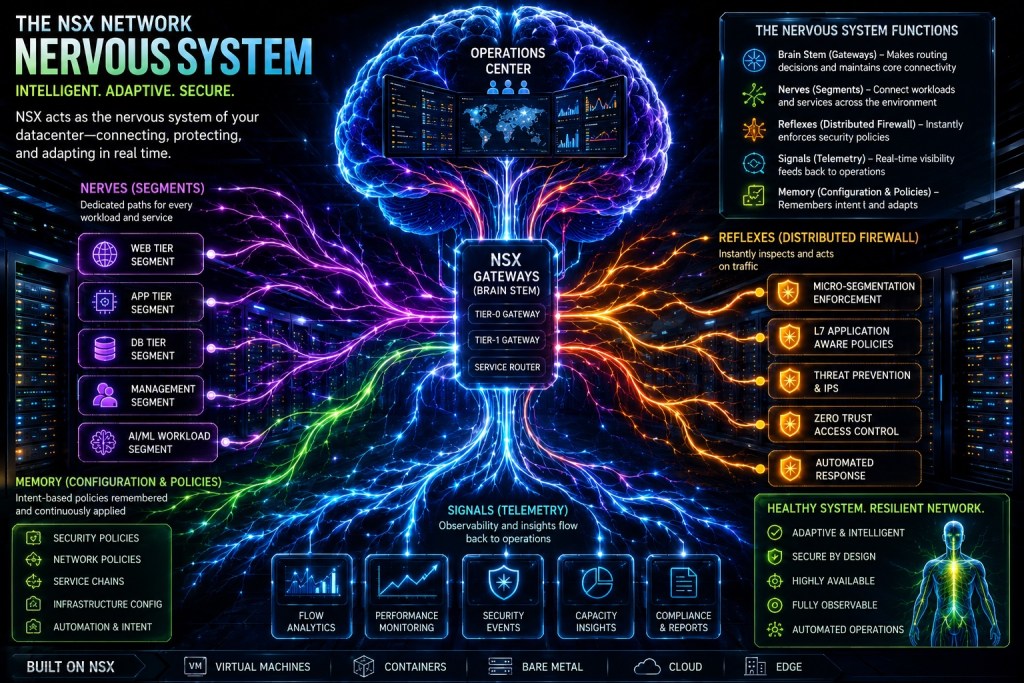
The nervous-system model provides a more useful way to think about NSX. Workload segments resemble nerves connecting applications and services. Tier-0 and Tier-1 gateways act as routing and service junctions. The Distributed Firewall operates like a reflex mechanism, enforcing policy at the workload boundary without waiting for traffic to reach a centralized appliance. Telemetry carries signals back to operations, while configuration and policy preserve the intended behavior of the environment.
This model is valuable because NSX is not simply a virtual networking product. It is a distributed architecture that combines connectivity, routing, security, policy, and operational visibility. The value comes from how those capabilities work together.
The model also needs guardrails. A biological metaphor can clarify architecture, but it can also hide important implementation details. Understanding where the metaphor stops is just as important as understanding where it helps.
The Nervous-System Model at a Glance
The following mapping translates the image into practical NSX architecture.
| Nervous-system function | NSX construct | Primary responsibility | Important design caveat |
|---|---|---|---|
| Brain stem | Tier-0 and Tier-1 gateways | Routing, service insertion, north-south connectivity, and centralized services | Not every packet traverses an Edge node or Service Router |
| Nerves | NSX segments | Logical Layer 2 connectivity for workloads and services | Segments should represent real connectivity and policy boundaries, not arbitrary application labels |
| Reflexes | Distributed Firewall and distributed security services | Enforce east-west policy close to workloads | Effective policy depends on accurate groups, tags, rule order, entitlement, and operational ownership |
| Signals | Flow records, logs, events, metrics, and alerts | Provide evidence about behavior, performance, and security | Collecting telemetry without retention, ownership, and response processes creates noise rather than insight |
| Memory | Groups, policies, configuration, profiles, and automation state | Preserve declared intent and repeatable configuration | Configuration is not self-correcting unless drift detection and reconciliation are implemented |
| Operations center | VCF Operations, security operations, network operations, and automation | Interpret signals, coordinate response, and improve policy | Dashboards do not replace troubleshooting skill, change control, or service ownership |
The most important point is that these are not independent features. The segment defines where a workload connects. The gateway defines how that connectivity reaches other networks. Security policy governs what communication is permitted. Telemetry shows whether the resulting behavior matches the design.
The Brain Stem: Tier-0 and Tier-1 Gateways
The image places Tier-0 and Tier-1 gateways at the center of the nervous system. That is directionally useful because gateways connect the distributed NSX environment to external networks and centralized services.
The implementation is more nuanced than a single central router.
Tier-0 Establishes External Connectivity
A Tier-0 gateway commonly provides the connection between NSX logical networking and the physical network. It can participate in dynamic routing, exchange routes with upstream infrastructure, and provide the north-south path for workloads that need to reach networks outside the NSX domain.
The Tier-0 architecture separates distributed routing from centralized services. Distributed routing functions can be realized on transport nodes, while components that require Edge execution are placed on NSX Edge nodes.
This distinction matters operationally. The Tier-0 gateway is a logical construct, not one virtual router through which every packet must pass. Treating it as a traditional centralized router can lead to incorrect traffic-flow assumptions and unnecessary concentration of east-west traffic.
Tier-1 Creates Application or Tenant Boundaries
Tier-1 gateways are commonly used to provide routing and service boundaries for application environments, tenants, projects, or groups of segments. A Tier-1 can connect downstream workload segments to an upstream Tier-0 gateway while allowing services and policies to be applied at a more appropriate scope.
This creates a useful hierarchy:

The diagram shows organizational separation, but the hierarchy should not be created automatically for every application. Too many gateways can increase operational complexity, while too few can create oversized failure, routing, and ownership domains.
Some designs also connect segments directly to Tier-0 gateways. The appropriate model depends on tenancy, service requirements, routing boundaries, scale, and the need for Tier-1 services.
Service Routers Host Centralized Functions
Stateful or centralized services may require a Service Router on an NSX Edge node. Examples can include network address translation, gateway firewalling, and other services whose state cannot simply be distributed across every transport node.
This is where the brain-stem metaphor is most accurate. Traffic requiring these services must reach an Edge-based execution point. The Edge cluster therefore becomes a real availability, capacity, and lifecycle dependency.
Edge sizing cannot be treated as a secondary task. Throughput requirements, routing convergence, service placement, failure domains, maintenance behavior, and recovery capacity all influence whether the central service path remains healthy.
The Nerves: Segments Connect Workloads and Services
In the image, segments branch outward like nerves to web, application, database, management, and AI workloads. This is a strong representation of their connectivity role, but segments are more than application labels.
An NSX segment provides logical Layer 2 connectivity. Depending on the design, it can be overlay-backed or VLAN-backed and connected to a Tier-0 or Tier-1 gateway. Workloads attached to the same segment share a logical connectivity domain, while routing connects that segment to other networks.
A segment should normally answer questions such as:
- Which workloads require Layer 2 adjacency?
- Which routing boundary should serve them?
- Which failure or maintenance domain contains them?
- Which security groups and policies apply?
- Which services depend on the segment?
- Who owns its addressing, capacity, and lifecycle?
Creating one segment for every application does not automatically create good micro-segmentation. Security groups and Distributed Firewall rules can provide finer policy boundaries than the underlying Layer 2 layout.
Conversely, placing every workload on a small number of large segments may simplify IP planning while making troubleshooting, ownership, and blast-radius management harder. Segment design should balance connectivity requirements, operational clarity, address management, tenancy, and policy scope.
The Reflex Arc: Distributed Firewall Enforcement
The Distributed Firewall is one of the strongest parts of the nervous-system analogy. It can enforce policy at the workload boundary instead of requiring east-west traffic to traverse a centralized firewall appliance.
This changes the security model.
In a traditional environment, traffic may need to leave the source network, reach a physical or virtual firewall, and then return to the destination network. With distributed enforcement, the policy decision can occur close to the source or destination workload interface on the transport node.

The second model reduces the need to hairpin local traffic through a central enforcement point. It can also preserve policy as workloads move within the prepared environment, provided the destination cluster and host have the required security functionality enabled.
Micro-Segmentation Depends on Good Identity
The enforcement point can be distributed, but the policy model still depends on accurate workload classification.
Static IP-address rules are easy to understand, but they are difficult to maintain in dynamic environments. Groups based on tags, names, operating systems, application roles, projects, or other attributes can create more durable policy, but only when those attributes are governed.
A tag such as application=payments becomes a security control input. If anyone can apply it without approval, the tag is not merely metadata. It is a pathway for changing effective network access.
A production-ready model therefore needs:
- controlled tag and group ownership
- naming and classification standards
- separation between policy authors and workload deployers where appropriate
- review of dynamic group membership
- automated validation for unexpected membership changes
- logging that supports investigation without overwhelming the platform
Layer 7 and Threat Controls Add Context
Application-aware rules, intrusion detection and prevention, identity-based controls, and threat-prevention capabilities can deepen the reflex model. Instead of evaluating only source, destination, and port, policy can incorporate more context about the traffic or identity.
These capabilities are not universal substitutes for basic segmentation. Their availability and behavior depend on the deployed version, entitlement, activation state, cluster configuration, traffic visibility, and supported inspection model.
Encrypted traffic also creates a practical boundary. A policy engine cannot infer unlimited application detail from traffic it cannot inspect. Architects should define what context is reliably available before building policy that depends on it.
The Signals: Telemetry Creates Operational Awareness
A nervous system without feedback cannot distinguish normal activity from failure. The same is true for NSX.
Flow information, firewall logs, security events, interface statistics, routing state, capacity data, health alerts, and configuration events provide different views of the environment. Together, they can help operators answer questions such as:
- Which workloads are communicating?
- Which firewall rule permitted or rejected the connection?
- Where did packet loss or latency begin?
- Is the expected route being advertised?
- Is an Edge node approaching a capacity threshold?
- Did a configuration change precede the incident?
- Is observed communication consistent with the application design?
VCF Operations for Networks can consume network data and flows to provide broader topology and behavior analysis. That information is most valuable when it is connected to application ownership and operational processes.
Telemetry volume alone is not observability. A useful signal must have context, retention, ownership, and an expected response.
For example, collecting every permitted firewall session may generate enormous logging volume without improving incident response. Logging should be intentional. High-value policy boundaries, denied connections, privileged paths, regulated workloads, and temporary troubleshooting rules often deserve different logging strategies.
The Memory: Intent, Groups, and Configuration
The image describes security policies, network policies, service chains, infrastructure configuration, and automation as the memory of the NSX nervous system.
That description is useful as long as memory is understood as declared and stored intent, not autonomous learning.
NSX preserves configuration through objects such as:
- segments and gateways
- routing configuration
- groups and tags
- firewall policies and rules
- context profiles
- transport zones and transport-node profiles
- Edge clusters
- service configurations
- API-created policy objects
The environment only adapts safely when an operator or controlled automation process changes that intent.
A mature policy lifecycle looks like this:
This closed loop is the real intelligence of the platform. NSX provides the enforcement and telemetry capabilities, but governance determines whether the resulting system is adaptive or merely complicated.
Automation Must Preserve Intent
API-driven configuration is valuable because it can make policies repeatable, reviewable, and integrated with application delivery. It can also reproduce mistakes at machine speed.
A production automation pattern should include:
- source-controlled configuration or policy definitions
- peer review for security-impacting changes
- environment-specific variables rather than copied object identifiers
- pre-change validation
- post-change traffic and membership checks
- rollback criteria
- audit evidence
- drift detection between declared and realized state
The goal is not to automate every click. The goal is to make the intended network and security state reproducible.
The Operations Center: Humans Remain in the Loop
The operations center in the image represents dashboards, analytics, and centralized decision-making. In practice, it should represent a cross-functional operating model rather than one screen or one team.
NSX spans several ownership domains:
| Operational domain | Primary concern |
|---|---|
| Network engineering | Routing, transport, segments, Edge capacity, and upstream connectivity |
| Security engineering | Policy design, micro-segmentation, threat controls, and exceptions |
| Platform operations | Lifecycle, certificates, backups, integration health, and cluster readiness |
| Application teams | Dependency knowledge, service ownership, and communication requirements |
| Observability teams | Telemetry pipelines, retention, dashboards, and alert quality |
| Automation teams | API workflows, policy as code, validation, and drift remediation |
| Governance and risk | Control evidence, policy standards, review cadence, and exception management |
An incident rarely stays inside one of these domains. A rejected connection may be caused by an intentional firewall rule, incorrect group membership, missing routing, a failed Edge service, DNS resolution, application configuration, or an upstream physical-network change.
A healthy operating model establishes who owns the first response, how evidence is shared, and when the incident crosses organizational boundaries.
What a Healthy NSX Nervous System Looks Like
A healthy NSX environment is not defined by the number of features enabled. It is defined by predictable behavior.
Connectivity Follows an Explicit Model
Segments, Tier-1 gateways, Tier-0 gateways, Edge clusters, and physical uplinks have documented purposes. Operators can explain the expected path for east-west, north-south, and service-dependent traffic.
Security Policy Matches Application Intent
Rules are built around real communication requirements. Group membership is governed, default behavior is deliberate, exceptions have owners, and stale rules are removed.
Distributed and Centralized Functions Are Separated
Architects know which decisions occur on transport nodes and which services require Edge execution. This prevents accidental traffic concentration and improves capacity planning.
Telemetry Is Actionable
Critical flows, security events, route state, health data, and changes are retained long enough to investigate incidents. Dashboards support known operational questions instead of displaying every available metric.
Automation Includes Validation
Automated changes are not considered successful simply because an API returned a success code. The workflow verifies realization, connectivity, expected policy behavior, and rollback readiness.
Lifecycle Is Part of the Architecture
Cluster preparation, entitlement, version compatibility, certificates, backups, Edge capacity, and upgrade sequencing are included in the design. They are not deferred to operations after deployment.
Common Failure Patterns
The nervous-system metaphor also helps explain how an NSX design becomes unhealthy.
Segment Sprawl
Segments are created faster than they can be governed. Naming becomes inconsistent, address space is fragmented, and ownership becomes unclear.
Gateway Sprawl
Every project receives dedicated Tier-1 services without a decision framework. Edge resource consumption, routing configuration, and operational dependencies grow unnecessarily.
Overcentralized Traffic
Traffic that could remain distributed is forced through Edge services or external appliances. The design introduces avoidable latency, capacity requirements, and failure concentration.
Weak Classification Governance
Dynamic groups depend on tags that are inconsistently applied or insufficiently controlled. Policy appears correct, but the wrong workloads become members.
Excessive Logging
Operators enable broad logging without estimating event volume, storage, transport, or investigation value. Important signals become difficult to find.
Dashboard-Driven Troubleshooting
Teams rely on a high-level health indicator without understanding the underlying routing, policy, transport, and service paths. The dashboard shows a symptom, but not necessarily the cause.
Unclear Support and Entitlement Boundaries
Designs assume that advanced security capabilities are available everywhere. Deployment mode, entitlement, cluster enablement, and version dependencies are discovered only during implementation.
Practical Design Questions
Before treating NSX as the nervous system of a private cloud, architects and operators should be able to answer the following:
- Which traffic remains distributed, and which traffic must reach an Edge node?
- What is the purpose of every Tier-0 and Tier-1 gateway?
- Which segments represent Layer 2 requirements versus organizational preference?
- How are workload tags created, approved, validated, and removed?
- Which security capabilities are enabled on each cluster?
- What telemetry is collected, how long is it retained, and who investigates it?
- What happens when an Edge node, host, manager appliance, or upstream router fails?
- How are policy changes tested before production?
- What confirms that an API-driven change was realized correctly?
- Which team owns the complete application communication path?
An environment that cannot answer these questions may still pass traffic, but it is not yet operating as a coordinated system.
Conclusion
The nervous-system analogy provides a strong mental model for NSX because it emphasizes relationships rather than isolated features. Segments connect workloads, gateways establish routing and service boundaries, distributed security enforces policy close to the workload, telemetry reports what is happening, and configuration preserves the intended state.
The most important architectural lesson is that NSX is both distributed and coordinated. Efficient workload traffic should remain distributed where possible, while centralized services should be placed deliberately on resilient, correctly sized Edge infrastructure. Security policy should follow workload identity and application intent, but only when the metadata behind that identity is governed.
Telemetry completes the model, but it does not make the environment intelligent by itself. Intelligence emerges from the operating loop that connects evidence to ownership, investigation, controlled change, and validation.
A healthy NSX nervous system is therefore not the environment with the most segments, policies, or dashboards. It is the environment in which connectivity and security behavior remain explainable, observable, recoverable, and aligned with application intent.
