



TL;DR
The best LLM for enterprise RAG is not automatically the largest or newest model. The right model is the one that works with your retrieval design, citation expectations, latency target, cost profile, data controls, and evaluation requirements. Model selection should happen after source quality, access control, retrieval behavior, and test questions are understood.
Why This Comparison Matters
Most model-selection conversations start in the wrong place. They begin with a leaderboard, a vendor announcement, or a debate about which model is best. That may be interesting, but it is not how enterprise RAG should be designed.
A RAG system is not only a model. It is a retrieval workflow, a source-quality problem, a security model, a prompt contract, an evaluation loop, and an operating cost. The model matters, but it rarely fixes weak indexing, poor chunking, stale documents, missing metadata, or vague user intent.
For enterprise teams, the better question is this: which model is fit for this retrieval pattern, risk profile, latency budget, and governance requirement?
Scope and Assumptions
This article assumes the organization is building a retrieval-augmented assistant for internal enterprise knowledge. The assistant may answer questions from platform documentation, runbooks, tickets, policies, architecture standards, or engineering notes.
This article does not recommend a single current model by name. Model availability, pricing, context size, regional support, data handling, and enterprise controls change too often. Those details should be validated against current vendor documentation during the research stage.
The goal is to define a practical selection method, not crown a model.
Model Selection Flow at a Glance
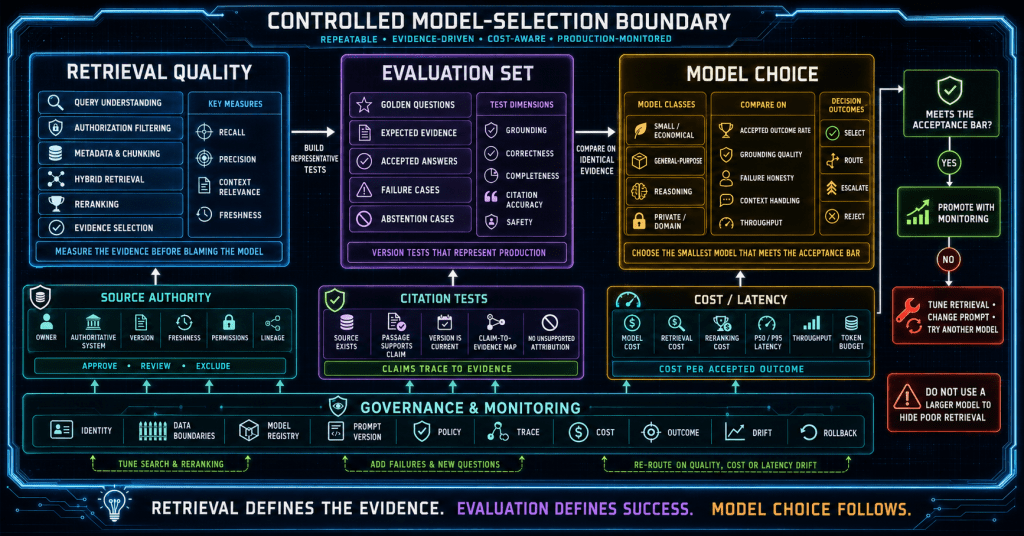
The diagram below shows the sequence that should happen before shortlisting models. Retrieval quality and evaluation design must come before model preference.
If retrieval quality is not measured before model selection, the evaluation will be misleading. A stronger model may appear better simply because it is more fluent when guessing.
Evaluation Scorecard Design
A practical model comparison needs more than general intelligence. Enterprise RAG needs evidence discipline, stable behavior, operational traceability, and an acceptable cost curve.

A model that scores high on fluency but low on grounding is a poor fit for enterprise RAG. Production users need correct, traceable, and bounded answers more than polished language.
Comparison Criteria
The model should be compared against practical enterprise criteria, not general capability alone.
| Criteria | What to Evaluate | Why It Matters |
|---|---|---|
| Grounded answer quality | Does the model stay close to retrieved sources? | Reduces unsupported answers |
| Citation discipline | Does it cite the right sources and avoid fake authority? | Builds user trust and auditability |
| Context handling | Can it use enough retrieved context without losing instructions? | Impacts complex knowledge workflows |
| Failure behavior | Does it admit uncertainty when retrieval is weak? | Reduces hallucination risk |
| Latency | Can it respond within the workflow expectation? | Determines user adoption |
| Cost | What is the cost per interaction at expected volume? | Prevents pilot-to-production surprise |
| Data controls | Does it meet security, region, and retention needs? | Required for enterprise approval |
| Tool integration | Can it work with retrieval, agents, functions, and observability? | Determines architecture flexibility |
| Evaluation support | Can responses be tested and traced? | Needed for operations and regression testing |
Where Smaller Models Fit
Smaller models can be effective when the task is constrained and the retrieval layer is strong. They often fit classification, routing, short synthesis, formatting, and low-latency internal assistant flows.
Use a smaller model when questions are narrow and predictable, retrieved chunks are short and highly relevant, answer format is controlled, latency and cost are more important than deep reasoning, and the model is not expected to perform complex multi-step analysis.
The caveat is failure behavior. A smaller model can look acceptable during happy-path testing and degrade quickly when the query is ambiguous or the retrieved evidence conflicts.
Where Larger Models Fit
Larger models are stronger candidates when the use case requires synthesis across multiple sources, ambiguous reasoning, long instructions, or more nuanced language generation.
Use a larger model when questions are complex or multi-part, retrieved evidence may be spread across multiple documents, the answer requires tradeoff analysis, the assistant must explain uncertainty clearly, or the user population includes executives and cross-functional teams.
The tradeoff is cost and latency. Larger models can make the assistant feel more capable, but they can also hide weak retrieval because their answers sound polished.
Where Specialized Models Fit
Specialized or domain-tuned models may fit regulated, technical, or domain-specific workloads when the organization has strong evaluation data and a clear deployment strategy.
Do not assume specialization automatically means better. It must be tested against actual documents, user questions, compliance requirements, and failure cases.
A specialized model that performs well in general domain examples may still fail if the retrieval layer returns stale, noisy, or conflicting evidence.
Common Misunderstandings
The first misunderstanding is that a larger context window solves retrieval. It does not. Larger context can help, but stuffing more content into the prompt often increases cost, latency, and the chance that the model pays attention to the wrong evidence.
The second misunderstanding is that model accuracy can be evaluated with generic benchmark results. Enterprise RAG accuracy depends on your documents, your access model, your metadata, and your expected answer behavior.
The third misunderstanding is that model selection is permanent. In a healthy architecture, the model is a replaceable component behind a stable evaluation and orchestration layer.
Practical Evaluation Design
Build a model evaluation set before choosing the model. Keep it simple but realistic.
| Test Type | Example |
|---|---|
| Known answer | What is the restart order for this platform? |
| Conflicting evidence | Two documents disagree and the model must cite the approved source |
| Missing answer | The model must say it cannot find evidence |
| Permission boundary | User asks for content outside their role |
| Multi-source synthesis | Model must combine runbook, ticket, and architecture note |
| Format constraint | Response must produce a change-review checklist |
The evaluation should score answer correctness, citation quality, unsupported claims, refusal behavior, latency, and cost.
Decision Guidance
Choose the least complex model that meets answer-quality, citation, security, and latency requirements for the workflow. Then build the architecture so the model can be replaced later.
A practical model-selection sequence looks like this:
- define the use case and user group
- build representative test questions
- validate retrieval quality separately from generation
- compare at least two model classes
- measure latency and cost under realistic load
- test failure behavior, not just correct answers
- lock model choice behind versioned configuration
- monitor drift after deployment
Conclusion
Enterprise RAG does not need the most impressive model. It needs the right model for the retrieval architecture, risk profile, and operating model.
Model selection should come after source design, retrieval quality, access control, and evaluation criteria are understood. Otherwise, the organization risks buying fluency instead of reliability.
The best model is the one that can produce grounded, traceable, cost-aware answers inside the constraints of the system you actually operate.
External References
