



TL;DR
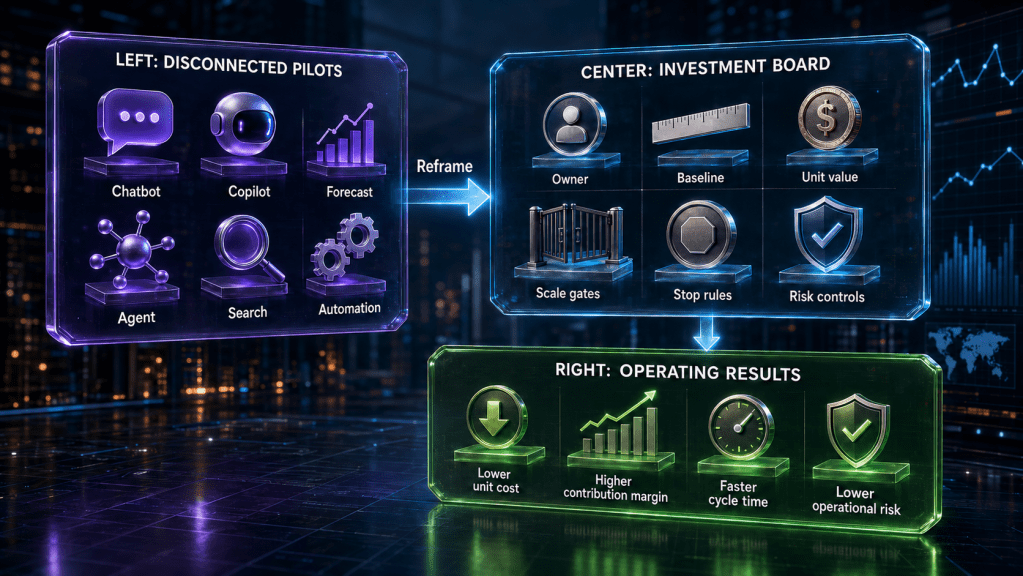
AI ROI is stalling because many organizations are managing experiments, not investments. A pilot can prove that a model works, users are interested, or a workflow can be partially automated. It does not prove that the organization can produce repeatable business value after integration, data, security, change management, support, and operating costs are included.
CEOs and CIOs should replace disconnected AI pilots with a governed investment portfolio. Every initiative should have an accountable business owner, a measured baseline, a defined unit of value, fully loaded unit economics, evidence-based scale gates, and termination criteria agreed before enthusiasm turns into sunk cost. The goal is not to scale more pilots. The goal is to scale the few investments that improve operating results and stop the ones that do not.
Introduction
Enterprise AI adoption is accelerating, but enterprise-wide financial impact is not keeping pace.
McKinsey’s 2025 global AI survey found that only about one-third of organizations were scaling AI across the enterprise. Thirty-nine percent of respondents attributed some level of EBIT impact to AI, and most of those respondents said the contribution was below 5 percent. IBM’s 2025 CEO study reported that only 25 percent of AI initiatives had delivered expected ROI and only 16 percent had scaled enterprise-wide. Half of surveyed CEOs also said rapid technology investment had created disconnected, piecemeal technology inside their organizations.
At the same time, executive conviction remains high. BCG’s 2026 AI Radar found that 72 percent of CEOs considered themselves the primary AI decision-maker, 82 percent were more optimistic about AI ROI than a year earlier, and more than 90 percent planned to maintain or increase AI investment even if returns did not arrive within the next year. Deloitte’s 2026 State of AI in the Enterprise found that worker access to AI rose sharply, while only 34 percent of surveyed organizations were truly reimagining the business around it.
That combination creates a dangerous management condition: investment continues, pilots multiply, expectations rise, and the evidence required to distinguish operating value from experimentation remains weak.
The answer is not another innovation program. It is a better investment operating model.
AI Adoption Is Not the Same as Operating Value
AI adoption is easy to demonstrate. A license can be assigned. A chatbot can answer questions. A copilot can generate drafts. An agent can complete a controlled task. A team can report hours saved, prompts submitted, users activated, or model accuracy achieved.
Those signals may be useful, but they are not operating results.
Operating value appears when the organization can connect AI activity to a measurable change in cost, revenue, cycle time, quality, capacity, risk, or customer outcome. That connection must survive normal enterprise conditions: incomplete data, integration failures, user resistance, exceptions, security controls, support costs, model changes, vendor pricing, and workflow variability.
A pilot asks whether AI can contribute to a task.
An investment asks whether the complete operating system around that AI can produce enough value to justify its cost and risk.
The distinction matters because pilot economics are usually artificially favorable. The pilot may use a curated data set, a cooperative user group, temporary engineering support, low transaction volume, manual exception handling, and costs absorbed by an innovation team. Scale removes those protections. The use case inherits production identity, data, integration, observability, security, legal, support, training, and lifecycle requirements.
That is where expected ROI often disappears.
Why AI ROI Stalls After the Pilot
Many AI pilots have an executive sponsor, a technology lead, a vendor team, and enthusiastic users. None of those roles automatically owns the business result.
An outcome owner is accountable for a measurable change in the operating process. That owner can change policy, staffing, incentives, workflow design, and adoption expectations. Without that authority, the AI team can improve the tool while the surrounding process remains unchanged.
“Deploy an AI assistant” is not an owned outcome.
“Reduce average handling cost per resolved claim while holding accuracy, customer satisfaction, and regulatory compliance within agreed thresholds” is an owned outcome.
The Baseline Is Missing or Conveniently Reconstructed
ROI cannot be measured against a baseline that did not exist before the pilot.
Teams frequently discover this too late. They know the proposed AI cost, but they do not know the current cost per transaction, rework rate, exception rate, cycle-time distribution, quality score, error cost, or adoption level of the existing process. The pilot then gets compared with anecdotes instead of a controlled operating baseline.
A baseline should use a defined period, population, scope, and measurement method. It should also be owned by the business and finance, not created solely by the project team after results are available.
Unit Economics Exclude the Real Cost of Scale
Model inference cost is only one line item.
The fully loaded cost of an AI workflow may include data preparation, retrieval, integration, orchestration, licenses, infrastructure, observability, evaluation, security reviews, human approvals, exception handling, support, training, change management, model updates, incident response, and vendor management.
If those costs are not allocated to the unit of work, the organization is not measuring economics. It is measuring a partial technology bill.
The Pilot Optimizes a Task Instead of the Process
A writing assistant may reduce drafting time without shortening the complete approval cycle. A service desk copilot may improve summaries without increasing resolved tickets. A sales assistant may generate more outreach while lowering lead quality. A coding assistant may increase code volume while moving the review, testing, or security bottleneck downstream.
Task productivity becomes enterprise value only when the complete workflow converts the saved capacity into throughput, quality, risk reduction, or financial return.
Shared Dependencies Are Treated as Free
Multiple pilots often depend on the same data platform, identity integration, model gateway, vector store, observability stack, evaluation framework, security controls, and support team. When each project ignores those shared costs, every business case looks stronger than the portfolio actually is.
The opposite problem also occurs. A foundational capability may be rejected because it cannot show direct use-case ROI even though several valuable workflows depend on it.
Portfolio management must separate shared capability investments from use-case investments while preserving the relationship between them.
There Is No Evidence-Based Scale Gate
Many pilots move to production because the demonstration was impressive, the executive sponsor is visible, the vendor is engaged, or the organization fears falling behind.
Those are reasons to explore. They are not reasons to scale.
A scale decision should require evidence that the workflow is valuable, adoptable, reliable, governable, supportable, and economically viable at realistic volume. If the gate is not defined before the pilot starts, the project team can reinterpret success after the fact.
The Organization Has No Way to Stop
AI initiatives accumulate political support, sunk cost, and public commitments quickly. Without pre-agreed termination criteria, weak projects become permanent pilots, low-value production services, or zombie platforms that continue consuming staff and budget because nobody wants to declare the experiment over.
Stopping an initiative is not failure when the experiment answered the investment question. Continuing without evidence is the more expensive failure.
Replace the Pilot Funnel with an Investment Portfolio
The better model is not a bigger pilot funnel. It is a portfolio that moves investments through explicit decisions.
The diagram below shows the operating logic. What matters is the branch after evidence collection. Every initiative must be able to scale, redesign, park, or stop. A process that only allows forward movement is not governance. It is an approval conveyor belt.

This portfolio should contain several kinds of investments because AI value does not arrive through one mechanism or one time horizon.
Efficiency Investments
These investments target a measurable reduction in cost, labor effort, cycle time, rework, or service friction. They are usually the easiest to model because the baseline unit already exists.
Examples include cost per resolved ticket, minutes per document reviewed, infrastructure incidents per engineer, or cost per invoice processed.
Growth Investments
These investments target contribution margin, conversion, retention, product velocity, or new revenue. They require more careful attribution because the AI component is often one influence inside a larger commercial system.
The unit should be tied to economic output, such as contribution margin per converted opportunity, renewal lift per account, or revenue per qualified recommendation. Activity metrics such as messages generated or leads touched are not enough.
Risk and Resilience Investments
These investments reduce expected loss, detection time, control failure, outage duration, fraud exposure, or compliance effort. Their value may be probabilistic rather than directly realized every month.
The business case should show the event probability, impact range, control effectiveness, evidence quality, and residual risk. Avoid turning uncertain risk reduction into a precise savings number that the evidence cannot support.
Shared Capability Investments
These investments create reusable foundations such as approved model access, data controls, identity integration, evaluation pipelines, observability, tool gateways, or secure AI platforms.
They should not be forced to pretend they produce direct revenue. Their value comes from reuse, avoided duplication, faster delivery, lower marginal cost, and risk reduction across dependent use cases. The portfolio should track which business investments consume the capability and how that consumption changes cost and time to value.
The Minimum Record for Every AI Investment
A portfolio becomes useful when every investment is described in a comparable way. The goal is not to create a large governance document. The goal is to make the decision logic visible.
| Portfolio field | Executive question | Minimum evidence |
|---|---|---|
| Business outcome | What operating result should change? | One measurable outcome with quality and risk guardrails |
| Accountable owner | Who owns the result, not only the technology? | Named executive and business process owner |
| Baseline | What happens today without the AI investment? | Defined period, population, scope, and measurement method |
| Unit of value | What repeatable unit connects work to economics? | Transaction, case, user, decision, asset, request, or other business unit |
| Investment thesis | Why should AI improve this unit? | Causal mechanism, not only a model capability claim |
| Fully loaded cost | What will the complete workflow cost to build and run? | Fixed, variable, shared, transition, support, and control costs |
| Adoption path | How will usage become normal work? | Workflow change, training, incentives, role impact, and accountable manager |
| Scale gates | What evidence is required before more capital or authority is released? | Predefined thresholds and review owner |
| Termination criteria | What conditions cause stop, park, or redesign? | Economic, operational, adoption, quality, risk, and dependency triggers |
| Measurement cadence | When will forecast value become realized value? | Data source, reporting frequency, finance review, and audit trail |
This record creates comparability without pretending every use case is identical. A fraud model, coding assistant, service agent, and AI platform will use different metrics, but each should still answer who owns the result, what the baseline is, how value is measured, what scale requires, and when funding stops.
Ownership Must Span the Business, Technology, and Financial Model
AI ROI cannot be delegated entirely to the CIO, but it cannot be managed without the CIO either.
| Role | Primary accountability |
|---|---|
| CEO | Sets portfolio ambition, resolves cross-functional conflicts, protects long-term bets, and requires termination discipline |
| CIO | Owns technology strategy, shared platform economics, architecture reuse, integration, reliability, and delivery capacity |
| CFO | Validates baselines, cost allocation, benefit realization, capital treatment, and forecast-to-actual reporting |
| Business outcome owner | Owns workflow redesign, adoption, operating policy, staffing decisions, and realized business performance |
| CISO, legal, and risk leaders | Define risk thresholds, control requirements, exception paths, and evidence needed for scale |
| Data and AI platform leaders | Own reusable services, data readiness, model access, evaluation, observability, and marginal run cost |
| Product and operations teams | Own day-to-day service performance, user feedback, incident handling, and lifecycle improvement |
The CEO and CIO partnership is especially important. The CEO can force the enterprise to choose priorities and redesign work across silos. The CIO can prevent each business unit from building a separate AI island with duplicated data, identity, governance, and support costs.
The CFO closes the loop by distinguishing forecast value from realized value. Without that distinction, every portfolio review becomes a presentation of potential rather than an operating review.
Build Unit Economics Before Approving Scale
Unit economics make AI value inspectable.
The exact unit depends on the workflow, but the formulas should connect cost and benefit to repeatable work.
Realized Benefit per Unit
  = Baseline Cost or Margin per Unit
  - AI-Enabled Cost or Margin per Unit

Net Contribution per Unit
  = Realized Benefit per Unit
  - Variable AI and Control Cost per Unit

Monthly Net Value
  = Eligible Volume
  x Adoption Rate
  x Success Rate
  x Net Contribution per Unit
  - Fixed Monthly Run Cost

Break-Even Volume
  = Fixed Monthly Run Cost
  / Net Contribution per Unit

Realized ROI
  = (Verified Benefits - Total Investment Cost)
  / Total Investment Cost
The formula should include adoption and success rates because available volume is not the same as realized volume. A solution may technically support 100,000 transactions per month while only 20 percent of users trust it, or while only half of eligible cases can be completed without manual rework.
An Illustrative Service Desk Example
Assume a service desk workflow has the following measured baseline and target economics:
| Measure | Value |
|---|---|
| Baseline fully loaded cost per resolved ticket | $18.40 |
| AI-enabled variable cost per resolved ticket | $15.10 |
| Net savings per successfully processed ticket | $3.30 |
| Fixed monthly platform and support cost | $58,000 |
| Eligible monthly ticket volume | 35,000 |
| Break-even volume | Approximately 17,576 tickets |
| Net monthly value at full eligible volume | Approximately $57,500 |
| Annualized net value before transition costs | Approximately $690,000 |
This example does not prove that the investment should scale. The economics remain valid only if resolution quality, reopen rate, customer satisfaction, security, and staff adoption remain within agreed thresholds. If the AI workflow reduces handling cost but increases repeat incidents, the apparent savings may simply move cost into another queue.
That is why unit economics must be paired with operating guardrails.
Use Scale Gates to Release Capital and Authority
A scale gate should release more than budget. It may also release more users, more data, more transactions, more integration depth, or more autonomous authority.
| Gate | Decision | Evidence required |
|---|---|---|
| Problem admission | Is this problem worth an AI investment? | Named owner, measured baseline, strategic fit, unit of value, and non-AI alternatives considered |
| Technical feasibility | Can the bounded pattern work? | Representative data, achievable quality, integration path, security review, and known failure modes |
| Operational value proof | Does the workflow improve the target unit? | Controlled comparison, adoption evidence, quality guardrails, exception rate, and initial unit economics |
| Controlled production | Can the service operate safely and reliably? | Monitoring, support ownership, rollback, incident process, access controls, evaluation, and cost telemetry |
| Scale approval | Does value improve or hold at realistic volume? | Fully loaded economics, capacity model, process redesign, training plan, risk acceptance, and finance validation |
| Harvest or retire | Should the organization expand, optimize, replace, or stop? | Realized benefits, trend data, dependency changes, vendor changes, control performance, and opportunity cost |
The gates should be proportional to risk. A read-only summarization assistant does not need the same approval path as an agent that can modify customer records or production systems. The portfolio record should make that distinction explicit.
The key discipline is that evidence thresholds are defined before the experiment begins. Otherwise, teams can select whichever metric improved and call the pilot successful.
Termination Criteria Protect the Portfolio
Termination criteria should be approved with the investment thesis, not introduced when leadership becomes disappointed.
Useful termination triggers include:
- No accountable business owner remains in place.
- A credible baseline cannot be established within the discovery window.
- The workflow cannot produce positive unit contribution at realistic volume and adoption.
- Quality, safety, compliance, or customer-impact thresholds cannot be maintained.
- Adoption remains below the required threshold after workflow redesign, training, and manager accountability.
- Required data, identity, integration, or platform dependencies are not feasible within the investment horizon.
- The use case duplicates another portfolio capability with lower cost or stronger evidence.
- Variable model, infrastructure, or human-review cost grows faster than value per unit.
- The solution creates more exception handling, rework, or operational burden than it removes.
- A market, regulatory, vendor, or architecture change invalidates the original thesis.
Termination does not always mean delete everything.
Stop means the evidence no longer supports continued investment.
Park means the thesis may remain valid, but a dependency, timing condition, or market constraint prevents responsible progress.
Redesign means the problem is still valuable, but the workflow, AI pattern, data model, or operating assumption was wrong.
Scale means the evidence supports releasing more capital and operating scope.
These decisions should be visible at the portfolio level so capital, staff, and platform capacity can move toward better investments.
A Practical AI Investment Record
The following YAML is not a vendor configuration. It is a governance contract that a CEO, CIO, CFO, business owner, and delivery team can review using the same language.
Change the values to match the real workflow, data sources, financial model, risk thresholds, and review cadence. Successful use means the business owner and finance agree on the baseline, production telemetry can calculate the unit economics, and each gate produces a documented scale, redesign, park, or stop decision.
investment:
  id: AI-OPS-017
  name: service-desk-resolution-copilot
  portfolio_class: efficiency
  status: operational-value-proof

  owners:
    executive: COO
    business_outcome: VP_Service_Operations
    technology: CIO
    finance_validation: FP&A_Director
    risk_review: CISO_Delegate

  outcome:
    statement: >
      Reduce fully loaded cost and median cycle time per resolved
      service ticket without increasing reopen rate, security risk,
      or reducing customer satisfaction.
    unit_of_value: resolved_ticket

  baseline:
    measurement_period: trailing_12_months
    eligible_monthly_volume: 35000
    cost_per_unit_usd: 18.40
    median_cycle_time_minutes: 42
    reopen_rate_percent: 8.0
    customer_satisfaction_score: 4.2

  target_economics:
    ai_enabled_variable_cost_per_unit_usd: 15.10
    fixed_monthly_run_cost_usd: 58000
    minimum_net_contribution_per_unit_usd: 3.00
    minimum_monthly_volume_for_scale: 20000
    maximum_payback_months: 18

  scale_gates:
    operational_value_proof:
      minimum_adoption_percent: 65
      minimum_successful_completion_percent: 80
      maximum_reopen_rate_percent: 8.0
      minimum_customer_satisfaction_score: 4.2
      required_observation_days: 90
    controlled_production:
      required_controls:
        - scoped_workload_identity
        - approved_data_sources
        - human_review_for_security_tickets
        - end_to_end_traceability
        - rollback_and_disable_path
        - per_unit_cost_telemetry

  termination_criteria:
    - no_positive_unit_contribution_at_realistic_volume
    - reopen_rate_exceeds_guardrail_for_two_review_periods
    - adoption_below_threshold_after_workflow_redesign
    - required_data_access_cannot_be_governed
    - support_cost_invalidates_payback_target
    - duplicate_enterprise_capability_is_selected

  review:
    operating_review: monthly
    portfolio_rebalance: quarterly
    decision_options:
      - scale
      - redesign
      - park
      - stop
This artifact does something most pilot charters do not. It makes value, ownership, risk, and stopping conditions part of the same record.
Run the Portfolio as an Operating Review
AI portfolio governance should not become a quarterly innovation showcase. It should behave like an operating review.
The meeting should focus on decisions and variances:
- What changed in realized unit economics?
- Which investments advanced or stalled at a gate?
- Which assumptions were invalidated?
- Where is adoption lower than the business case requires?
- Which shared capabilities are creating reuse or duplication?
- Which risks, incidents, or control costs changed the economics?
- Which initiatives should receive more capital?
- Which initiatives should be redesigned, parked, or stopped?
- How much capital and capacity were recycled from terminated work?
A useful dashboard should show portfolio concentration, committed spend, forecast value, realized value, gate distribution, time in stage, adoption, unit-cost trend, quality guardrails, operational incidents, and dependency risk.
It should not lead with prompts submitted, licenses assigned, models tested, or pilots launched. Those are activity measures. They can explain progress, but they do not prove value.
The First 90 Days for a CEO and CIO
A 90-day reset will not produce complete enterprise AI transformation. It can establish the management system needed to stop funding disconnected experimentation.
Days 0 to 30: Build the Investment Inventory
Create one inventory of AI pilots, production services, platform programs, vendor commitments, and business-led experiments. Include shadow projects where possible.
For every item, record the owner, business outcome, baseline status, current spend, shared dependencies, data access, operating stage, and next decision. Remove duplicate naming that makes the same capability appear to be several unrelated initiatives.
Do not start by ranking model sophistication. Start by asking which operating result each investment exists to change.
Days 31 to 60: Reconstruct the Economics and Gates
Select the small number of investments that are strategically important or materially funded. Build their baselines, units of value, fully loaded cost models, adoption assumptions, risk guardrails, and termination criteria.
At the same time, separate shared platform costs from use-case costs. Assign a clear allocation method so foundational investments are visible without making every dependent use case look free.
Define the evidence required for the next gate. Initiatives that cannot establish a credible owner, baseline, or unit of value should not receive automatic expansion funding.
Days 61 to 90: Rebalance and Publish Decisions
Hold the first portfolio operating review. Scale the investments with evidence. Redesign the ones with a valid problem but a weak pattern. Park those blocked by a real dependency. Stop those that cannot justify further capital.
Publish the decision logic internally. Teams need to see that termination is an expected outcome of disciplined experimentation, not a punishment for innovation.
Then connect funding to the gate model. Budget should be released in stages, and additional autonomy, production scope, and user reach should require the same evidence discipline as additional capital.
Common Executive Traps
Treating Every AI Investment as a One-Year Cost Takeout
Efficiency investments may support a relatively short payback model. Growth, risk, and shared capability investments may require different evidence and time horizons.
Different clocks do not mean no discipline. Every investment still needs milestones, leading indicators, review triggers, and a defined condition under which the thesis is no longer credible.
Counting Time Saved as Cash
Time saved is not automatically financial value. The organization must show what happens to the released capacity.
Does it reduce overtime, contractor spend, backlog, cycle time, error rate, or hiring demand? Does it increase throughput or customer capacity? If nothing changes in the operating system, the time may be useful to employees without appearing as measurable enterprise ROI.
That can still be worthwhile, but it should be described honestly.
Funding Platforms Without Consumption Accountability
A shared AI platform can reduce duplication and risk, but only if business use cases consume it. Track onboarding time, marginal cost, reuse, reliability, security exceptions, and the number of funded investments that depend on it.
A platform with no consumption plan is not strategic infrastructure. It is inventory.
Scaling Before Redesigning the Workflow
AI often exposes process debt. Approval paths, data ownership, exception handling, policy ambiguity, and system fragmentation become visible when a model or agent tries to move through the workflow.
Scaling the AI before fixing those problems automates the friction and makes the eventual redesign more expensive.
Protecting Pilots Because of Sunk Cost or Executive Visibility
High-profile pilots are often the hardest to stop. That is exactly why termination criteria must be agreed before results arrive.
The portfolio should reward teams for producing decision-quality evidence, including evidence that an idea should not scale.
Conclusion
AI ROI is not stalling because enterprises lack pilots. It is stalling because pilots are being funded, measured, and governed as isolated technology experiments instead of business investments.
The practical correction is straightforward, even when the organizational change is difficult. Assign an outcome owner. Establish the baseline before the result. Define a repeatable unit of value. Include the complete cost of production. Release capital and authority through evidence-based gates. Agree on termination criteria before momentum creates sunk-cost protection.
The CEO’s role is to force prioritization, cross-functional ownership, and honest portfolio decisions. The CIO’s role is to turn AI into a reusable, supportable, measurable operating capability instead of a collection of disconnected tools. The CFO’s role is to validate that forecast benefits become realized results.
The goal is not a perfect ROI model for an uncertain technology. The goal is a management system that can distinguish learning from value, potential from evidence, and strategic patience from undisciplined spending.
Organizations that make that shift will not necessarily run the most pilots. They will know which investments deserve to become part of the operating model, which ones need redesign, and which ones should end before they consume another quarter of attention and capital.
