

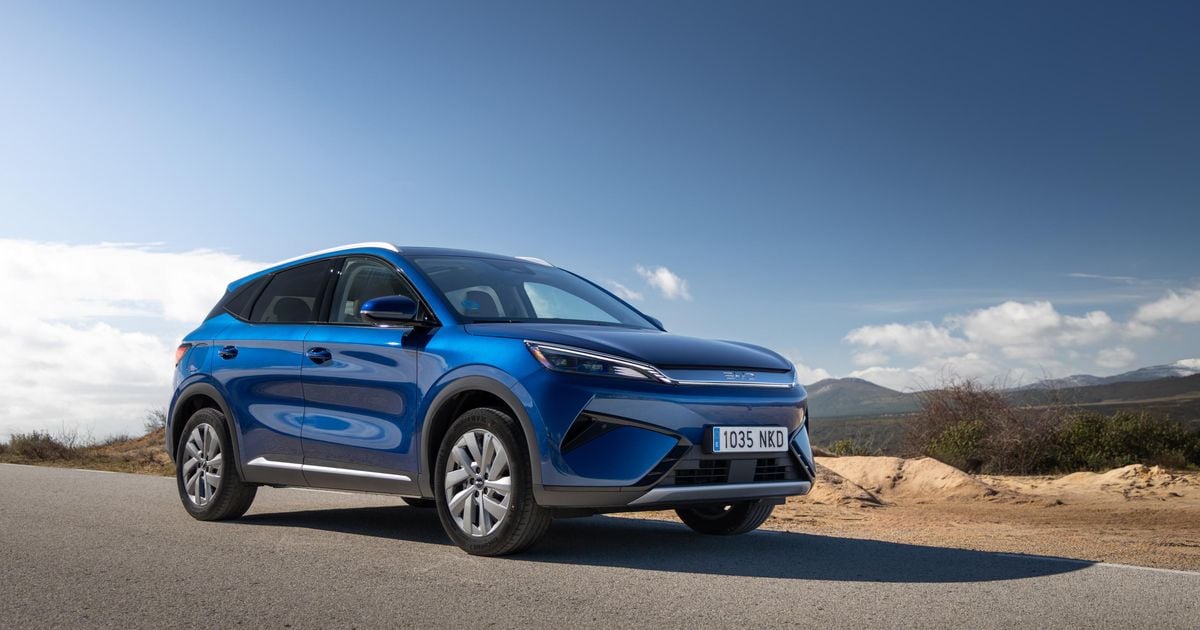

The BYD Atto 3 Evo electric SUV has been confirmed for Australian showrooms, bringing substantial upgrades and expanded powertrain options for the longest-serving model in BYD Australia’s lineup.
Already on sale in the UK and parts of Europe, the new small/medium electric SUV is yet to be detailed for Australia, so we don’t yet know local pricing, the number of model grades, or their equipment levels. The current front-wheel drive Atto 3 is priced from $39,990 before on-road costs.
The Chinese brand has added an ‘expression of interest’ page for the Atto 3 Evo to its Australian website ahead of first customer deliveries expected in September 2026.
It’s one of several new BYD models due to arrive in Australia, where it will join recently released Seal 6 Touring and M9 people mover, with other potential future additions including a hybrid version of the Atto 2 small SUV.

Despite similar exterior styling to the current Atto 3, and identical length, width, height and wheelbase measurements, the Atto 3 Evo brings significant upgrades over the current model, which rivals compact electric SUVs like the the MG S5 EV, Geely EX5, and Jaecoo J5.
These include BYD’s new e-Platform 3.0 Evo 800V architecture – from which the Evo takes its name – adding rear-wheel drive (RWD) and all-wheel drive (AWD) configurations in addition to the existing front-wheel drive (FWD) model.
The four-year-old FWD Atto 3 is expected to remain on sale, with the RWD Evo likely to be positioned above it as a more expensive model. However, the AWD Atto 3 Evo is not expected to be offered in Australia, as its pricing could approach that of the larger Sealion 7 mid-size electric SUV, which starts from $54,990 before on-road costs.
Overseas, the rear-drive Atto 3 Evo produces 230kW of power and 380Nm of torque, and has a claimed 0-100km/h acceleration time of 5.5 seconds. It uses a 74.8kWh Blade lithium iron phosphate (LFP) battery, delivering up to 510km of WLTP driving range.
That’s a significant improvement over Australia’s current Atto 3 Essential, which produces 150kW and 310Nm, completes the 0-100km/h sprint in a claimed 7.9 seconds, and powers its front-mounted electric motor with a 49.9kWh battery for a claimed 410km WLTP range.
The existing Atto 3 Premium uses a larger 60.5kWh battery to increase its claimed WLTP range to 420km, while cutting its claimed 0-100km/h time to 7.3 seconds.
The Evo also brings substantially faster DC charging, with a peak rate of 220kW, compared with the current Atto 3’s maximums of 70kW (Essential) and 88kW (Premium). BYD claims a 10 to 80 per cent recharge can be completed in around 25 minutes.
The AWD Atto 3 Evo adds an electric motor up front, lifting total outputs to 330kW and 560Nm. Despite using the same 74.8kWh battery, its higher performance trims the claimed WLTP driving range down to 470km, while reducing its claimed 0-100km/h sprint time to just 3.9 seconds.
Both Atto 3 Evo variants offer 3.3kW vehicle-to-load (V2L) capability.
Inside, despite unchanged exterior dimensions, boot capacity has increased by 50 litres to 490L, expanding to 1360L with the rear seatbacks folded. There’s also a new 101L front trunk, whereas the current Atto 3 offers no front storage.
The dashboard features a 15.6-inch rotating central touchscreen as standard, replacing the existing Atto 3’s 12.8-inch display in the Essential and the 15.6-inch unit in the Premium.
The updated infotainment system adds Google services, AI-powered voice control, NFC key access and wireless smartphone charging, while the digital instrument cluster grows from 5.0 inches to 8.8 inches.
Other upgrades include a new five-link rear suspension in place of the current four-link arrangement, designed to improve ride comfort, stability and second-row passenger comfort. Standard 18-inch alloy wheels are retained.
The Atto 3, which became BYD Australia’s first SUV when the Chinese brand was officially launched here in 2022, recorded a 64.6 per cent year-on-year sales increase during the first half of 2026.
The model contributed 3052 sales to BYD’s year-to-date total, helping the brand climb to second place behind Toyota in both May and June 2026, led by the Sealion 7 electric SUV and Shark 6 dual-cab ute.
