



TL;DR
The MCP gateway should be the governed capability-access layer beneath the trusted agent controller. It should admit approved servers, expose only permitted tools, validate schemas, enforce identity and routing rules, isolate credentials, detect capability changes, and preserve trace evidence.
The gateway should not become the only security control.
Each MCP server must still enforce domain authorization, validate business rules, constrain downstream access, protect credentials, execute safely, and return structured evidence. The target enterprise system must remain authoritative for resource-level permissions and state.
The recommended division is:
The controller authorizes the workflow. The gateway governs the connection. The server enforces the domain. The enterprise system protects the record.
A public registry entry, successful connection, valid schema, or OAuth token is not enough to approve a server for production. Enterprise trust requires an admission pipeline, a private catalog, exact artifact or endpoint control, dynamic tool filtering, separate credentials, runtime verification, and a tested disablement path.
Introduction
Part 1 of this series established that MCP belongs in the agent tool plane rather than serving as the complete agent controller. Part 2 defined the trusted controller that owns identity context, workflow state, policy, approvals, budgets, retries, cancellation, and termination.
Part 3 moves below that controller.
Once an action has been authorized, the platform still needs a safe way to locate the correct MCP server, expose the correct subset of tools, create the connection, obtain the right credential, validate the request, route it to the approved environment, interpret the response, and detect when the server changes.
That is the role of the governed MCP gateway and server layer.
This layer is where many deployments become difficult to operate. A proof of concept may connect an agent directly to one local server using a desktop configuration file. Production environments may contain dozens or hundreds of servers, several runtime types, different identity providers, local and remote transports, overlapping tool names, regulated data, multiple environments, and tools capable of changing authoritative systems.
The architectural problem is no longer simply how to connect.
It is how to keep discovery, permission, routing, execution, and lifecycle control coherent as the number of connections grows.
The MCP Gateway Is an Enterprise Pattern, Not a Protocol Participant
The official MCP architecture defines three primary participant roles:
- MCP host
- MCP client
- MCP server
An MCP host coordinates one or more clients. Each MCP client maintains a connection to an MCP server. Servers expose tools, resources, prompts, and other supported capabilities.
The protocol does not define an additional participant called an MCP gateway.
The gateway is an enterprise deployment pattern placed around or between those protocol roles. Depending on the implementation, it may be:
- embedded inside the MCP host
- implemented as a shared network service
- deployed as a client-side proxy
- combined with a private registry
- integrated with an API gateway
- split across host-side and network-side enforcement points
The name matters less than the control responsibilities.
A gateway becomes useful when it provides a stable policy boundary even though models, agents, clients, servers, tools, and downstream APIs continue to change.
It should answer questions such as:
- Which servers may this host connect to?
- Which version or endpoint has been approved?
- Which tools may this agent see?
- Which user and workload identities are involved?
- Which credential should be used downstream?
- Which environment is permitted?
- Has the tool schema changed since approval?
- Where should the request be routed?
- Which arguments require additional approval?
- What telemetry and evidence must be retained?
- How can the server or tool be disabled immediately?
A gateway that cannot answer those questions is usually only a proxy.
Scope and Assumptions
This article assumes an enterprise environment in which:
- agents access real systems through MCP
- more than one MCP server exists
- some servers are locally executed
- some servers are remotely hosted
- identities and permissions differ by user, agent, tenant, and environment
- production tools require stronger controls than development tools
- the organization needs a controlled catalog and lifecycle
- downstream systems remain responsible for their native authorization
The article does not assume that every organization needs one large centralized gateway product.
A smaller environment can implement the same control model through a trusted host, an internal registry, policy-as-code, a secrets manager, isolated runtime profiles, and controlled MCP clients.
The goal is not architectural centralization for its own sake.
The goal is consistent enforcement.
Decision Criteria for the Gateway and Server Layer
A workable design should satisfy several practical criteria.
| Criterion | Design question |
|---|---|
| Admission control | Can an unreviewed server connect to a production agent? |
| Capability minimization | Does the model see only the tools required for the current task? |
| Identity separation | Are requester, agent, gateway, server, and downstream identities distinguishable? |
| Schema integrity | Can the platform detect incompatible or unsafe contract changes? |
| Environment isolation | Can development requests reach production tools or credentials? |
| Credential containment | Can one server reuse another server’s credential or the user’s broad token? |
| Domain enforcement | Does the MCP server independently validate the business operation? |
| Failure safety | Can the system distinguish retryable failures from uncertain side effects? |
| Change visibility | Does a new tool or changed description trigger review? |
| Operational control | Can operators disable one server, tool, route, or credential quickly? |
| Auditability | Can the complete request path be reconstructed? |
| Portability | Can models or frameworks change without rebuilding the governance model? |
The gateway should be judged by these outcomes, not by the number of protocols or connectors it advertises.
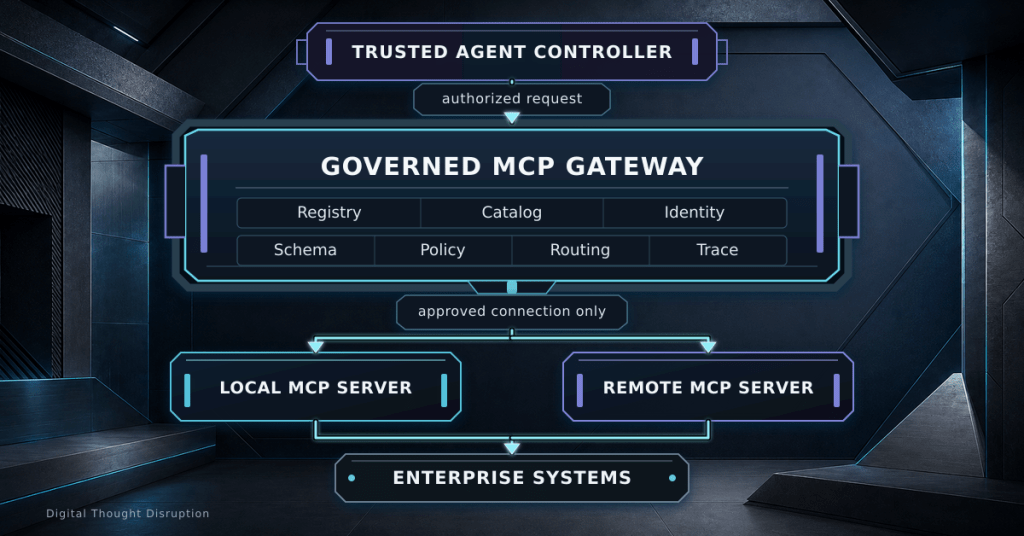
The diagram below shows the relationship between the trusted controller, gateway controls, MCP connections, servers, and enterprise systems.

The gateway narrows and governs access before the request reaches a server.
The server then performs another control decision using domain knowledge that the gateway may not possess.
The enterprise system performs the final resource-level enforcement.
This layered design is deliberate. It prevents one incorrect gateway rule, compromised server, or overprivileged token from becoming the only barrier protecting an enterprise system.
Responsibility Boundaries
| Layer | Owns | Must not be trusted to own alone |
|---|---|---|
| Trusted controller | Workflow intent, policy, risk, approval, budget, lifecycle | MCP transport details and domain execution |
| MCP gateway | Server admission, tool exposure, schema enforcement, connection routing, credential selection, telemetry | Final business authorization or authoritative workflow state |
| MCP server | Domain validation, downstream authorization, business rules, execution, evidence | Enterprise-wide workflow policy or unrestricted credential delegation |
| Enterprise system | Authoritative resource state and native permissions | Agent planning or cross-system orchestration |
| Model | Proposed tool and candidate arguments | Server identity, permission scope, environment, or approval status |
The controller may authorize an action class such as restarting one unhealthy service.
The gateway decides which approved MCP server and tool may carry that action, which identity and route apply, and whether the tool contract still matches the approved version.
The server determines whether the named service exists, whether it is in a restartable state, whether the caller may act on it, and whether the requested operation violates a domain rule.
The enterprise platform applies its own native access controls and records the final state.
An MCP server should not enter the production catalog because someone discovered it, installed it successfully, or found it in a public registry.
Discovery is the start of review.
It is not the end of review.
The official MCP Registry provides standardized metadata, namespace ownership signals, package references, endpoint information, and version records. Its documentation also makes the boundary clear: the registry focuses on metadata and namespace authentication, while broader security scanning and curation are handled elsewhere in the ecosystem.
An enterprise admission process should therefore collect evidence across several layers.
Publisher identity
Confirm who controls the server namespace, repository, package, image, domain, and release process.
Namespace ownership reduces simple impersonation. It does not prove that the publisher is secure, the release account is uncompromised, or the implementation follows enterprise requirements.
Executable identity
Determine exactly what will run.
For a locally executed server, identify:
- package and exact version
- container image digest
- binary hash
- source commit
- dependency lock
- installation command
- runtime command
- startup arguments
- environment variables
- dynamically downloaded components
Avoid approving a repository while executing an unverified package that happens to share the same name.
Remote service identity
For a remote server, identify:
- exact endpoint
- domain owner
- TLS identity
- hosting region
- authentication provider
- data-processing boundary
- retention behavior
- subprocessors
- service-level expectations
- change-notification process
- incident contact
A remote server can change without a client package update. The admission record therefore needs both technical and vendor-operational evidence.
Capability inventory
Start the candidate server in a controlled environment and enumerate:
- tools
- descriptions
- input schemas
- output schemas
- annotations
- resources
- prompts
- task support
- external dependencies
- network destinations
- required authorization scopes
The runtime capability inventory is more meaningful than a marketing description.
Risk classification
Classify every capability independently.
| Tool class | Example | Default enterprise treatment |
|---|---|---|
| Bounded read | Retrieve one approved ticket or service record | Allow with narrow identity and logging |
| Broad read | Search mailboxes, repositories, or customer records | Require data-boundary review and result filtering |
| Reversible write | Create a draft, add a comment, or open a ticket | Policy approval or user confirmation |
| Consequential write | Change production configuration or access | Explicit approval and post-condition verification |
| Destructive | Delete, revoke, terminate, or purge | Deny by default or require controlled break-glass |
| Execution | Run code, shell commands, or deployment actions | Strong isolation and narrowly approved workflows |
| Open-world | Browse arbitrary destinations or call arbitrary APIs | Avoid or constrain to an explicit allowlist |
A server can contain tools in several risk classes. Approval should operate at the tool level rather than treating the complete server as uniformly safe.
Build a Private Catalog, Not a Shared Bookmark List
The enterprise MCP catalog should represent a trust decision, not merely a discovery result.
Useful catalog fields include:
- server identifier
- approved owner
- business purpose
- environment
- exact artifact or endpoint
- approved protocol and SDK versions
- reviewed source commit
- approved tool subset
- tool risk classifications
- tool-definition hash
- required identities and scopes
- permitted data classifications
- network destinations
- sandbox profile
- approval requirements
- evidence-retention requirements
- review date
- approval expiration
- known risks
- compensating controls
- quarantine status
- deprecation status
- emergency disablement owner
The public registry can feed the intake pipeline. It should not automatically feed the production model context.
The internal catalog should publish only entries that have passed the organization’s review and promotion process.
MCP supports tool discovery through the tools list operation. Servers can also announce that the available tool list has changed.
Those protocol capabilities do not require the host to expose the entire returned list to the model.
The gateway should calculate the visible catalog for each request using trusted context such as:
- authenticated requester
- agent workload identity
- tenant
- task type
- workflow stage
- target environment
- data classification
- risk tier
- approval status
- remaining authority budget
- current incident or change window
A diagnostic workflow may receive only health, inventory, and read-only tools.
A remediation workflow may gain one write tool only after a policy decision and approval.
A development agent should never receive production tools merely because it can technically connect to the same server.
Use deny-by-default catalog construction
Start with no tools.
Add tools only when every required condition matches.
This is safer than discovering everything and attempting to remove prohibited tools afterward.
Separate discovery from invocation permission
A user may be allowed to know that a capability exists without being allowed to invoke it.
Conversely, hiding a tool from the model is useful but should not be the only authorization control. A direct request against the server must still be rejected when the caller lacks permission.
Control name collisions
Different servers may advertise identical or ambiguous tool names.
The gateway should maintain a stable internal identity that includes:
- server identifier
- server version
- tool name
- contract version
- environment
The model-facing name can remain readable, but the execution system should resolve it to an unambiguous approved target.
Treat list changes as security events
A changed tool list should not be processed as a harmless user-interface refresh.
A new tool, removed tool, altered description, changed schema, or different annotation can change what the model sees and how it behaves.
The gateway should:
- retrieve the new tool surface
- normalize it
- calculate a new hash
- compare it with the approved record
- identify material differences
- remove affected tools from the visible catalog
- quarantine the server when required
- trigger revalidation
- alert the owner
Automatic exposure of newly discovered tools undermines the original approval.
An MCP tool definition is not passive API documentation.
The model consumes the tool name and description as part of its decision context. A malicious or poorly written description can influence tool selection, request unrelated data, suppress warnings, or encourage the model to combine tools in an unsafe way.
Review descriptions for:
- hidden operational instructions
- attempts to override host policy
- requests for unrelated secrets
- instructions to call another tool
- language that bypasses approval
- misleading claims about safety
- instructions to conceal behavior
- unnecessary inclusion of sensitive examples
Descriptions should explain:
- what the tool does
- what it does not do
- required inputs
- expected side effects
- important constraints
- what successful execution means
- common failure conditions
They should not become a second system prompt.
Schema Governance Is Contract Governance
The MCP Tools specification requires a valid input schema for each tool and allows an output schema for structured results.
That gives the gateway and server a useful enforcement contract, but only when the schemas are designed carefully.
Constrain inputs narrowly
Use explicit constraints such as:
- required fields
- enumerated operations
- minimum and maximum values
- string patterns
- maximum lengths
- bounded arrays
- approved identifier formats
- explicit object properties
- rejection of additional properties
Avoid schemas such as:
{
  "type": "object",
  "additionalProperties": true
}
for consequential operations. That pattern allows the model to invent fields the review process never considered.
A safer schema is explicit:
{
  "type": "object",
  "additionalProperties": false,
  "properties": {
    "service_id": {
      "type": "string",
      "pattern": "^[a-z0-9-]{3,64}$"
    },
    "environment": {
      "type": "string",
      "enum": ["development", "test", "production"]
    },
    "restart_mode": {
      "type": "string",
      "enum": ["single_instance", "rolling"]
    },
    "reason": {
      "type": "string",
      "minLength": 10,
      "maxLength": 500
    }
  },
  "required": [
    "service_id",
    "environment",
    "restart_mode",
    "reason"
  ]
}
The schema restricts shape. Trusted policy must still determine whether the selected environment and operation are authorized.
Define structured outputs
An output schema should give the controller and verification service something stronger than free-form text.
Useful output fields include:
- execution status
- target identifier
- operation identifier
- side-effect status
- authoritative record version
- retry classification
- verification hints
- evidence references
- structured error code
- correlation ID
A model-friendly summary can still be returned as text, but automation should depend on the structured result.
Version schemas deliberately
A schema change can be operationally significant even when the server version number changes only slightly.
The gateway should record:
- input schema hash
- output schema hash
- description hash
- annotation hash
- contract version
- approved server version
Breaking changes should require explicit promotion.
Adding an optional field may still be material when the field enables a new capability or data path.
Test more than schema validity
A request can be schema-valid and still unsafe.
Test:
- unauthorized resource identifiers
- wrong tenant
- cross-environment targets
- boundary values
- duplicate requests
- conflicting state
- expired approvals
- unexpected Unicode and encoding
- injection content
- oversized outputs
- slow dependencies
- malformed downstream responses
- unknown execution outcomes
Schema validation is one layer of control, not the complete business rule.
Identity Must Remain Separate Across the Connection Path
An MCP request may involve several identities:
- requester
- agent
- controller
- gateway
- MCP client
- MCP server
- downstream service identity
Collapsing these identities into one shared token weakens authorization and auditability.
A good design records which identity is responsible at each boundary.
The inbound token presented to an MCP server should be intended for that MCP server.
It should not be forwarded unchanged to an unrelated downstream API.
The server should obtain a separate downstream credential using an approved pattern such as:
- delegated token exchange
- workload identity
- managed identity
- short-lived service credential
- approved credential broker
- narrowly scoped application role
The model should never provide the token, select the credential, or choose an arbitrary downstream audience.
OAuth Access Is Not Complete Business Authorization
MCP authorization provides a standard way to protect access to an MCP server. It does not eliminate the need for tool-level and resource-level authorization.
A valid token may prove that:
- the client authenticated
- the user or workload is known
- the token was issued for the MCP server
- certain scopes were granted
- the token is within its valid lifetime
It does not automatically prove that the caller may:
- modify the specific customer record
- restart the named production service
- approve the financial transaction
- delete the requested resource
- access data belonging to another tenant
- operate during the current change window
The server must combine token claims with current domain state and business rules.
Avoid wildcard scopes such as:
- full access
- all tools
- admin
- unrestricted data
Use progressive and tool-aligned scopes where practical.
A baseline token may permit discovery and low-risk reads. Higher-impact operations can require narrower elevation tied to a specific use case.
The enterprise-managed authorization extension can reduce per-server authorization sprawl by involving the organization’s identity provider. That improves centralized access control, onboarding, revocation, and policy consistency. It does not remove the server’s obligation to validate the requested operation.
Routing Is a Security Decision
The gateway should not route merely by server name.
Routing decisions may need to consider:
- tenant
- environment
- region
- data residency
- server trust tier
- approved version
- service health
- maintenance state
- downstream dependency
- model or agent release
- workflow type
- policy obligation
A production request should resolve only to a production-approved server instance.
A development host should not be able to replace a production destination through model-generated arguments, environment variables, or a changed configuration file.
Do not accept arbitrary destinations
Avoid tools or gateway parameters such as:
- target URL
- arbitrary hostname
- custom API base
- proxy destination
- unrestricted resource URI
when those values come from the model.
Use internal identifiers that trusted routing configuration resolves to approved destinations.
Constrain remote server egress
Remote connections should pass through an egress policy that can enforce:
- approved domains
- approved IP ranges
- TLS requirements
- redirect handling
- DNS behavior
- rate limits
- request size
- response size
- timeout
- regional routing
- data-class restrictions
OAuth discovery introduces additional outbound lookups. Those URLs must be validated to prevent the client or gateway from being induced to access internal services, metadata endpoints, or unintended destinations.
Isolate local servers
A local server can inherit significant access from the host process.
Use controls such as:
- non-root execution
- restricted file system
- explicit mounted paths
- no ambient shell environment
- no inherited cloud credentials
- no container-engine socket
- controlled child processes
- outbound network deny by default
- CPU and memory limits
- process limits
- execution timeout
- temporary writable storage
- application sandbox or container boundary
Local does not mean trusted.
It means the execution risk is closer to the user or agent runtime.
The MCP Server Must Remain a Domain Enforcement Point
A common gateway mistake is to assume that a request reaching the server has already been fully authorized.
That makes the server a thin proxy and creates a single point of control failure.
The MCP server should independently enforce:
- token audience and validity
- tool-level permission
- tenant boundary
- resource-level authorization
- business state
- input constraints
- operation preconditions
- rate limits
- idempotency
- downstream credential scope
- data minimization
- output sanitization
- post-action evidence
The server understands domain rules that the gateway may not.
For example, the gateway may know that the caller is allowed to use service.restart.request in production.
The server may know that:
- the service is in a protected deployment window
- a rolling restart is already running
- the service belongs to a different tenant
- only one instance may be restarted
- a database migration is active
- the requested action would violate quorum
- the target is marked as non-interruptible
- an incident commander has placed a hold
The server should return a structured denial rather than blindly forwarding the operation.
Keep Read, Simulate, Propose, and Execute Separate
One tool that performs every mode through a parameter is difficult to govern.
Prefer separate tools such as:
service.health.readservice.restart.simulateservice.restart.proposeservice.restart.executeservice.restart.status
This separation improves:
- tool discovery
- scope design
- approval rules
- model selection
- auditing
- testing
- error handling
- blast-radius analysis
The execute tool should require stronger authorization and a narrower schema than the simulation tool.
The simulation result can become evidence for approval without granting permission to perform the change.
Error Contracts Must Support Safe Recovery
The MCP Tools specification distinguishes protocol errors from tool execution errors.
Protocol errors cover conditions such as:
- unknown tool
- malformed request
- server-level protocol failure
Tool execution errors can describe:
- invalid business input
- downstream API failure
- resource conflict
- policy or domain rejection
A production server should go further by returning an actionable structured error contract.
{
  "status": "failed",
  "error": {
    "code": "RESOURCE_STATE_CONFLICT",
    "category": "business_rule",
    "retryable": false,
    "side_effect_state": "not_started",
    "message": "The service has an active deployment.",
    "operator_action": "Wait for the deployment to complete.",
    "correlation_id": "op-7f291"
  }
}
Useful error fields include:
- stable code
- category
- retryable status
- side-effect state
- target identifier
- current authoritative state
- required approval
- retry delay
- operator action
- evidence reference
- correlation ID
Distinguish unknown outcome from failed outcome
A timeout after sending a request does not prove the side effect failed.
The server or gateway should classify outcomes such as:
- not started
- started
- completed
- failed before side effect
- partially completed
- outcome unknown
- compensated
- compensation failed
The controller should query status or the authoritative system before retrying an unknown outcome.
Do not let the model define retryability
The model can interpret an error and propose a response.
Trusted code must decide whether the operation may be retried, whether the same idempotency key applies, and whether approval remains valid.
The gateway should validate results before returning them to the model.
A legitimate MCP server can return content originating from:
- tickets
- chat systems
- websites
- source repositories
- documents
- customer records
- databases
- third-party APIs
That content may contain instructions intended to manipulate the model.
Tool results must not be allowed to:
- change system policy
- add tools
- increase scopes
- mark an approval as complete
- select a different environment
- disable validation
- alter the authority budget
- inject credentials
- bypass confirmation
The gateway or host should distinguish:
- control instructions from trusted code
- tool metadata from approved catalog state
- untrusted result data
- user-facing content
- model-facing summaries
- evidence stored for verification
Validate output schemas
When an output schema exists, reject or quarantine results that do not conform.
A schema-valid result may still contain unsafe text, sensitive data, or misleading values, so additional inspection remains necessary.
Sanitize and classify output
Apply controls for:
- secret detection
- sensitive-data classification
- tenant boundary
- maximum size
- allowed content types
- allowed resource links
- URI schemes
- embedded files
- active content
- malicious instructions
- invalid encoding
Do not automatically fetch every resource link returned by a server.
A returned URI is data until trusted policy approves how it will be used.
A Practical Gateway Policy
The following YAML is an enterprise policy example. It is not a native MCP configuration format.
It shows the controls that should surround an approved server and its tools.
mcp_gateway_policy:
  version: 3

  defaults:
    unknown_servers: deny
    unknown_tools: deny
    unapproved_versions: deny
    tool_surface_change: quarantine
    direct_production_connections: deny

  server:
    id: com.example.platform/service-operations
    owner: platform-operations
    environment: production

    approved_runtime:
      type: remote
      release: 4.2.3
      endpoint_id: platform-operations-primary
      automatic_updates: false

  catalog:
    expose:
      - service.health.read
      - service.restart.simulate
      - service.restart.execute
      - service.operation.status

    risk:
      service.health.read: bounded_read
      service.restart.simulate: simulation
      service.restart.execute: consequential_write
      service.operation.status: bounded_read

    change_detection:
      hash_names: true
      hash_descriptions: true
      hash_input_schemas: true
      hash_output_schemas: true
      hash_annotations: true
      action_on_difference: quarantine

  identity:
    inbound:
      validate_audience: true
      require_user_or_workload_subject: true
      permit_wildcard_scopes: false

    downstream:
      credential_source: workload_identity
      token_passthrough: deny
      one_identity_per_environment: true
      token_lifetime_minutes: 15

  routing:
    production:
      allowed_endpoint_ids:
        - platform-operations-primary
      deny_model_supplied_destinations: true
      require_tls: true
      egress_default: deny

  schemas:
    reject_additional_properties: true
    validate_input_at_gateway: true
    validate_input_at_server: true
    validate_structured_output: true
    maximum_result_bytes: 1048576

  approvals:
    service.restart.execute:
      required: true
      bind_to_target: true
      bind_to_argument_hash: true
      bind_to_tool_version: true
      maximum_age_minutes: 20

  execution:
    require_idempotency_key: true
    unknown_outcome_retry: deny
    default_timeout_seconds: 30
    maximum_concurrent_calls_per_run: 2
    verify_postcondition: true

  telemetry:
    record_server_id: true
    record_server_version: true
    record_tool_contract_hash: true
    record_user_and_agent_identity: true
    record_policy_decision: true
    record_route: true
    record_result_classification: true
    redact_secrets: true
    capture_raw_tokens: false

  emergency_controls:
    server_kill_switch: true
    per_tool_kill_switch: true
    route_kill_switch: true
    credential_revocation: true
The values should be adjusted for the actual server, environment, tool risk, identity system, and service objectives.
Successful enforcement means:
- an unapproved server cannot connect
- an unapproved tool cannot appear
- a schema change triggers quarantine
- the model cannot choose a production endpoint
- inbound and downstream tokens remain separate
- consequential writes require valid approval
- unknown outcomes are not blindly retried
- operators can disable the affected capability quickly
A policy file that is not enforced by the host, gateway, runtime, and server is documentation only.
A useful MCP trace should connect:
- original business request
- controller run ID
- user identity
- agent identity and release
- policy decision
- visible tool catalog
- server and tool versions
- tool contract hash
- selected route
- authorization scopes
- approval evidence
- sanitized arguments
- execution latency
- protocol result
- tool result
- downstream operation ID
- retry decision
- verification result
- final workflow state
Logs that record only the tool name and response time are insufficient for investigation.
At the same time, full argument and result capture can expose:
- access tokens
- passwords
- private keys
- customer data
- source code
- incident details
- regulated records
Telemetry design should use:
- field-level redaction
- data classification
- allowlisted attributes
- hashed identifiers where appropriate
- restricted evidence stores
- separate operational and forensic retention
- access reviews
- deletion procedures
Trace completeness and data minimization must be designed together.
Lifecycle Management Is Part of Gateway Governance
An approved MCP server is not approved forever.
The trust decision should be re-evaluated when material inputs change.
Useful revalidation triggers include:
- publisher ownership
- package version
- image digest
- source commit
- signing identity
- dependency lock
- installation command
- startup arguments
- remote endpoint
- authentication provider
- hosting region
- tool names
- descriptions
- schemas
- annotations
- authorization scopes
- network destinations
- data retention
- subprocessor list
- security finding
- support status
- operational owner
Promote changes through environments
Use a release path such as:
Testing a server beside other production tools matters because risks can emerge through combinations.
A broad-read server paired with an external messaging tool creates a different risk than either server in isolation.
Define rollback
Rollback may involve:
- restoring the prior server version
- restoring the previous tool-surface hash
- routing to an alternate approved endpoint
- disabling one changed tool
- reverting a gateway policy
- revoking a new credential
- returning the workflow to read-only mode
The rollback path should be tested before an upgrade reaches production.
Define retirement
Retirement should remove:
- server catalog entry
- tool exposure
- credentials
- DNS or route configuration
- environment variables
- package access
- sandbox permissions
- approval policies
- dashboards and alerts
- retained secrets
- obsolete evidence according to retention policy
A deprecated server that still has a valid token remains an active risk.
Common Gateway and Server Failure Modes
| Failure mode | Operational consequence | Corrective control |
|---|---|---|
| Gateway acts as a transparent proxy | Connections are centralized but not governed | Add identity, catalog, schema, policy, routing, and evidence enforcement |
| Registry listing treated as approval | Unreviewed code or endpoints gain access | Use an enterprise admission and promotion pipeline |
| Entire tool list exposed | Model receives unnecessary authority and prompt surface | Build the visible catalog per request |
| Tool annotations trusted automatically | Unsafe operations are misclassified | Treat annotations as hints until the server is trusted and behavior tested |
| One token reused end to end | Audience, accountability, and least privilege collapse | Separate inbound, workload, server, and downstream credentials |
| Schema validation treated as authorization | Valid but unauthorized operations execute | Apply policy and domain checks after schema validation |
| Gateway is the only authorization layer | A policy defect exposes the backend | Reauthorize in the MCP server and enterprise system |
| Tool changes appear automatically | New capabilities bypass review | Hash the tool surface and quarantine changes |
| Timeout triggers automatic retry | Side effects may be duplicated | Reconcile unknown outcomes and require idempotency |
| Local server inherits host environment | Broad credentials and file access leak | Use sandboxing and explicit credential injection |
| Remote server accepts arbitrary destinations | SSRF and data exfiltration paths expand | Use trusted destination IDs and egress policy |
| Logs contain raw tokens and data | Observability becomes a breach path | Redact, minimize, and separate forensic evidence |
| No named owner | Nobody can approve, monitor, or disable the server | Require ownership before catalog promotion |
| No emergency controls | A compromised tool remains reachable | Test server, tool, route, and credential kill switches |
Practical Implementation Sequence
Inventory existing connections
Find every MCP server configured in:
- desktop clients
- IDEs
- agent frameworks
- automation services
- shared hosts
- CI/CD environments
- container platforms
- internal gateways
Record server, owner, transport, tools, identities, secrets, environments, and downstream systems.
Establish an enterprise server identifier
Assign one stable identity per approved server and version line.
Do not rely only on display names or package names.
Create the private catalog
Populate ownership, artifact, endpoint, tool, schema, risk, identity, route, and lifecycle evidence.
Begin with read-only or low-risk servers.
Put catalog enforcement in the host or gateway
Make unlisted servers and tools unavailable by default.
Prevent local configuration from silently bypassing the approved catalog.
Introduce dynamic tool filtering
Build the visible tool list from trusted workflow context.
Verify that denied tools cannot be called directly even when their names are known.
Separate credentials
Replace shared API keys and user-owned personal tokens with narrow delegated or workload identities.
Validate token audience and downstream scope.
Add schema and contract checks
Validate both inbound arguments and structured results.
Store approved contract hashes and detect drift.
Add network and runtime controls
Sandbox local servers and route remote servers through controlled egress.
Block arbitrary destinations and unnecessary network access.
Add domain enforcement
Confirm that every MCP server performs its own resource and business-rule checks rather than trusting the gateway blindly.
Add observability and kill switches
Correlate the complete request path and test emergency disablement.
Remove direct production paths
Once the governed route is operational, block unmanaged clients and direct server access where practical.
A gateway cannot provide a reliable boundary while unrestricted alternate paths remain open.
MCP Gateway and Server Governance Checklist
Admission and catalog
- Every server has a named technical and business owner.
- Public discovery is separate from enterprise approval.
- The exact artifact, digest, package, or endpoint is recorded.
- Runtime capabilities are enumerated before production access.
- Tools are classified individually by risk.
- The private catalog contains review and expiration dates.
- Unknown servers and versions are denied by default.
Tool exposure
- The visible catalog is built per user, agent, task, environment, and risk.
- Discovery permission is separate from invocation permission.
- Tool identities include server and version context.
- New or changed tools trigger revalidation.
- Tool descriptions are reviewed as model-facing input.
- Annotations are not treated as trusted security controls.
Schemas and contracts
- Input schemas reject unnecessary properties.
- Strings, arrays, numbers, and identifiers are bounded.
- Output schemas are defined for automation-critical results.
- Gateway and server both validate requests.
- Structured outputs are validated before use.
- Contract hashes and versions are stored.
- Business-rule testing extends beyond schema validity.
Identity and authorization
- Requester, agent, gateway, server, and downstream identities are distinguishable.
- Tokens are audience-bound.
- Token passthrough is prohibited.
- Downstream credentials are short-lived and narrowly scoped.
- Wildcard scopes are avoided.
- Server-level and resource-level authorization remain active.
- The model cannot select credentials or token audiences.
Routing and isolation
- Environment and region routes come from trusted configuration.
- Model-supplied destinations are rejected.
- Remote server traffic passes through egress controls.
- OAuth discovery URLs and redirects are validated.
- Local servers run with restricted file, process, and network access.
- Development clients cannot reach production servers or credentials.
Execution and errors
- Write operations require idempotency keys.
- Error codes are stable and structured.
- Retryability is decided by trusted code.
- Unknown outcomes are reconciled before retry.
- Side-effect state is included in error evidence.
- Timeouts, concurrency, and rate limits are enforced.
- Post-conditions are independently verified.
Results and telemetry
- Tool output is treated as untrusted data.
- Output schemas and content controls are applied.
- Sensitive fields are redacted.
- Resource links are not fetched automatically.
- One trace connects controller, gateway, server, and backend.
- Tool and contract versions appear in evidence.
- Raw tokens are never logged.
Lifecycle and operations
- Changes move through development and staging before production.
- Tool-surface drift can quarantine a server automatically.
- Rollback to the prior approved version is tested.
- Server, tool, route, and credential kill switches exist.
- Credentials are revoked during retirement.
- Direct unmanaged production paths are removed.
- Incident ownership and escalation are documented.
Operational Ownership
| Capability | Primary owner |
|---|---|
| Private MCP catalog | AI platform or developer-platform team |
| Publisher and artifact review | Application security and software supply chain |
| Tool risk classification | Application owner and AI governance |
| User and workload identity | Identity and access management |
| Token and scope design | Identity team and MCP server owner |
| Gateway policy | AI platform and security architecture |
| Local runtime isolation | Endpoint, container, or platform engineering |
| Network routing and egress | Network security |
| Domain validation | MCP server and enterprise application owner |
| Tool contract testing | MCP server owner and quality engineering |
| Runtime telemetry | Observability and security operations |
| Approval requirements | Business service owner and risk owner |
| Incident disablement | Platform owner with security authority |
| Revalidation and retirement | Registry governance owner |
One owner should remain accountable for the end-to-end agent service even when these responsibilities are distributed.
Without that accountability, the gateway can become a catalog of technical integrations with no one responsible for their combined behavior.
Conclusion
The MCP gateway and server layer is where standardized connectivity becomes an enterprise capability.
The gateway should admit approved servers, expose the minimum tool catalog, enforce identity and routing, validate schemas, isolate credentials, constrain network paths, detect changes, and preserve evidence. The MCP server should remain responsible for domain authorization, business validation, safe execution, idempotency, and structured results. The enterprise system should continue protecting the authoritative resource.
No single trust signal is sufficient.
A registry listing proves discovery. Namespace verification provides publisher accountability. A schema defines a contract. An OAuth token establishes a form of access. A gateway creates a central enforcement point.
Production trust appears only when those signals are combined with artifact control, tool-level approval, least-privilege identity, domain enforcement, runtime isolation, change detection, verification, and operational ownership.
The practical architecture is:
The controller authorizes the workflow. The gateway governs the connection. The server enforces the domain. The enterprise system protects the record.
Part 4 of this series will follow the request beyond the server boundary and explain how the execution runtime should enforce idempotency, isolate side effects, verify post-conditions, collect evidence, compensate for partial failure, and roll back agent actions without creating additional damage.
