


Introduction
The moment an AI agent can call tools, the security conversation changes.
A chatbot that only generates text can still create risk, but an agent that can query systems, send messages, update records, open tickets, run code, trigger workflows, or call internal APIs has crossed into operational territory.
At that point, the prompt is no longer the main boundary.
The tool layer is.
Enterprise teams need to treat tool calling as an access and governance problem. That means every tool needs an owner, purpose, schema, identity scope, approval rule, telemetry trail, and rollback expectation.
Without that discipline, the tool catalog becomes the agent’s blast radius.
Traditional application security assumes code follows predefined paths. An AI agent introduces a different behavior pattern. The model interprets a request, chooses a tool, fills in arguments, consumes the result, and may choose another tool based on what happened.
That loop is powerful, but it is also where mistakes compound.
A bad tool description can cause the model to pick the wrong capability. A broad schema can let the model send dangerous parameters. A missing approval gate can allow a low-confidence agent to execute a high-impact action. A weak identity boundary can let the agent act with more privilege than the user who initiated the task.
Tool calling is where model reasoning meets enterprise authority.
That makes it the practical security boundary for agentic AI.
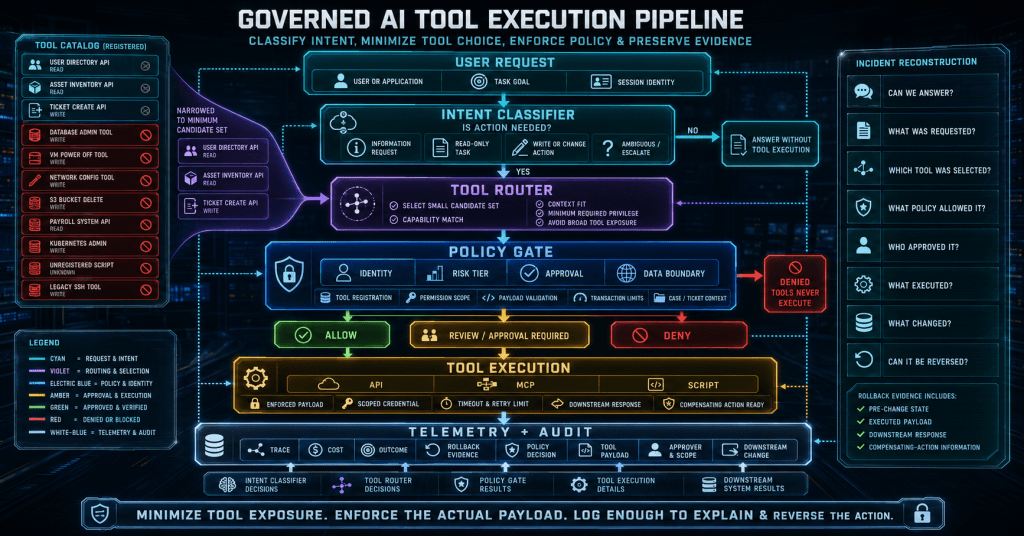
The model should not see every tool, and it should not execute every selected tool automatically. Tool access needs routing, policy, approval, telemetry, and rollback awareness.

The key pattern is narrowing. The agent should move from user intent to a small candidate tool set, then through policy, then into execution. Sending every available tool to the model and hoping it picks correctly is not an enterprise strategy.
A tool is usually deterministic code. It performs a defined operation and returns a result.
A subagent is another reasoning system. It may plan, call tools, summarize evidence, and make intermediate decisions before returning a result.
That difference matters for governance.
A tool can often be secured like an API. It has a schema, permissions, validation rules, and predictable behavior.
A subagent needs stronger supervision because it introduces another context window, another reasoning loop, another prompt, and often another tool set.
| Capability | Tool | Subagent |
|---|---|---|
| Core behavior | Executes defined code | Performs delegated reasoning |
| Cost profile | Usually lower | Usually higher |
| Latency | Usually lower | Usually higher |
| Visibility | Direct result visible to orchestrator | Intermediate reasoning may be hidden |
| Best fit | API calls, search, validation, transformation | Research, synthesis, parallel analysis, complex subtasks |
| Governance concern | Parameters, permissions, side effects | Scope, tool access, delegation, hidden failure modes |
The default should be simple: use a tool when the task is deterministic and well-bounded. Use a subagent when the work requires independent reasoning, context isolation, or parallel investigation.
Subagents should not be introduced just because the architecture diagram looks more advanced.
Not all tools carry the same operational risk. A weather lookup and a database update should not share the same approval path.
A practical risk model starts with action impact and reversibility.
Every tool should have a tier before it is exposed to an agent. The tier should determine approval requirements, logging depth, allowed identities, rate limits, and rollback expectations.
Tool catalogs tend to grow.
A useful agent starts with five tools. Then a team adds Slack, a ticketing system, a CRM lookup, calendar access, file search, database queries, workflow triggers, deployment actions, and internal APIs. Eventually the agent is choosing from a crowded catalog with overlapping names and similar schemas.
That creates three problems.
The first is selection error. The model may choose a tool that sounds right but is not appropriate for the task.
The second is parameter confusion. The model may call the correct tool with arguments that belong to a different tool.
The third is context waste. Every unnecessary tool definition consumes space that could have been used for instructions, evidence, history, or reasoning.
The fix is not simply a better model. The fix is tool catalog governance.
The agent should not receive the entire tool inventory by default. It should receive a small, relevant, policy-filtered set of candidates.

This pattern makes tool exposure deliberate. The model only sees tools that are relevant to the task, allowed for the user, approved for the environment, and appropriate for the risk tier.
Permission Gates for High-Impact Actions
Human approval should not be a vague button at the end of the workflow. It should be attached to specific actions with specific evidence.
High-impact tools should require approval before execution, not after the agent has already acted.
Approval should include:
- The selected tool
- Proposed arguments
- User identity
- Target system
- Expected effect
- Rollback path
- Confidence or evaluation signal
- Evidence used to justify the action
A simple tool policy can make this explicit:
tool_policy:
  tools:
    update_ticket_priority:
      risk_tier: write
      allowed_roles:
        - service_desk_lead
        - platform_operations
      approval_required: conditional
      approval_when:
        - priority_set_to_p1
        - customer_impact_unknown
      rollback:
        method: restore_previous_priority
        required: true
    restart_service:
      risk_tier: execute
      allowed_roles:
        - platform_operations
      approval_required: always
      required_evidence:
        - impacted_service
        - health_check_result
        - change_window
        - rollback_owner
      rollback:
        method: run_service_restore_procedure
        required: true
    delete_record:
      risk_tier: destructive
      approval_required: always
      dual_approval_required: true
      default: deny
The point is to make approval a policy outcome, not a user interface afterthought.
Observability Is Part of the Control
A tool call without traceability is an incident waiting to happen.
Every production agent should capture:
- User request
- Candidate tools considered
- Tool selected
- Arguments generated
- Policy decision
- Approval decision
- Tool response
- Error handling
- Follow-up action
- Session cost
- Final outcome
This is more than logging. It is the evidence chain needed to debug agent behavior, explain outcomes, detect misuse, and improve the system.
For traditional applications, a failed API call may be enough to investigate. For agents, teams need the trajectory: what the agent believed, which tool it selected, why it selected it, what happened next, and whether the outcome stayed inside policy.
Statistical Guardrails and Runtime Checks
Deterministic policy is necessary, but it is not enough.
Agents are probabilistic systems. The same request can lead to different intermediate reasoning, tool choices, or outputs. Runtime checks help catch situations where the agent is drifting, uncertain, or attempting an action that does not match the task.
Useful guardrail patterns include:
- Schema validation before tool execution
- Argument allowlists and denylists
- Confidence thresholds for high-risk actions
- Semantic drift checks against allowed task scope
- Rate limits for repeated tool calls
- Budget caps per session
- Output validation before user delivery
- Post-action validation after execution
Guardrails should not be hidden inside the prompt. They should be implemented as runtime controls that can be tested, logged, and audited.
Practical Implementation Path
Do not start with a hundred tools and a fully autonomous agent.
Start with a small catalog. Assign an owner to every tool. Define purpose, risk tier, required identity scope, approval behavior, telemetry requirements, and rollback expectation.
Then expose tools through a gateway or controlled runtime instead of wiring them directly into prompts. Add routing so the model only sees relevant tools. Add policy gates before high-impact actions. Add trace capture before the first production pilot.
The rollout sequence should look like this:

That sequence keeps the agent useful while preventing tool access from becoming uncontrolled authority.
Conclusion
Tool calling is where agentic AI becomes operational.
That is why tool governance needs to be treated as an enterprise security boundary. The model should not receive every tool by default. It should not execute high-impact actions without policy. It should not act with unbounded privilege. It should not leave operators guessing why a tool was selected.
The right design narrows the tool set, enforces identity, gates risky actions, captures full traces, validates arguments, and defines rollback expectations before production users depend on the agent.
Prompts still matter.
But once an agent can act, the real control surface is the tool layer.
