Skip to content
Close Menu

    Subscribe to Updates

    Get the latest news from tastytech.

    What's Hot

    VCF 9.1 Management Services and Aria: Turning the Upgrade into an Operating Model

    July 12, 2026

    Human-in-the-Loop Is Not a Button: Designing Approval Paths for AI Agents That Can Actually Act

    July 12, 2026

    Tiny 332-layer chip just sampled by SanDisk could unlock massive 512TB drives by 2027

    July 12, 2026
    Facebook X (Twitter) Instagram
    Facebook X (Twitter) Instagram
    tastytech.intastytech.in
    Subscribe
    • AI News & Trends
    • Tech News
    • AI Tools
    • Business & Startups
    • Guides & Tutorials
    • Tech Reviews
    • Automobiles
    • Gaming
    • movies
    tastytech.intastytech.in
    Home»Tech Reviews»Tiny 332-layer chip just sampled by SanDisk could unlock massive 512TB drives by 2027
    Tiny 332-layer chip just sampled by SanDisk could unlock massive 512TB drives by 2027
    Tech Reviews

    Tiny 332-layer chip just sampled by SanDisk could unlock massive 512TB drives by 2027

    gvfx00@gmail.comBy gvfx00@gmail.comJuly 12, 2026No Comments4 Mins Read
    Share
    Facebook Twitter LinkedIn Pinterest Email


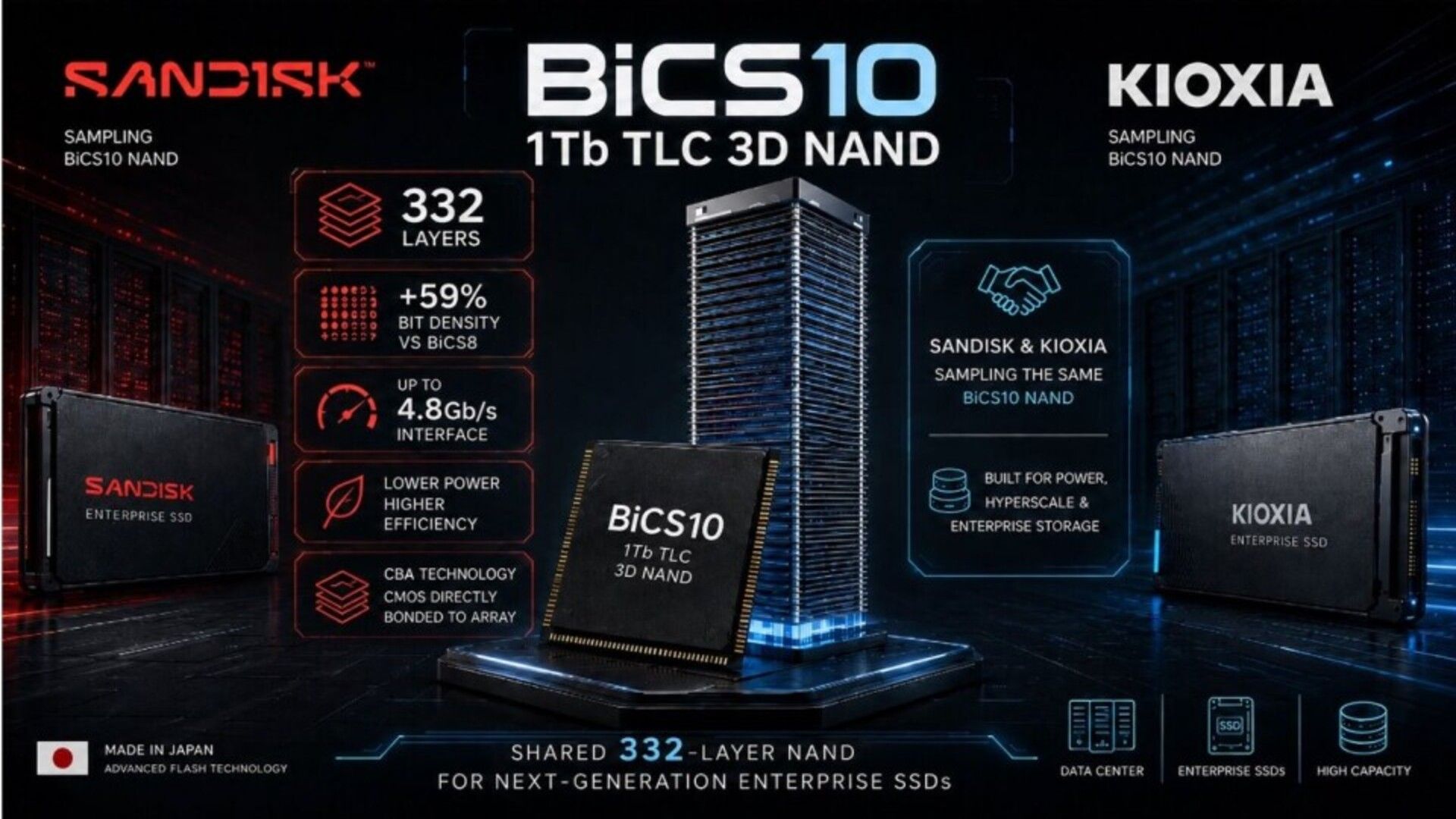
    • SanDisk’s BiCS10 chip reaches 29Gb per square millimetre in density
    • Bit density improved 59% compared to the previous BiCS8 generation
    • Interface speeds now hit 4.8Gb/s, a 33% increase

    SanDisk has confirmed it is now sampling BiCS10, its 10th-generation 3D NAND flash chip, built jointly with longtime manufacturing partner Kioxia.

    The 1Tb TLC chip packs 332 memory layers into a die that reaches an area bit density above 29Gb per square millimetre, which the company calls industry-leading.

    That figure represents a 59% improvement in bit density compared to the previous BiCS8 generation currently in mass production.

    Latest Videos From

    Table of Contents

    Toggle
    • A small chip built to scale into massive drives
    • Current pricing shows why 512TB drives won’t come cheap
      • Related posts:
    • DNS Server 101: Tricks to Better Security
    • Amazon's Big Summer Prime Day Sale Might Be Moving This Year. Here's What to Expect and How to Get R...
    • Norton VPN enters the AI agent space with 'first truly AI native' VPN for agents

    A small chip built to scale into massive drives

    BiCS10 uses Sandisk’s CMOS directly bonded to an array architecture, paired with a new Toggle DDR6.0 interface that pushes data transfer speeds up to 4.8Gb/s.

    This marks a 33% improvement over the prior generation’s interface speed, according to SanDisk’s own announcement of the sampling milestone.


    You may like

    Power efficiency also improved substantially, with input power consumption dropping 10% and output power consumption falling 34% relative to BiCS8.

    SanDisk has already confirmed a broader roadmap built around this chip, targeting a 256TB SSD in 2026 and a 512TB drive in 2027.

    Sign up to the TechRadar Pro newsletter to get all the top news, opinion, features and guidance your business needs to succeed!

    The company has also teased an eventual 1PB data center drive, though it has not committed to a specific year for that product.

    These capacity jumps depend on QLC memory adoption, with SanDisk shifting toward QLC for most capacity-focused products by 2028.

    The technology behind these future drives comes from a new 332-layer 3D NAND generation developed through the SanDisk and Kioxia partnership.


    What to read next

    The chip is built as a 1Tb TLC die, with capacity increases coming through layer stacking and improved lateral scaling rather than adding more bits per cell.

    Instead of adding more bits into each memory cell, the companies are increasing density through additional layers, improved layouts, and new circuit designs.

    The company reported that the new generation achieved a 4.8Gbps data transfer rate while reducing read energy consumption by 29% compared with previous designs.

    These improvements are aimed at increasing capacity without sacrificing endurance and reliability as much as higher-bit-per-cell methods could create.

    Current pricing shows why 512TB drives won’t come cheap

    Existing high-capacity enterprise drives offer the clearest signal of where 512TB pricing will eventually land.

    Solidigm’s 122.88TB D5-P5336 series currently retails between roughly $49,275 and $64,168, depending on configuration and packaging options chosen.

    Scaling that per-terabyte cost toward a 512TB drive suggests a price comfortably beyond $300,000 once SanDisk’s version reaches market in 2027.

    Competition in this space remains intense, with Kioxia, Samsung, Solidigm, and Micron all racing toward similar capacity milestones on comparable timelines.

    Samsung has separately confirmed plans for a 512TB PCIe 6.0 drive around 2027, following a 256TB Gen 5 launch expected in 2026.

    NAND supply itself remains tight, with flash contract prices projected to rise 70 to 75% quarter over quarter heading into mid-2026.

    That shortage, driven largely by enterprise demand tied to generative AI infrastructure, will likely keep pricing on these drives elevated well beyond initial launch.

    SanDisk’s BiCS10 sampling marks only the earliest technical step toward that 2027 target, with mass production and finished drives still several years from broad availability.


    Google logo on a black background next to text reading 'Click to follow TechRadar'

    Follow TechRadar on Google News and add us as a preferred source to get our expert news, reviews, and opinion in your feeds.

    Swipe to scroll horizontally
    Row 0 – Cell 0 Row 0 – Cell 1 Row 0 – Cell 2
    Row 1 – Cell 0 Row 1 – Cell 1 Row 1 – Cell 2
    Row 2 – Cell 0 Row 2 – Cell 1 Row 2 – Cell 2

    Related posts:

    Scientists turn ordinary wood into a solar-powered energy device that keeps generating electricity l...

    Today's NYT Mini Crossword Answers for April 20

    Wikipedia Says It's Losing Traffic Due to AI Summaries, Social Media Videos

    Share. Facebook Twitter Pinterest LinkedIn Tumblr Email
    Previous ArticleLego Donkey Kong leak shows a arcade-themed set that’s different than expected
    Next Article Human-in-the-Loop Is Not a Button: Designing Approval Paths for AI Agents That Can Actually Act
    gvfx00@gmail.com
    • Website

    Related Posts

    Tech Reviews

    UniFi Cloud Gateway Backups and Migration: Tips Keeping Protect Recordings and More

    July 12, 2026
    Tech Reviews

    Allstate accuses Broadcom of auditing it because it quit VMware, CA

    July 12, 2026
    Tech Reviews

    Phoebe Gates’ AI Shopping App Phia Reportedly Claimed Unearned Affiliate Sales Through Fake Clicks

    July 12, 2026
    Add A Comment
    Leave A Reply Cancel Reply

    Top Posts

    Black Swans in Artificial Intelligence — Dan Rose AI

    October 2, 2025207 Views

    Every Clue That Tony Stark Was Always Doctor Doom

    October 20, 2025131 Views

    We let ChatGPT judge impossible superhero debates — here’s how it ruled

    December 31, 2025100 Views
    Stay In Touch
    • Facebook
    • YouTube
    • TikTok
    • WhatsApp
    • Twitter
    • Instagram

    Subscribe to Updates

    Get the latest tech news from tastytech.

    About Us
    About Us

    TastyTech.in brings you the latest AI, tech news, cybersecurity tips, and gadget insights all in one place. Stay informed, stay secure, and stay ahead with us!

    Most Popular

    Black Swans in Artificial Intelligence — Dan Rose AI

    October 2, 2025207 Views

    Every Clue That Tony Stark Was Always Doctor Doom

    October 20, 2025131 Views

    We let ChatGPT judge impossible superhero debates — here’s how it ruled

    December 31, 2025100 Views

    Subscribe to Updates

    Get the latest news from tastytech.

    Facebook X (Twitter) Instagram Pinterest
    • Homepage
    • About Us
    • Contact Us
    • Privacy Policy
    © 2026 TastyTech. Designed by TastyTech.

    Type above and press Enter to search. Press Esc to cancel.

    Ad Blocker Enabled!
    Ad Blocker Enabled!
    Our website is made possible by displaying online advertisements to our visitors. Please support us by disabling your Ad Blocker.