


This post features the top five 10Gbps Multi-Gig routers — routers with multiple 10Gbps ports — among those I’ve evaluated. They matter because 10Gbps is the highest theoretical bandwidth available for any home or small business. Consequently, these are also the best routers for those with 10Gbps Internet.
I’ve used all of these devices for extended periods — from over a month to over a year — with my 10Gbps Sonic Fiber-optic plan, and I’m still using some of them right now at various locations with different multi-gigabit broadband plans. That’s to say they are really the top among their peers.
Dong’s note: I first published this post on May 2, 2024, and last updated it on June 30, 2026, with the latest picks.

Top five best routers with 10Gbps Multi-Gig ports of 2026: The list
A couple of things to keep in mind:
- We’re talking about wired networking here, and to qualify for this list, the bare minimum is that the routers must have at least two 10Gbps ports — one for the WAN and one for the LAN. With a 10Gbps switch and proper cabling, the entire home will have the highest possible bandwidth.
- These lists are sorted in recommendation order — the numbers indicate the ranking, with #1 being the best in my experience for my needs.
Notes on 10GbE network hardware
Network hardware needs at least two 10GbE network ports, high processing power, and compatible firmware to deliver top real-world performance at this grade.
Generally, consumer-grade 10GbE-capable routers and switches do not deliver true 10Gbps (10,000Mbps) throughput. After “overhead”, they sustain between 6.5Gbps and 9.5Gbps. Traffic-related features, such as QoS and security, when enabled, can adversely affect their bandwidth.
Hardware supporting the entry-level Multi-Gig, 2.5GbE, often can deliver closer to 2.5Gbps in real-world performance.
There are dozens of 10Gbps-capable routers on the market that I’d consider great, and picking only five is challenging. That said, when applicable, I’ll include comparable alternatives worthy of your consideration. So, consider these five as the top representatives of their peers.
1. UniFi Cloud Gateway Beast (UDM-Beast): 2x SFP28 (25Gbps), 2x SFP+ (10Gbps), 8x 10GBASE-T

The UDM-Beast represents rack-mount non-Wi-Fi “routers” from Ubiquiti. As the name suggests, it’s by far the most powerful non-Wi-Fi router for home and SMB use.
And when it comes to ports and port grade, it’s future-proof with ten 10Gbps ports and two 25Gbps ports. By itself, it can power a true 10 Gbps network, and even a 25 Gbps one when coupled with a switch. It’s the only router on this list that can deliver true 10,000Gbps of performance, and beyond, even after overhead.
Alternative:
Pros
Top-notch, future-proofing hardware specs with ten 10GbE ports and two 25Gbps ports to deliver excellent real-world performance
A complete set of useful networking features — powerful security/web-filtering, versatile VPN support, SD-WAN, Multi-WAN, to name a few — handled by top-notch processing power
Robust web-based user interface, useful and comprehensive mobile apps, generally easy to use
Dual-drive support with RAID 1, top-capacity built-in UniFi NVR, no subscription required
Cons
A Ubiquiti login account is required for some useful features to work
No PoE ports, comparatively high power consumption
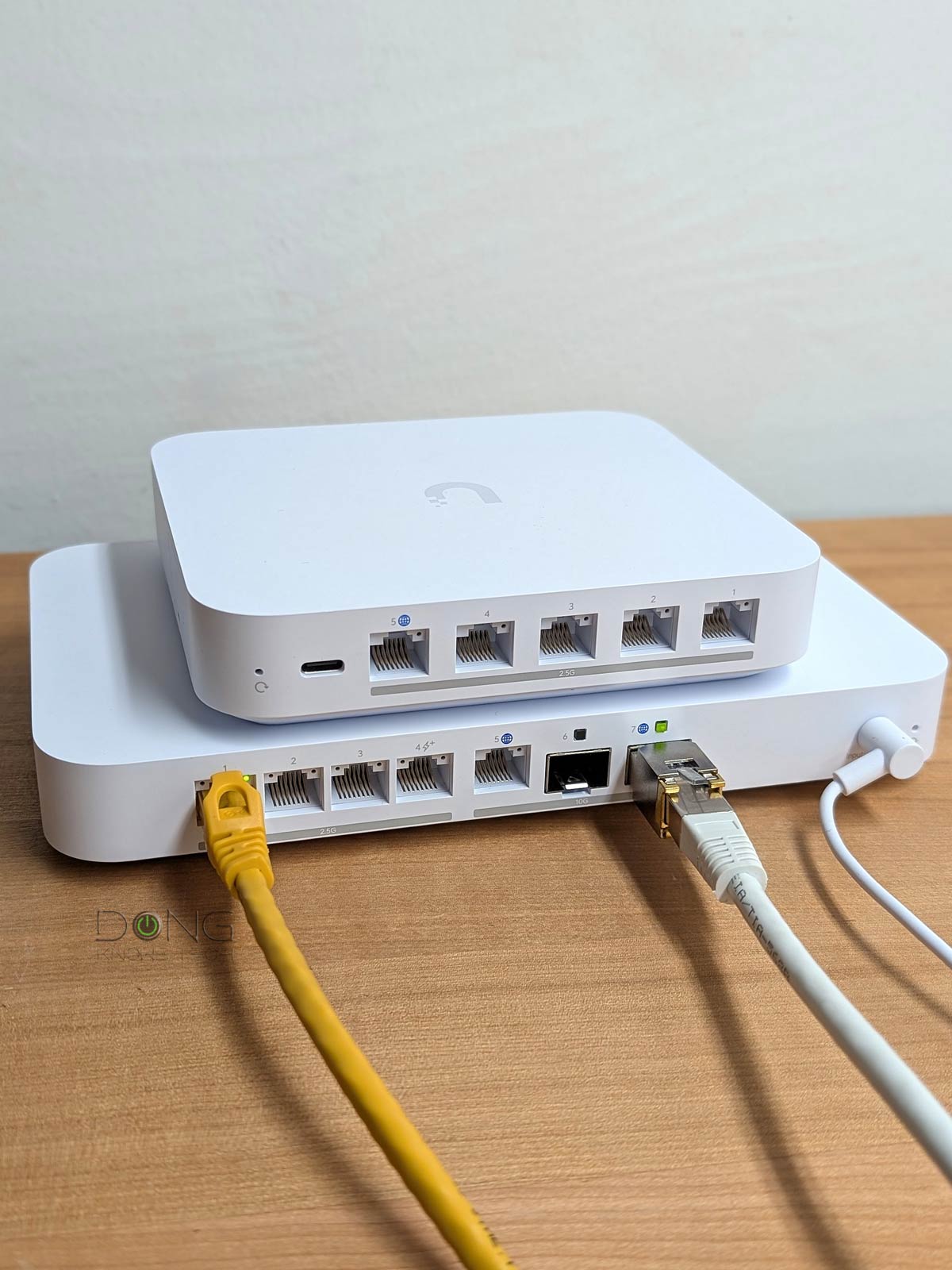
2. Ubiquiti UniFi Cloud Gateway Fiber (UCG-Fiber): 1x 10GBASE-T, 2x SFP+, 4x 2.5GBASE-T

If the UDM-Beast is a rack-mount gateway, the UniFi Cloud Gateway Fiber is a desktop-design counterpart. It, too, is a non-Wi-Fi router that can host multiple UniFi access points to create a robust mesh system.
The UCG-Fiber has two SFP+ ports, one 10GBASE-T port, and four 2.5GBASE-T ports, making it an excellent choice for home and small businesses with super-fast broadband.
Similar alternatives:
Pros
Top-tier hardware with three 10Gbps ports, four 2.5GBASE-T ports, PoE+ support, and an NVMe slot for NVR
Excellent and reliable real-world performance; can handle lots of concurrent UniFi devices (Wi-Fi access points, cameras, IP phones, etc.) and end-users
Compact and aesthetically pleasing design with everything for all users, from home to enterprise-grade
Lots of valuable features, each with tons of customization, comparatively affordable
Cons
Only one PoE+ port, no PoE++ support; SFP+ ports are less practical than 10GBASE-T
A Ubiquiti login account is required for the built-in Remote Management, as well as some other useful features, to work
Runs a bit warm, no SSD caddy is included in the non-storage version; no USB port or network-attached storage features
3. ASUS GT-BE19000AI: 2x 10GBASE-T and 4x 2.5GBASE-T
The GT-BE19000AI is arguably ASUS’s best Wi-Fi 7 router. Despite a similar design to previous ASUS ROG gaming routers, such as the GT-BE98 Pro or the GT-AX11000 Pro, it’s a totally different beast thanks to support for Edge AI and Docker hosting. Other than that, it has multiple Multi-Gig ports, tons of gaming features, and uncompromising Wi-Fi 7 support.
Like all ASUS routers, you can use multiple GT-BE19000AI units to build a formidable AiMesh Wi-Fi system.
Similar alternative:
Pros
Top-tier Wi-Fi 7 with excellent real-world performance
Refined ASUSWRT 6.0 firmware with lots of free, in-depth, and valuable features and settings (advanced VPN, AiProtection online protection, Parental Control, adblocking, virtual SSDs, AI-enabled gaming-related features, and AiMesh)
Two 10Gbps and four 2.5Gbps Multi-Gig ports with WAN/LAN flexibility; supports Dual-WAN and LAN Link Aggregations
No vendor required login account, silent performer, runs relatively cool
Cons
Bulky design, buggy and impractical Docker/AI support
Pricey, not wall-mount-ready
4. TP-Link Archer GE800: 1x 10GBASE-T, 1x 10GBASE-T/SFP+ combo, 4x 2.5GBASE-T
The Archer GE800 is TP-Link’s first actual gaming router. It’s a powerhouse with 7 top-tier Wi-Fi specs and a multi-Gigabit approach, including two 10Gbps and four 2.5Gbps ports. This Wi-Fi machine is arguably the best standalone router TP-Link has ever made.
Similar alternatives:
Pros
Top-tier tri-band Wi-Fi 7 specs with full multi-Gigabit to deliver excellent real-world performance
Robust web user interface with an excellent set of network features and Wi-Fi settings, including MLO and gaming-related features
Competitively priced; useful (optional) mobile app; EasyMesh-ready; cool-looking design
Cons
Bulky design with an audible internal fan; runs hot; Wi-Fi throughputs could be comparatively a tad better
No AFC; online protection and advanced parental controls require subscriptions
5. NETGEAR Nighthawk RS700S: 2x 10GBASE-T
The Nighthawk RS700S is NETGEAR’s first standalone router with two Multi-Gig ports — both are 10GBASE-T. Despite its markedly different design, it has virtually the same hardware specs as the ASUS RT-BE96U.
It’s the least recommended on this list due to its neutered web user interface. The omission of the standard and widely used web-based remote access feature alone is a deal-breaker for many advanced users. In fact, that was the reason I stopped using it after a month.
It’s also the sole router on this list that’s not mesh-capable — it works well only for homes where a single access point is sufficient. Still, if you have 10Gbps broadband, the NETGEAR RS700S has enough to make you happy.
Pros
Top-tier tri-band specs with Wi-Fi 7 support
Two 10Gbps Multi-Gig ports
Robust web interface, helpful (optional) mobile app
Practical fanless design; runs cool and quiet
Cons
Only two Multi-Gig ports; no standard Remote Management via Dynamic DNS
Online protection and Parental Controls require the Nighthawk mobile app and premium subscriptions
The takeaway
“Money is not an issue. Just tell me the best router to get!” is the request I often receive, and the list above indeed includes the best options that money can buy.
In fact, if you have 3Gbps or faster broadband, one of those mentioned above is a must-have to get the best possible real-world performance.
Keep in mind, though, that networking, whether in real life or technology, is always a matter of nuance, and individual needs vary significantly. In most cases, you need to figure that out first, and only then will money help.
