

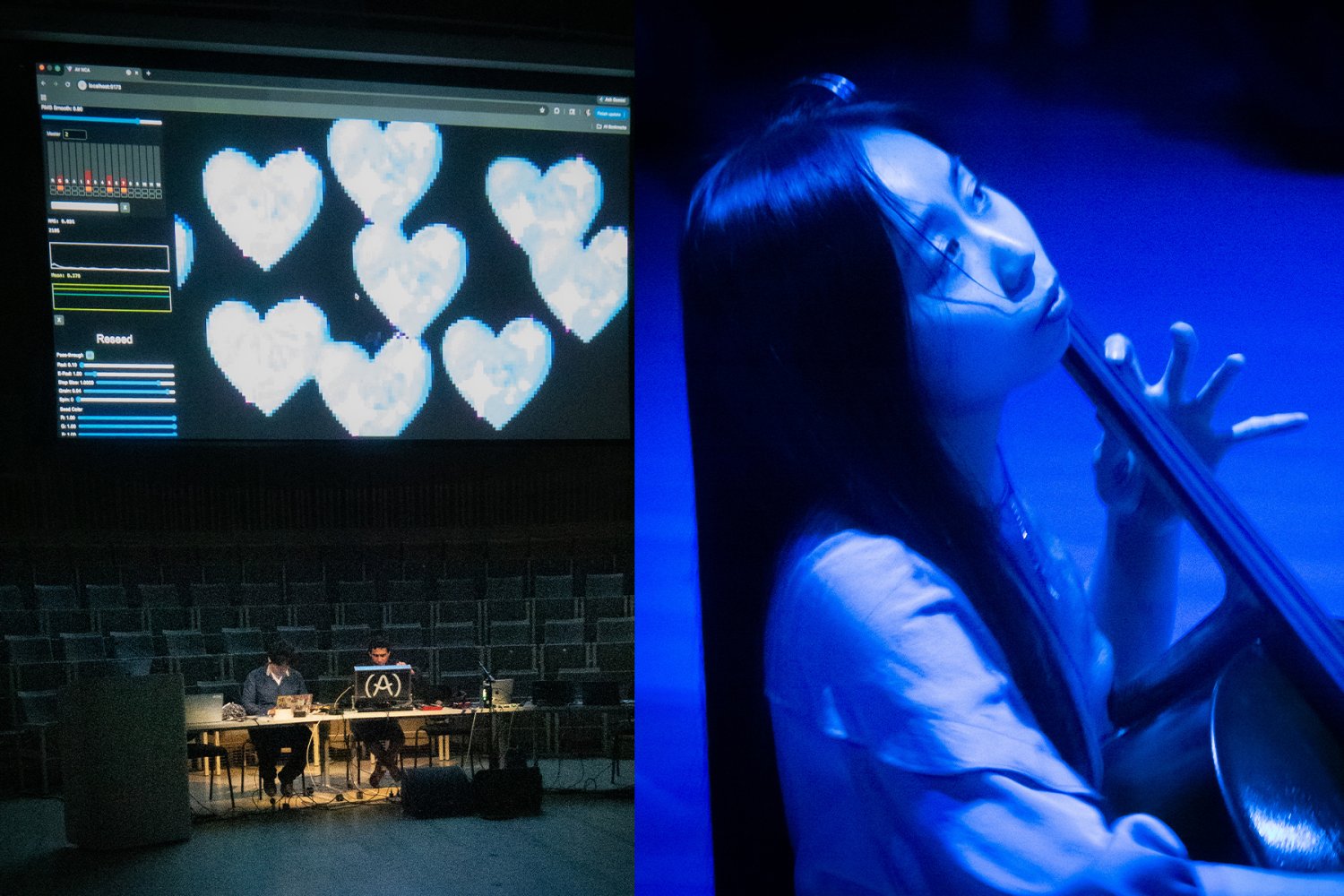


The MIT Music Technology and Computation (MTC) Graduate Program — launched in fall 2024 as a collaboration between the Music and Theater Arts Section in the School of Humanities, Arts, and Social Sciences (SHASS), and the School of Engineering (SoE) — presented its inaugural MIT Music Technology Research Showcase on May 13. The event played to a standing room-only house in the Edward and Joyce Linde Music Building’s Thomas Tull Concert Hall and featured diverse and captivating research presentations and music performances.
The celebratory occasion featured MTC’s first five enrollees (all of whom were previously MIT undergraduates), alongside several PhD students and faculty. Each scholar presented inspiring exemplars of artful engineering that reflected the broader and burgeoning music technology scene at MIT.
The 90-minute event exhibited a broad array of research projects, including a real-time visualization of what an AI co-improvising agent is about to play on a piano; a sound-art installation based on noisy network communication; a hip-hop dance circle where music is generated from dancing; and the use of electroencephalogram (EEG) signals to identify the musical tunes that our brains are imagining.
“A new space for exploration and insights”
An interplay of technical presentation with live performance, the showcase began with remarks from SHASS Dean and professor of philosophy Agustín Rayo, SOE Dean and professor of chemical engineering Paula Hammond, and MTC Director and professor of the practice of music Eran Egozy.
Rayo began, “The goal of this program is simple — for MIT to lead the world in music technology theory and application,” adding “it’s not just about making music with technology; it’s also about working across disciplines to help better shape the future of expression in an AI-driven world, all while reflecting MIT at its best.”
Rayo noted the graduate program was made possible in part by the opening of the Edward and Joyce Linde Music Building in 2025, which provided new classrooms, studios, rehearsal spaces, and a dedicated music technology lab. He also credited the MIT Schwarzman College of Computing for its support for the graduate program.
Hammond followed: “As those in this room already know, music and engineering share some common roots. Both rely on mathematical precision and are informed by defined structures, rhythms, and frequencies. Both demand hard work and technical know-how, paired with inspiration and imagination, to create something entirely new. Given those congruities, it’s no surprise that so many faculty, students, and staff members across MIT are also accomplished musicians and artists.”
She continued, “Our music program is a gem. Only at MIT could we bring the top technologists and the top musicians together to create unique opportunities for collaboration. Here we have brought together faculty and students who identify strongly with both music and engineering to form a new space for exploration and insights. It’s a strong example of the collaborative culture that defines the Institute.”
Egozy called the event a “harmonious hybrid of concert and symposium,” and recollected, “it’s a little mind-boggling to see what our students have achieved in just one short and fast-paced year. While we originally debated the trade-offs between a one-year and a two-year master’s program, I think this cohort really showed us that we can make huge strides in learning and research abilities in a concentrated period of time.”
Student research on display
One of those students is Claire Southard ’25, SM ’26, who developed a machine-learning model used to identify musical notes hidden in EEG signals.
Southard explains, “every year, musicians are diagnosed with movement disorders such as Parkinson’s disease and dystonia, or experience injuries that prevent them from controlling their hands and bodies in the ways required to play their instruments. Because of this, too many musicians are forced to stop doing what they love. My work explores one strategy to help such musicians perform again by translating the music they’re trying to play directly from their brain activity — bypassing the need for motor control altogether. To do this, I trained machine-learning models to predict the music a person is imagining from their brain activity measured using EEG, and many of the predicted pieces were found to be recognizable representations of what the user imagined. By designing a system that allows musicians to create music regardless of their physical abilities, I hope this work helps bring a more accessible future for music performance closer to reality.”
Before joining MTC, Southard was initially unaware of the breadth, scope, and magnitude of what the program could offer for further pursuing and realizing her interests. “The MIT Music Technology and Computation Graduate Program taught me so much about the possibilities at the intersection of STEM and the arts,” she says. “When I first started the program, I honestly wasn’t sure what counted as ‘music technology.’ Through classes, research, and conversations with faculty, guest speakers, and peers, I learned the field was far broader and more fascinating than I could have previously imagined.”
She continues, “coming from a background in neuro- and computer science, many of my undergraduate projects happened entirely on devices. But this program allowed me to encounter more hands-on experiences, from conducting audio recordings to building electronic musical instruments from scratch.”
Another MTC graduate, and student speaker at the 2026 SHASS Advanced Degree Ceremony, Mariano Salcedo ’25, SM ’26, presented a custom web application allowing anyone to create unique emergent visuals that are driven by real-time streaming music. To accomplish this effect, Salcedo built algorithms that leverage the complex visual behavior of self-organized systems as the means toward an aesthetically synergetic end.
In his Advanced Degree Ceremony oration, Salcedo expressed his gratitude and admiration for the passionate people that he’s met not only in MTC, but at MIT overall. In an appropriately compassionate mode, he empathetically opined, “I think what times like this call from us is to lead the way in human and humane-centered technology, which means we don’t only just ask what we can build, but we also ask who is it going to affect, who is not going to affect? Who does it benefit?”
Music technology thriving at MIT
Associate Professor Anna Huang SM ’08 of MTA and the Department of Electrical Engineering and Computer Science (EECS, through SCC), a graduate of the MIT Media Lab, and one of the world’s leading researchers in collaborative human-AI music-making, echoed both Southard and Salcedo’s sentiments through her keynote presentation, “In Search of Resonance in Human-AI Interaction.” A compelling and intimately conversational address, her speech emphasized the importance of centering the human musician in all that is done relating to AI, while also making efforts to include all musics of the world in its discourse at every opportunity.
With many of her family members in the audience, Huang reflected, “I have the privilege of being in both MIT Music and EECS — an interdisciplinary, shared space. What does it mean to build music technology in this context? We’re surrounded by extremely talented musicians, so we take this co-design approach: We work with these musicians, we go into the studio, and every week we try something. And the technology grows with the creative process. We’re always trying to push both of these forward, and it’s always on the edge. It’s very, very rewarding. It’s where I feel most at home.”
Huang also explained how this practice sets the stage for a new Studies in Music Technology subject that she will be co-teaching in the fall with recently appointed Professor of Theater Arts Grisha Coleman. Class 21M.369/569 (Tuning Attention: Creative Practices in Movement, Sound, and AI) proposes that the study of sound and movement practices can inform how we build and envision computational systems, focusing particularly on our relationship to AIs. It will introduce students to a range of musical practices in improvisation and somatics by way of motion-capture technologies, critical interaction design, generative modeling, and algorithms for interpretability and learning through human feedback.
All considered, the future of the MIT Music Technology and Computation Graduate Program is bright. Egozy says MTC admitted 10 master’s students for the 2026-27 academic year from over 100 applicants. Unlike this year’s class, next year’s students will not only include recent MIT undergraduate alumni, but also new faces to campus.
“Widening the pool to graduates of other schools and institutions will bring an extraordinary wealth of perspectives and experiences to the program. Additionally, all three shared faculty between MTA and EECS — including Mark Rau, Paris Smaragdis SM ’97, PhD ’01, and Huang — are inviting new Music Technology PhD students to their labs by way of EECS,” Egozy says.
Embodying its mission, MTC is proving to be a vibrant, multidisciplinary program that attracts many kinds of students with a variety of career objectives from wide-ranging backgrounds.
“Despite their diversity, our students all possess a central commonality,” Egozy says, “not just a shared love for music, but also a deep desire to augment that passion by way of technology in a very warmhearted, humanitarian way.”
List of projects
Rachel Loh, Quanta Fellow in Music Technology and Computation: “Visualizing the Internal State of Music Models for Live Human-AI Improvisation”
Noble Harasha, Quanta Fellow in Music Technology and Computation: “Modeling Subjectivity and Collective Sensory Perception as Noisy, Analog Communication in Feedback-Driven Networks”
Z Chen, Quanta Fellow in Music Technology and Computation: “Generative Music as a Catalyst for Social Choreography”
Nithya Shikarpur: “The Moving Drone: A Live Improvisation in the Context of Hindustani Music with the Human Voice, Generative models, and Loops”
Mariano Salcedo, Alex Rigopulos (1992) Fellow in Music Technology and Computation: “Neural Cellular Automata for Interactive Music Visualization”
Claire Southard, John Piscitello Fellow in Music Technology and Computation: “Neural Decoding of Imagined Music”
Stephen Brade, Suwan Kim, Valerie Chen: “Whale, Cello (there?): A Musical Dialog between Cello and a Real-time Diffusion Model Trained on Whale Songs”
