


# Introduction
If you work with sensor readings, server metrics, or any data that arrives over time, you already know that standard scikit-learn pipelines don’t quite fit. Time series data has structure that tabular models ignore: seasonality, trend, temporal ordering, and the fact that future values depend on past ones.
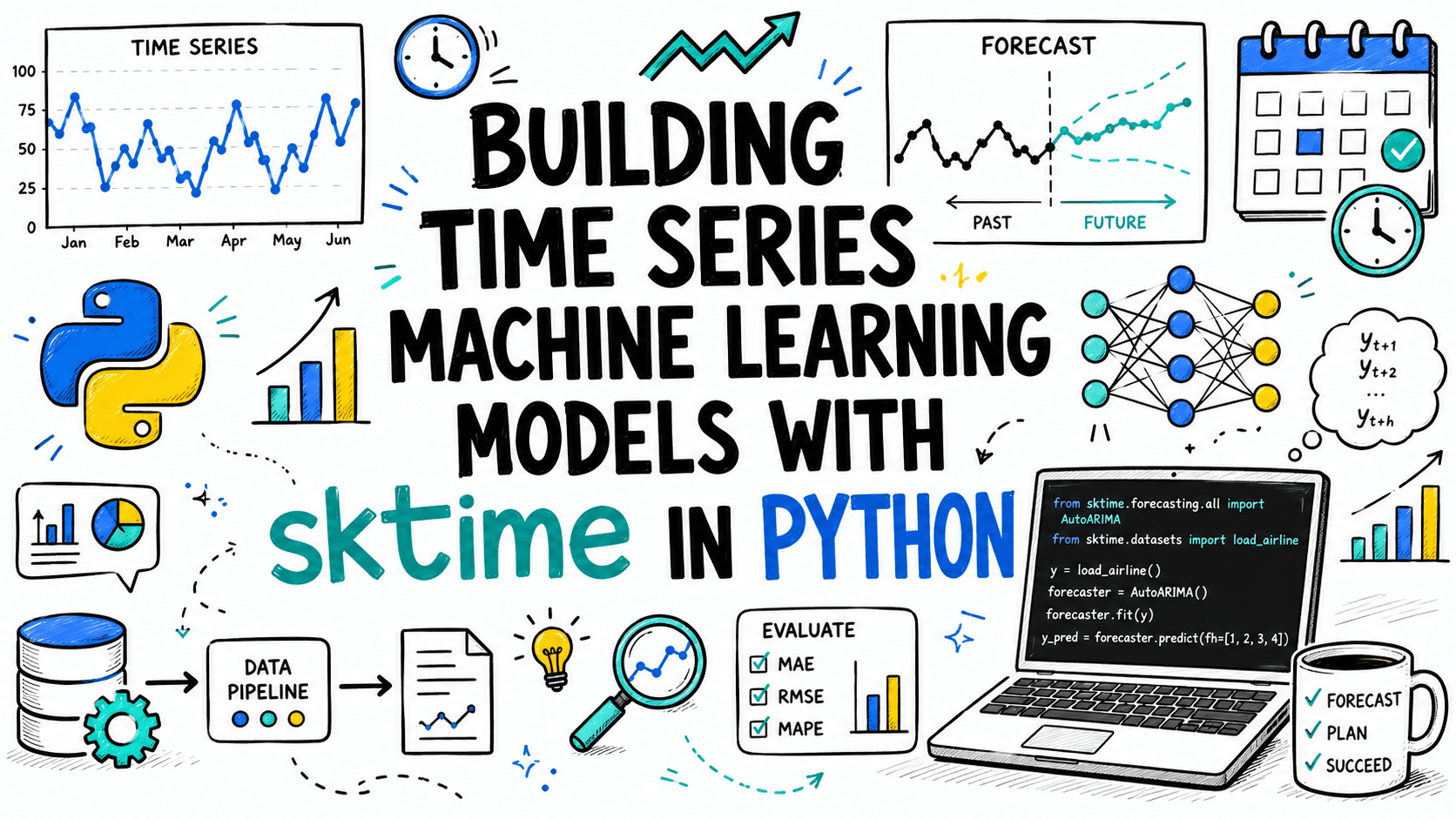
sktime is a Python library built specifically for this. It gives you a scikit-learn-style API — fit, predict, transform — but designed from the ground up for time series. You can do forecasting, classification, regression, and clustering on time series, all with a consistent interface.
In this article, you’ll work through an example problem: forecasting temperature readings from an industrial HVAC sensor. You’ll learn how sktime handles time series data, how to build preprocessing pipelines, how to fit forecasters, and how to evaluate them.
You can get the code on GitHub.
# Prerequisites
You’ll need Python 3.10 or higher and a basic familiarity with pandas. Install everything you need with:
pip install sktime pmdarima statsmodels
If you’d rather have all optional dependencies in one shot, pip install sktime[all_extras] covers them.
# What Makes sktime Useful
It helps to understand the problem sktime is solving. In scikit-learn, your data is a 2D table — rows are samples, columns are features. Time series data breaks this assumption because each “row” is actually a sequence of values over time, and the order of those values matters.
The main data containers you’ll use are:
| Data Type | Representation | Description |
|---|---|---|
| Series |
pd.Series or pd.DataFrame
|
A single time series used in vanilla forecasting. |
| Panel |
pd.DataFrame with a 2-level MultiIndex
|
A collection of multiple independent time series. |
| Hierarchical |
pd.DataFrame with a 3+ level MultiIndex
|
A structured set of time series with aggregation levels across multiple dimensions. |
For the time index itself, sktime supports several time indexes: DatetimeIndex, PeriodIndex, Int64Index, and RangeIndex on your pandas objects. The index must be monotonic. If you’re using DatetimeIndex, the freq attribute should be set.
# Setting Up the Dataset
Let’s create a realistic dataset. Imagine an HVAC sensor in a factory that records temperature every hour. The readings have a daily seasonal pattern (higher during working hours), a slight upward trend due to summer, and some noise.
import numpy as np
import pandas as pd

np.random.seed(42)

# 90 days of hourly readings starting Jan 1, 2026
n_hours = 90 * 24
timestamps = pd.date_range(start="2026-01-01", periods=n_hours, freq="h")

# Trend: gradual 5-degree rise over 90 days
trend = np.linspace(0, 5, n_hours)

# Daily seasonality: temperature peaks at 2pm, dips at 4am
hour_of_day = np.arange(n_hours) % 24
daily_cycle = 4 * np.sin(2 * np.pi * (hour_of_day - 4) / 24)

# Noise
noise = np.random.normal(0, 0.8, n_hours)

# Base temperature around 20°C
temperature = 20 + trend + daily_cycle + noise

# Introduce a few missing values (sensor dropout)
dropout_indices = [300, 301, 302, 1440, 1441]
temperature[dropout_indices] = np.nan

y = pd.Series(temperature, index=timestamps, name="temp_celsius")
y.index.freq = pd.tseries.frequencies.to_offset("h")

print(y.head())
print(f"\nShape: {y.shape}")
print(f"Missing values: {y.isna().sum()}")
print(f"Index type: {type(y.index)}")
Output:
2026-01-01 00:00:00    16.933270
2026-01-01 01:00:00    17.063277
2026-01-01 02:00:00    18.522783
2026-01-01 03:00:00    20.190095
2026-01-01 04:00:00    19.821941
Freq: h, Name: temp_celsius, dtype: float64

Shape: (2160,)
Missing values: 5
Index type:
# Splitting Time Series Data for Training and Testing
Splitting time series data is different from tabular data — you can’t shuffle rows. You must always split chronologically: train on earlier data, test on later data.
sktime provides temporal_train_test_split for this purpose:
from sktime.split import temporal_train_test_split

# Hold out the last 7 days (168 hours) as the test set
y_train, y_test = temporal_train_test_split(y, test_size=168)

print(f"Train: {y_train.index[0]} → {y_train.index[-1]}")
print(f"Test:  {y_test.index[0]} → {y_test.index[-1]}")
print(f"Train size: {len(y_train)}, Test size: {len(y_test)}")
Output:
Train: 2026-01-01 00:00:00 → 2026-03-24 23:00:00
Test:  2026-03-25 00:00:00 → 2026-03-31 23:00:00
Train size: 1992, Test size: 168
The function ensures the split is clean and chronological — no data leakage from the future into the training set.
# Defining the Forecasting Horizon
Before fitting any model, you need to tell sktime which time steps you want to predict. This is the ForecastingHorizon.
from sktime.forecasting.base import ForecastingHorizon

# Predict 168 steps ahead (7 days of hourly data)
# is_relative=False means we're using absolute timestamps
fh = ForecastingHorizon(y_test.index, is_relative=False)

print(f"Horizon length: {len(fh)}")
print(f"First forecast point: {fh[0]}")
print(f"Last forecast point:  {fh[-1]}")
This gives:
Horizon length: 168
First forecast point: 2026-03-25 00:00:00
Last forecast point:  2026-03-31 23:00:00
You can also use relative horizons like fh = [1, 2, 3, ..., 168], which means “1 step ahead, 2 steps ahead, …”. Absolute horizons are cleaner when you have actual timestamps you want predictions for.
# Building a Preprocessing and Forecasting Pipeline
Real sensor data has missing values, seasonal patterns, and trend — you need to handle all of these before or during forecasting. sktime’s TransformedTargetForecaster lets you chain transformations with a forecaster into a single estimator. The transformations are applied to the target series y before fitting, and automatically reversed on the way out during prediction.
from sktime.forecasting.exp_smoothing import ExponentialSmoothing
from sktime.forecasting.compose import TransformedTargetForecaster
from sktime.transformations.series.impute import Imputer
from sktime.transformations.series.detrend import Deseasonalizer, Detrender

pipeline = TransformedTargetForecaster(
    steps=[
        # Step 1: Fill missing sensor readings using linear interpolation
        ("imputer", Imputer(method="linear")),
        # Step 2: Remove the linear trend so the forecaster sees a stationary series
        ("detrender", Detrender()),
        # Step 3: Remove the daily seasonality (sp=24 for hourly data with 24-hour cycles)
        ("deseasonalizer", Deseasonalizer(model="additive", sp=24)),
        # Step 4: Forecast the cleaned, stationary residuals
        ("forecaster", ExponentialSmoothing(trend=None, seasonal=None)),
    ]
)

pipeline.fit(y_train, fh=fh)
y_pred = pipeline.predict()

print(y_pred.head())
Output:
2026-03-25 00:00:00    21.210066
2026-03-25 01:00:00    21.788986
2026-03-25 02:00:00    22.615184
2026-03-25 03:00:00    23.688449
2026-03-25 04:00:00    24.621127
Freq: h, Name: temp_celsius, dtype: float64
Here’s what each step does:
Imputer(method="linear")fills missing values by linearly interpolating between the surrounding readings, which works well for sensor data.Detrender()fits a linear trend to the training series and subtracts it; on prediction it adds the trend back.Deseasonalizer(sp=24)removes the 24-hour cycle from the residuals;spstands for seasonal period.- Finally,
ExponentialSmoothingforecasts the detrended, deseasonalized residuals. - When
predict()is called, all inverse transformations are applied in reverse order automatically, and you get back predictions in the original temperature scale.
# Evaluating the Forecast
sktime integrates with standard evaluation metrics. For forecasting, mean absolute error (MAE) and mean absolute percentage error (MAPE) are common choices.
from sktime.performance_metrics.forecasting import (
    mean_absolute_error,
    mean_absolute_percentage_error,
)

mae = mean_absolute_error(y_test, y_pred)
mape = mean_absolute_percentage_error(y_test, y_pred)

print(f"MAE:  {mae:.3f} °C")
print(f"MAPE: {mape*100:.2f}%")
Output:
MAE:  0.584 °C
MAPE: 2.40%
# Swapping in a Different Forecaster
One of the biggest advantages of the sktime interface is that swapping the underlying algorithm requires changing just one line. Let’s try an ARIMA model in place of exponential smoothing and compare.
from sktime.forecasting.arima import ARIMA

pipeline_arima = TransformedTargetForecaster(
    steps=[
        ("imputer", Imputer(method="linear")),
        ("detrender", Detrender()),
        ("deseasonalizer", Deseasonalizer(model="additive", sp=24)),
        # ARIMA(1,1,1) on the cleaned residuals
        ("forecaster", ARIMA(order=(1, 1, 1), suppress_warnings=True)),
    ]
)

pipeline_arima.fit(y_train, fh=fh)
y_pred_arima = pipeline_arima.predict()

mae_arima = mean_absolute_error(y_test, y_pred_arima)
mape_arima = mean_absolute_percentage_error(y_test, y_pred_arima)

print(f"ARIMA MAE:  {mae_arima:.3f} °C")
print(f"ARIMA MAPE: {mape_arima*100:.2f}%")
Output:
ARIMA MAE:  0.586 °C
ARIMA MAPE: 2.41%
The key point is that the preprocessing steps — imputation, detrending, deseasonalization — stayed identical. You only changed the final forecaster, and everything else composed cleanly around it.
# Cross-Validating Across Time
Holding out a single test window can be misleading. sktime provides time series cross-validation through splitters that respect temporal ordering.
SlidingWindowSplitter uses a rolling window: the training window slides forward in time, always staying the same length. ExpandingWindowSplitter grows the training set cumulatively as you move forward, which is more appropriate when you want to use all available history.
from sktime.split import ExpandingWindowSplitter
from sktime.forecasting.model_evaluation import evaluate

# Expanding window: start with 1800-hour train set, evaluate on 168-hour windows
cv = ExpandingWindowSplitter(
    initial_window=1800,
    fh=list(range(1, 169)),
    step_length=168,
)

results = evaluate(
    forecaster=pipeline,
    y=y,
    cv=cv,
    scoring=mean_absolute_error,
    return_data=False,
)

print(results[["test__DynamicForecastingErrorMetric", "fit_time"]].round(3))
print(f"\nMean CV MAE: {results['test__DynamicForecastingErrorMetric'].mean():.3f} °C")
Output:
   test__DynamicForecastingErrorMetric  fit_time
0                                0.627     0.274
1                                0.585     0.100

Mean CV MAE: 0.606 °C
evaluate returns a DataFrame with per-fold metrics and timing. The cross-validation MAE confirms that the model generalizes consistently across different time windows in the data.
# Next Steps
This article covered the core forecasting workflow in sktime, but the library extends far beyond basic prediction tasks.
It also supports time-series classification, probabilistic forecasting with uncertainty estimates, training shared models across multiple related time series, adapting traditional machine learning algorithms for sequential forecasting, and automating model selection and tuning workflows.
One of sktime’s biggest strengths is its consistent API and integration with the broader Python machine learning ecosystem, making experimentation easier for both beginners and experienced practitioners. The sktime docs and example notebooks are especially well-written and are worth bookmarking if you regularly work with forecasting or temporal data problems.
Bala Priya C is a developer and technical writer from India. She likes working at the intersection of math, programming, data science, and content creation. Her areas of interest and expertise include DevOps, data science, and natural language processing. She enjoys reading, writing, coding, and coffee! Currently, she’s working on learning and sharing her knowledge with the developer community by authoring tutorials, how-to guides, opinion pieces, and more. Bala also creates engaging resource overviews and coding tutorials.
