

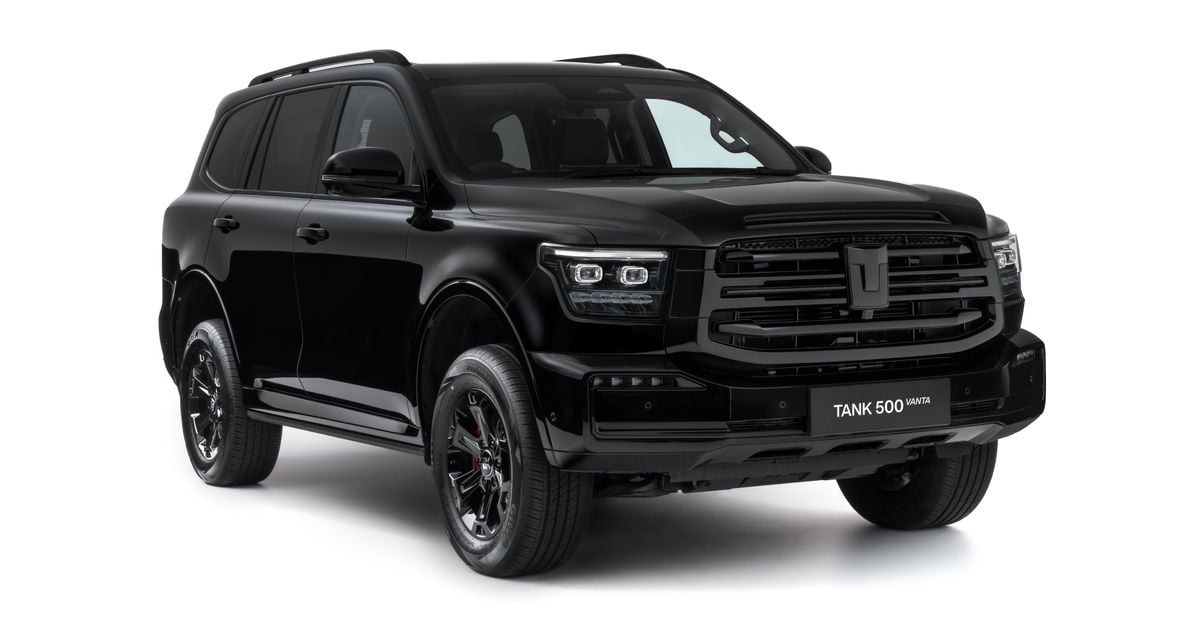

It might seem to be going against the grain in 2026, but GWM is axing another hybrid vehicle – and in its place it’s introducing a diesel.
The Tank 500 hybrid is in runout, with only stock of the blacked-out, top-spec Vanta version of the large off-road SUV remaining alongside the Ultra plug-in hybrid (PHEV).
That leaves only the two most expensive Tank 500 variants in showrooms for the coming months, with these priced at $74,490 and $76,990 drive-away, respectively. The now-axed Lux Hybrid previously opened the range at $64,490 drive-away.
GWM’s answer to the Toyota Prado will – along with the closely related Cannon Alpha ute – gain GWM’s new 3.0-litre turbo-diesel four-cylinder engine in the third quarter (July to September) of 2026.
CarExpert can save you thousands on a new car. Click here to get a great deal.

GWM has confirmed it’s benchmarking it against the 3.0-litre turbo-diesel used by the Ford Ranger and Everest in terms of performance and driveability – despite that engine featuring a pair of extra cylinders.
And despite being a four instead of a six, peak torque is actually higher (620Nm vs 600Nm), with maximum power not far behind (170kW vs 185kW). The hybrid, by comparison, has total system outputs of 255kW and 648Nm.
The new diesel will be mated with a nine-speed automatic transmission and a four-wheel drive system.
GWM promises a five per cent improvement in fuel consumption on the NEDC cycle compared to the 2.4-litre turbo-diesel used in the Cannon Alpha, and a 20 per cent improvement in the claimed 0-100km/h acceleration time. And despite lacking electrification, at least for now, the Tank 500 3.0TD isn’t expected to pollute much more.
“The diesel is actually similar to the hybrid from a CO2 point of view,” GWM Australia product planning manager Tim Leong told CarExpert.
On the combined cycle, the existing Tank 500 hybrid emits 199g/km, only 1g/km less than the Prado, which has a mild-hybrid 2.8-litre turbo-diesel four-cylinder engine. Both beat the Everest V6, which emits 224g/km.
The axing of the Tank 500 hybrid means buyers will have to opt for the diesel if they want seven seats, as the PHEV is available as a five-seater only.
But while the diesel will likely be more affordable than the PHEV, it’s unclear what price the Tank 500 range will open at once the 3.0-litre arrives.
GWM is looking to manage complexity as its powertrain lineup swells
“Moving forward, potentially in the case of the Tank 500, instead of having Lux, Ultra etc, we just have Ultra,” said Mr Leong.
GWM Australia is looking to add another seven-seat SUV in the Haval H7 Plus – a crossover SUV with car-like unibody construction – which is likely to provide a more affordable alternative to the Tank 500 for buyers not after off-road capability.
The company offers petrol, diesel, hybrid, plug-in hybrid and electric powertrains, depending on the model, and has now confirmed diesel hybrid and diesel plug-in hybrid powertrains are in the works.
It’s part of a strategy to offer a wide range of powertrain types, with GWM chairman Jack Wei looking to Toyota for insipiration.
The new electrified diesels are due for release in China in 2027, and either one or both of these powertrains will come to Australia.
GWM has yet to confirm which models will be offered with these electrified diesel powertrains, however, it’s understood the hybrid and plug-in hybrid systems can be mated with the brand’s existing 2.0-litre, 2.4-litre and upcoming 3.0-litre four-cylinder turbo-diesels.
The Tank 500 is GWM’s third-slowest seller in Australia, with 1519 examples delivered here last year, down 9.2 per cent on the previous year. That tally was less than a third of the volume of the smaller, more affordable Tank 300 off-road SUV.
So far this year, GWM has delivered 282 Tank 500s as it depletes stock of hybrid variants. The recently launched Denza B5 – another large Chinese off-road SUV, but available only with PHEV power – has pushed ahead of it with 546 deliveries in the first quarter of 2026.
