

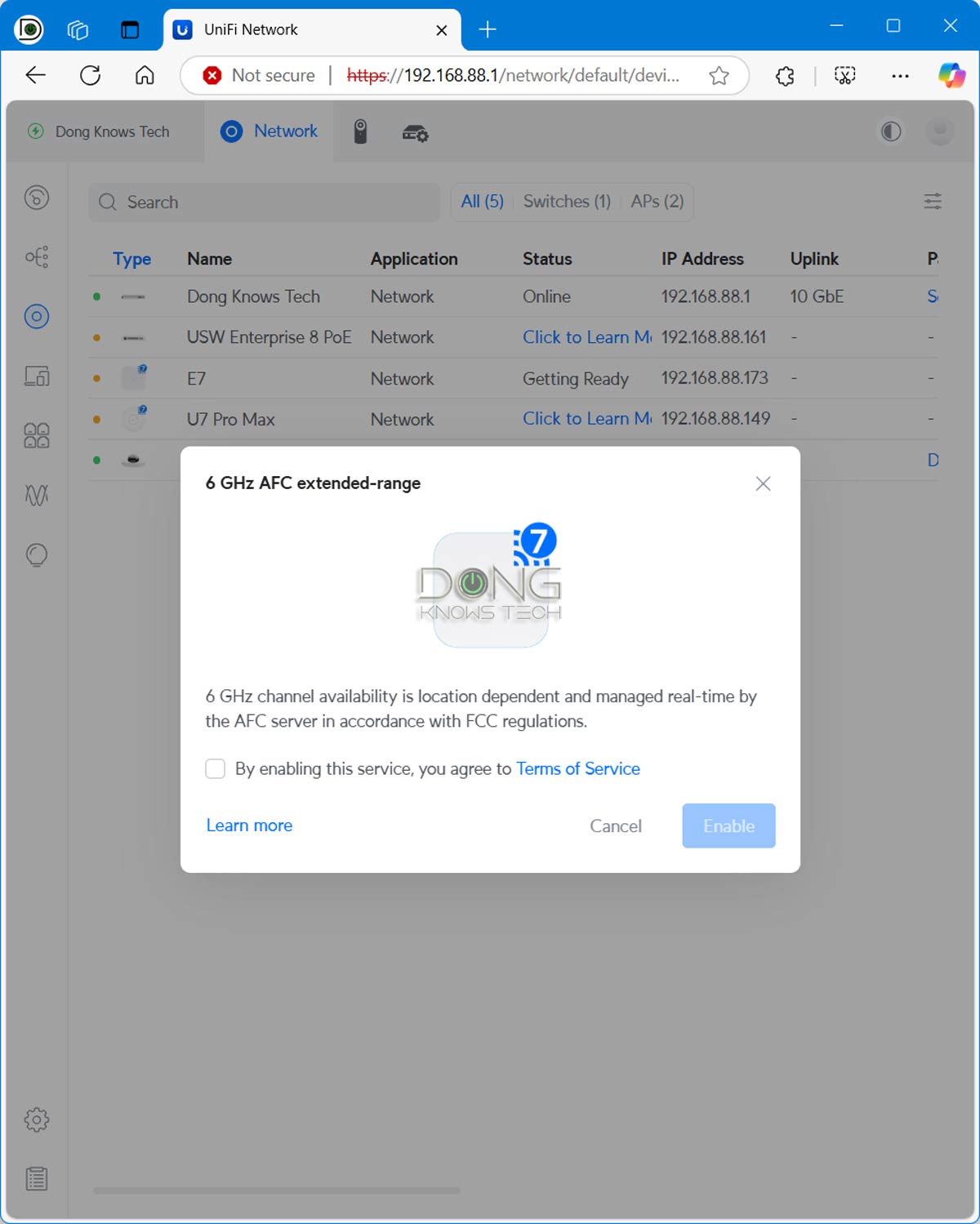

Automated Frequency Coordination, or AFC, is a valuable wireless networking feature that has recently become a reality with the release of the Wi-Fi 7 standard. It enables a Wi-Fi 7 access point (standalone or integrated inside a router) to significantly increase the range of its super-fast 6GHz frequency band.
However, similar to Wi-Fi 7’s MLO feature, AFC has proven to be a complex concept.
This post aims to explain it in detail and set the right expectations based on my real-world testing and serious use of Wi-Fi 7 hardware. You’ll also find a list of the top 5 AFC-enabled access points or routers you can bring home today.
Dong’s note: I first published this piece on July 18, 2025, and last updated it on April 17, 2026, with the latest information based on real-world testing and experience.

Automated Frequency Coordination: The 6GHz band’s often-elusive extra range
AFC is optional and not required for the general function of a Wi-Fi 7 access point. For that reason, it wasn’t even mentioned in the Wi-Fi Alliance’s initial certification of Wi-Fi 7. Besides that fact, there are a couple of other things to note about this feature.
AFC’s requirements
The first thing to note is that the AFC feature applies to the 6GHz band and, therefore, is not exclusive to Wi-Fi 7—the band was first used with Wi-Fi 6E. However, this feature was generally not available until Wi-Fi 7.
How the 6GHz band is regulated around the world
The 6GHz band has a total width of 1200 MHz, ranging from 5.925 MHz to 7.125 MHz, and is divided into 59 channels of 20 MHz each. These channels are grouped to create “sub-bands,” which also vary from one region to another.
In the U.S., the FCC has designated four sub-bands across the entire 6GHz spectrum, including UNII-5, UNII-6, UNII-7, and UNII-8, for Wi-Fi use, though portions of the band may be reserved for other applications.
The E.U. Commission allows only the UNII-5 equivalent portion of the frequency band for Wi-Fi use, which is 480 MHz wide, from 5925 MHz to 6425 MHz. Some other parts of the world are somewhere in between, with the UNII-5 portion adopted and the rest being considered.
In other regions, this band may not even be available for Wi-Fi.
Generally, Wi-Fi 6E needs a 160MHz channel to deliver the best performance, and Wi-Fi 7 requires double that, 320MHz. Due to spectrum availability and other constraints, real-world hardware typically uses narrower channels.
Overall, the complicated adoption of the 6GHz frequency is the main reason a Wi-Fi access point (or router) made for one region might not work in another.

The table below shows its current adoption worldwide. The “Considering” portion is generally slated to be finalized eventually, though that varies from one region to another.
| Country | Adopted Spectrum |
|---|---|
| United States | 5925-7125 MHz (entire band including UNII5, UNII-6, UNII-7, and UNII-8) |
| Albania | 5945-6425 MHz (UNII-5) |
| Andorra | 5945-6425 MHz |
| Argentina | 5925-7125 MHz |
| Australia | 5925-6425 MHz |
| Austria | 5945-6425 MHz |
| Azerbaijan | 5925-6425 MHz |
| Bahrain | 5925-6425 MHz |
| Bangladesh | 5925-6425 MHz |
| Belarus | 5945-6425 MHz |
| 5945-6425 MHz | |
| Belgium | 5945-6425 MHz |
| Bosnia and Herzegovina | 5945-6425 MHz |
| Brazil | 5925-7125 MHz |
| Bulgaria | 5945-6425 MHz |
| Burkina Faso | 5945-6425 MHz |
| Canada | 5925-7125 MHz |
| Chile | 5925-6425 MHz |
| Colombia | 5925-7125 MHz |
| Costa Rica | 5925-7125 MHz |
| Croatia | 5945-6425 MHz |
| Cyprus | 5945-6425 MHz |
| Czech Republic | 5945-6425 MHz |
| Denmark | 5945-6425 MHz |
| Dominican Republic | 5925-7125 MHz |
| Egypt | 5925-6425 MHz |
| El Salvador | 5925-7125 MHz |
| Estonia | 5945-6425 MHz |
| European Union | 5945-6425 MHz |
| Faroe Islands | 5945-6425 MHz |
| Finland | 5945-6425 MHz |
| France | 5945-6425 MHz |
| Georgia | 5945-6425 MHz |
| Germany | 5945-6425 MHz |
| Gibraltar | 5945-6425 MHz |
| Greece | 5945-6425 MHz |
| Guatemala | 5925-7125 MHz |
| Honduras | 5925-7125 MHz |
| Hong Kong | 5925-6425 MHz |
| Hungary | 5925-6425 MHz |
| Iceland | 5945-6425 MHz |
| India | 5945-6425 MHz |
| Ireland | 5945-6425 MHz 6425-7125 MHz |
| Isle of Man | 5945-6425 MHz |
| Italy | 5945-6425 MHz |
| Japan | 5925-6425 MHz 6425-7125 MHz |
| Jordan | 5925-6425 MHz |
| Kazakhstan | 5925-7125 MHz |
| Kenya | 5925-6425 MHz |
| Latvia | 5925-6425 MHz |
| Liechtenstein | 5945-6425 MHz |
| Lithuania | 5945-6425 MHz |
| Luxembourg | 5945-6425 MHz |
| Macao | 5945-6425 MHz |
| Macedonia | 5945-6425 MHz |
| Malaysia | 5925-6425 MHz |
| Malta | 5925-6425 MHz |
| Mauritius | 5925-6425 MHz |
| Mexico | 5925-6425 MHz |
| Moldova | 5925-6425 MHz |
| Monaco | 5945-6425 MHz |
| Montenegro | 5945-6425 MHz |
| Morocco | 5925-6425 MHz |
| Namibia | 5925-6425 MHz |
| Netherlands | 5945-6425 MHz 6425-7125 MHz |
| New Zealand | 5925-6425 MHz |
| Norway | 5945-6425 MHz |
| Pakistan | 5945-6425 MHz |
| Paraguay | 5925-6425 MHz |
| Peru | 5925-7125 MHz |
| Philippines | 5925-7125 MHz |
| Poland | 5925-7125 MHz |
| Portugal | 5945-6425 MHz 6425-7125 MHz |
| Qatar | 5925-6425 MHz |
| Romania | 5925-6425 MHz |
| Russian Federation | 5925-6425 MHz |
| San Marino | 5925-6425 MHz |
| Saudi Arabia | 5925-7125 MHz |
| Singapore | 5925-6425 MHz |
| Slovakia | 5925-6425 MHz |
| Slovenia | 5925-6425 MHz |
| South Africa | 5925-6425 MHz |
| South Korea | 5925-7125 MHz |
| Spain | 5945-6425 MHz |
| Sweden | 5945-6425 MHz |
| Switzerland | 5945-6425 MHz |
| Thailand | 5925-6425 MHz |
| Togo | 5925-6425 MHz |
| Tunisia | 5925-6425 MHz |
| Turkey | 5925-6425 MHz |
| Ukraine | 5925-6425 MHz |
| United Arab Emirates | 5925-6425 MHz |
| United Kingdom | 5945-6425 MHz |
| Holy See (Vatican City State) | 5945-6425 MHz |
| Vietnam | 5945-6425 MHz |
The second thing to note about the AFC is that, if available, this feature is highly relevant.
By nature, while the 6GHz band offers the most significant advantages of Wi-Fi 7, especially when used in an MLO link, it’s also the biggest shortcoming of the standard.
In case you’re new: the 6GHz band has the highest bandwidth (it’s the fastest) at the expense of its range, which is short, just about 75% of the 5GHz, due to the existing maximum allowed broadcast power. As a result, users can generally only enjoy this band at a relatively short distance from the access point, and often a line of sight is also required. Further out, or behind a thick wall, the effect of the 6GHz band is reduced or completely non-existent.
The AFC feature fixes the short-range issue. It enables the supported access point to use higher broadcast power in the 6GHz band, allowing for an extended range comparable to, or even exceeding, that of the 5GHz band.
That’s the idea anyway. Let’s see how the AFC works and, most importantly, when and where it is available.
How AFC works and its availability
AFC is implemented at the Wi-Fi access point and enables the hardware to check with a registered local database in real-time to determine whether or not it’s possible for its 6GHz band to operate without negatively impacting other existing registered hardware devices on the same band.
Once that’s established, the access point uses an exclusive channel on its 6GHz band (the SSID) that operates outside the constraints of broadcast regulations. Specifically, it can utilize higher broadcast power and, via more flexible antennas and FEM designs, achieve a higher signal output.
How much higher, you might ask?
Details vary by hardware model and locale, but the gist is that with AFC, a Wi-Fi access point may increase its broadcast power up to 36 dBm (from the current 30 dBm limit) or 4 watts (from 1 watt).
In practice, the 6GHz band may exceed the original (non-AFC) maximum allowed power by up to 6 dBm, as hardware is often certified below the 30 dBm threshold. The goal is to increase the range of the 6GHz band by about 25%, making it comparable to the 5GHz band.
As you can imagine, when this happens, the MLO feature of Wi-Fi 7 becomes significantly more compelling, as the bonded link (of the 5GHz and 6GHz) will offer both improved performance and extended range.
Tip
Automated Frequency Coordination (AFC) extends the Wi-Fi range of the 6GHz band to be comparable to that of the 5GHz band via special rules.
The feature is similar to checking with the local authorities for permission to close off sections of city streets for a drag race block party.
When approved, the usual traffic and parking laws no longer apply to the area, and the organizers can determine how the traffic can flow, among other things.
In any case, the AFC feature requires certification, and its availability is expected to vary from one region to another. Many Wi-Fi 7 access points (and routers) come with AFC-ready hardware, but this feature must be enabled via firmware updates and is only available where and when its operation meets local requirements.
The ASUS GT-BE19000AI and GS-BE18000 are two examples. Both were released without AFC, which was later enabled via firmware update.

It’s worth noting that hardware vendors generally prioritize compliance and compatibility over performance, so AFC is not the priority. As a result, this feature will be available only in select Wi-Fi 7 access points.
What to expect from AFC in real-world usage
The devil is in the details, and given the numerous details in the requirements, the real-world availability and use of AFC have been complicated.
The “local authorization” notion, for example, entails a lot of uncertainty just by itself. For once, the AFC-enabled Wi-Fi router or access point needs to report its precise GPS coordinates at least once every 24 hours to remain compliant. And getting the coordinates can be a tall order. While most Wi-Fi host devices can determine their rough location via the WAN IP address, that is not precise enough for AFC’s requirements.
For this reason, AFC is more suitable for outdoor Wi-Fi access points, since the hardware itself can easily obtain precise GPS coordinates when placed under an open sky. Additionally, enterprise-class hardware is often more equipped to handle AFC than its consumer-grade counterpart.
After that, there’s a privacy risk when you turn on AFC—you must share your precise location with the hardware vendor and other parties. That’s the reason why, before enabling AFC on an access point, you must accept the additional terms of use or privacy notice.
In my experience, using supported business-class access points, such as the UniFi E7 AP, is straightforward with AFC. All you have to do is turn it on, and the system will take care of the rest.
On the other hand, using a home router can be complicated. For example, the ASUS GS-BE18000, the first home-grade router with this feature, has no robust way of its own to determine its precise GPS coordinates, and instead puts that burden on a connected client, such as a Wi-Fi 7-enabled smartphone running the ASUS Router mobile app.


Another thing to note is that the AFC only increases the range, and not the real-world connection rate.
Specifically, devices placed within about 40 feet of an AFC-ready access point will never achieve a faster real-world rate, with or without AFC enabled. However, with AFC, devices at a longer distance will benefit and achieve faster connection speeds than without it.
In any case, the benefit of AFC always involves luck and variation in a changing environment. A host device might have AFC at one moment and not at another when it detects that the higher broadcast power is no longer allowed.
The takeaway
Like MLO, the idea behind Automated Frequency Coordination is great. However, its real-world use has many requirements, making its effect often elusive. So, AFC is somewhat of a luxury.
Keep the following conditions in mind before expecting it to work where you are:
- The feature must be supported by the Wi-Fi access point (standalone or integrated into a router) and enabled.
- The access point must be able to report its precise GPS coordinates to the AFC system.
- AFC is only in effect when its function doesn’t affect other devices on the same frequency bands.
I’d liken AFC to a jigsaw puzzle with many pieces. It can be challenging to put together, but when you can do that successfully, the result can be gratifying.
Can’t wait to try it out? The list below includes the current best five Wi-Fi 7 options that’ll give you a real AFC experience.
