

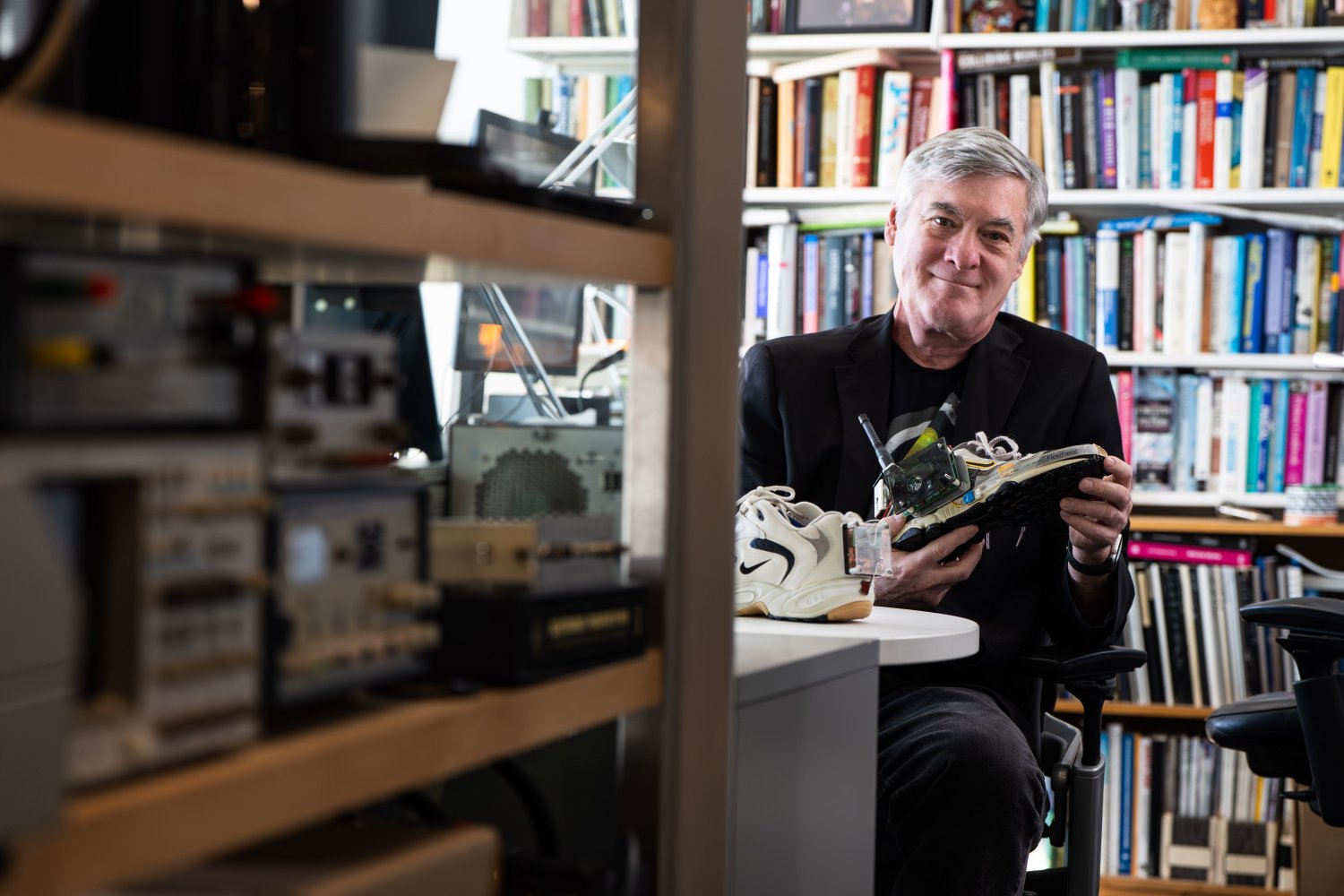

Joseph Paradiso thinks that the most engaging research questions usually span disciplines.
Paradiso was trained as a physicist and completed his PhD in experimental high-energy physics at MIT in 1981. His father was a photographer and filmmaker working at MIT, MIT Lincoln Laboratory, and the MITRE Corporation, so he grew up in a house where artists, scientists, and engineers regularly gathered and interesting music was always playing.
That mix of influences led him to the MIT Media Lab, where he is the Alexander W. Dreyfoos Professor, academic head of the Program in Media Arts and Sciences, and director of the Responsive Environments research group.
At the Media Lab, Paradiso conducts research that engages sensing of different kinds and applies it across diverse and often extreme applications. He works on developing technologies that can efficiently capture and process multiple sensing modalities, and leverages this capability in application domains like the internet of things, medicine, environmental sensing, space exploration, and artistic expression. These efforts use that information to help people better understand the world, express themselves, and connect with one another.

Joe Paradiso reflects on a life of music, physics, and sensing.
Video: MIT Media Lab
Early in his career, Paradiso helped pioneer the field of wireless wearable sensing. He built many systems with multiple embedded sensors that could send information from the human body in real-time. One of his early flagship projects in this area was a pair of shoes fielded in 1997 for real-time augmented dance performance that embedded 16 sensors in each shoe, allowing wearers’ movements to directly generate music through algorithmic mapping. And Paradiso’s research at the Media Lab has consistently focused on sensing and using that information in new ways.
“When I would list all the sensors … people would laugh. But now, my watch is measuring most of these things,” Paradiso notes. “The world has moved.”
That progression from early prototypes to everyday technology helped lay the groundwork for devices people now use regularly to track activity, health, and performance.
As sensing systems improved, Paradiso expanded his work from individuals to groups. He developed platforms that allowed dance ensembles to create music together through their collective motion. Achieving this required Paradiso and his team to develop new ways for compact wearable devices to communicate wirelessly at high speed, as well as new approaches to real-time data processing and extending the range of available microelectromechanical systems (MEMS) sensors.
Those same sensing platforms were later adapted for sports medicine in 2006. Working with doctors who support elite athletes, his array of compact, wearable sensors captured large amounts of high-speed motion data from multiple points on the body, aimed at helping clinicians assess injury risk, performance, and recovery on the go, without the complex equipment typically associated with biomechanical monitoring and clinical settings.
More recently, Paradiso’s research has extended beyond humans. Through collaborations with National Geographic Explorers, his team has deployed sensors in remote environments to study animal behavior, including low-power compact wearable devices to detect the environmental conditions around the animal as well as track them (currently on lions and hyenas in Botswana and goats in Chile), and acoustic sensors with onboard AI to detect and monitor populations of endangered honeybees in Patagonia. This work provides new ways to understand how ecosystems function and how the planet is changing.
Paradiso was named an IEEE Fellow in January, recognizing his achievement in wireless wearable sensing and mobile energy harvesting. This is the highest grade of membership in IEEE, the world’s leading professional association dedicated to advancing technology for the benefit of humanity.
Across art, health, and the natural world, Paradiso’s work reflects how foundational research at MIT can seed technologies that ripple outward over time, shaping new applications and opening new fields. As advances in wearable technologies drive the rush toward the ever-more-connected human, a persistent existential question lurks.
“Where do I stop, versus others begin?” Paradiso asks.
For him, the aim is not novelty for its own sake, but amplification: using technology to help people become more perceptive, better connected, and more aware of their place in a larger system.
