

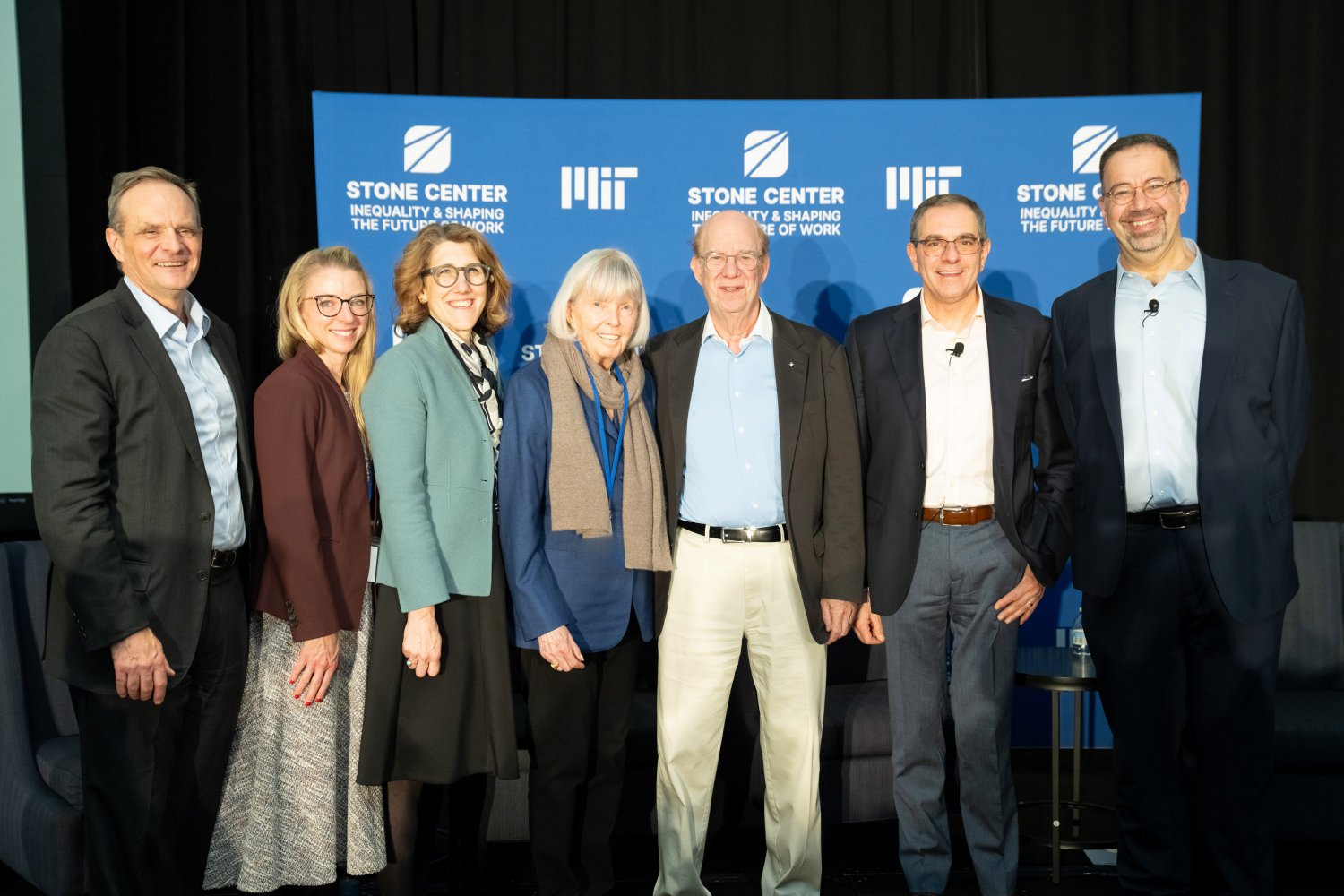


The James M. and Cathleen D. Stone Center on Inequality and Shaping the Future of Work officially launched on Nov. 3, 2025, bringing together scholars, policymakers, and practitioners to explore critical questions about economic opportunity, technology, and democracy.
Co-directed by MIT professors Daron Acemoglu, David Autor, and Simon Johnson, the new Stone Center analyzes the forces that contribute to growing income and wealth inequality through the erosion of job quality and labor market opportunities for workers without a college degree. The center identifies innovative ways to move the economy onto a more equitable trajectory.
MIT Provost Anantha Chandrakasan opened the launch event by emphasizing the urgency and importance of the center’s mission. “As artificial intelligence tools become more powerful, and as they are deployed more broadly,” he said, “we will need to strive to ensure that people from all kinds of backgrounds can find opportunity in the economy.”
Here are some of the key takeaways from participants in the afternoon’s discussions on wealth inequality, liberalism, and pro-worker AI.
Wealth inequality is driven by private business and public policy
Owen Zidar of Princeton University stressed that owners of businesses like car dealerships, construction firms, and franchises make up a significant portion of the top 1 percent. “For every public company CEO that gets a lot of attention,” he explained, “there are a thousand private business owners who have at least $25 million in wealth.” These business owners have outsized political influence through overrepresentation, lobbying, and donations.
Atif Mian of Princeton University connected high inequality to the U.S. debt crisis, arguing that massive savings at the top aren’t being channeled into productive investment. Instead, falling interest rates push the government to run increasingly large fiscal deficits.
To mitigate wealth inequality, speakers highlighted policy proposals including rolling back the 20 percent deduction for private business owners and increasing taxes on wealth.
However, policies must be carefully designed. Antoinette Schoar of the MIT Sloan School of Management explained how mortgage subsidy policies after the 2008 financial crisis actually worsened inequality by disadvantaging poorer potential homeowners.
Governments must provide basic public goods and economic security
Marc Dunkelman of the Watson School of International and Public Affairs at Brown University identified excessive red tape as a key problem for modern liberal democracy. “We can’t build high-speed rail. You can’t build enough housing,” he explained. “That spurs ordinary people who want government to work into the populist camp. We did this to ourselves.”
Josh Cohen of Apple University/the University of California at Berkeley emphasized that liberalism must deliver shared prosperity and fair opportunities, not just protect individual freedoms. When people lack economic security, they may turn to leaders who abandon liberal principles altogether.
Liberal democracy needs to adapt while keeping its core values
Helena Rosenblatt Dhar of the City University of New York Graduate Center noted that liberalism and democracy have not always been allies. Historically, “civil equality was very important, but not political equality,” she said. “Liberals were very wary of the masses.”
Speakers emphasized that liberalism’s challenge today is maintaining its commitments to limiting authoritarian power and protecting fundamental freedoms, while addressing its failures.
Doing so, in Dunkelman’s view, would mean working to “eliminate the sowing [of] the seeds of populism by making government properly balance individual rights and the will of the many.”
People-centric politics requires regulating social media
In his keynote at the launch, U.S. Representative Jake Auchincloss (Massachusetts 4th District) connected these notions of government effectiveness and public trust to the influence of technology. He emphasized the need to regulate social media platforms.
“In my opinion, media is upstream of culture, which is upstream of politics,” he said. “If we want a better culture, and certainly if we want a better politics, we need a better media.”
Auchincloss proposed that regulation should include holding social media companies liable for content and banning targeted advertising to minors.
He also echoed the urgency and importance of the center’s research agenda, particularly to understand whether AI will augment or replace labor.
“My bias has always been: Technology creates more jobs,” he said. “Maybe it’s different this time. Maybe I’m wrong.”
Augmentation is key to pro-worker AI — but it may require alternative AI architectures
Stone Center co-director Daron Acemoglu argued that expanding what humans can do, rather than automating their tasks, is essential for achieving pro-worker AI.
However, Acemoglu cautioned that this won’t happen by itself, noting that the business models of tech companies and their focus on artificial general intelligence are not aligned with a pro-worker vision for AI. This vision may require public investment in alternative AI architectures focused on “domain-specific, reliable knowledge.”
Ethan Mollick of the Wharton School of the University of Pennsylvania noted that AI labs are explicitly trying to “replace people at everything” and are “absolutely convinced that they can do this in the very near term.”
Meanwhile, companies have “no model for AI adoption,” Mollick explained. “There is absolute confusion.” Even so, “there’s enough money at stake [that] the machine keeps moving forward,” underscoring the urgency of intervention.
In a glimpse of what such intervention could look like, Zana Buçinca of Microsoft shared research findings that accounting for workers’ values and cognition in AI design can enable better complementarity.
“The impact of AI on human work is not destiny,” she emphasized. “It’s design.”
