

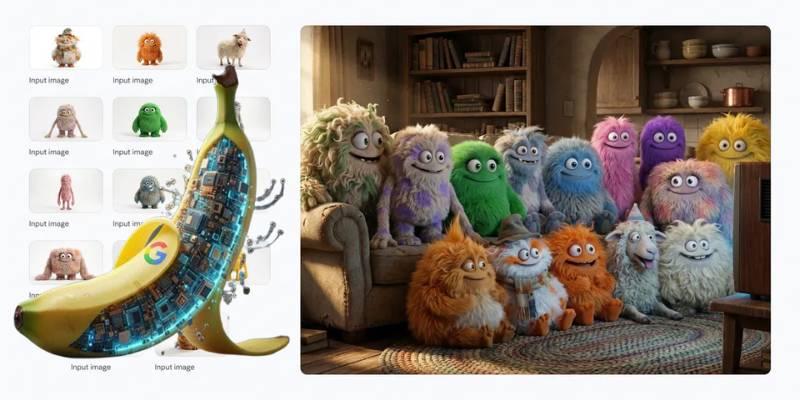

Google’s latest image-generation model, Nano Banana Pro, is arriving with the kind of hype that coincides only when a tech giant unveils something that seems uncomfortably like the future.
During the hands-on testing described in the Wired piece, reviewers were surprised at sharper detail, better control of lighting and a tendency to produce images that don’t collapse into blocky salesman artifacts as soon as you’d want to zoom much.
That write-up on wired. com did a great job capturing that energy, particularly the bit where they kind of squished their model with tricky prompts and it just spat out surprisingly coherent visuals at them.
Some people were also asking whether the model might finally be a cure for AI-generated text inside images-and bizarrely, it does seem to do better at labels and captions than older generations of models.
It’s still not game over, but the gap is closing quickly. Google themselves alluded to these successes when announcing their new generator on siliconangle. com, where they spoke of smarter thinking and 4K-level quality.
The twist is in just how fast this tech is spreading. Rather than leave it buried within Google’s own ecosystem, the company has begun to integrate with partner workflows.
Its more seamless integration with Adobe Firefly (as mentioned in the blog post over at adobe. com, opens up the door for designers who’ve been playing around with various tools just to get their drafts in order.
All of a sudden, generating high-quality images is something you can kick off from within Photoshop without having to grapple with models in an entirely different application.
But every time we jump ahead, the small voice in the back of the room wonders, “So … how do we actually know what’s true?”
And that question is louder than ever. In just the last couple of days, a report from theverge. com, Google is increasingly reliance on SynthID-style watermarking with an eye towards identifying AI-generated visuals.
It serves as a reminder that the very same tech designed to wow us also raises questions about authenticity, disinformation and misuse.
Funny – every time a new model like this one appears, you can almost hear the creative world divide itself in two.
One the one hand, people are overjoyed. More responsive drawing, improved prompt control, less weird extra fingers – that’s a win.
But then you talk to illustrators who are feeling some combination of hopeful and terrified that this progress will either open new doors or push them even further into the margins.
I’ve spoken to a couple of designers who confess to enjoying dicking around with the outputs, even as they nervously joke that something like Sama gets them one step closer to “being replaced by a banana model.”
That’s the sort of emotional whiplash this tech and its makers keep inflicting on us.
There’s also a peculiar cadence that occurs every time someone tests one of these models.
Sometimes Nano Banana Pro makes creates a beautiful, cinematic scene; other times it puts something that makes you wonder if you actually wrote what you thought you did.
Ostensibly, that inconsistency just makes it seem more human. Perhaps that’s the reason some folks don’t immediately shy away when the model does something weird - it’s kind of reassuring to know even the most sophisticated A.I. still has its eccentricities.
One more point worth noting is that these rapid advances are changing the conversations happening within marketing, gaming and film.
Studios need storyboard faster; advertisers need multiple variations in a short time frame; indy game developers don’t like wasting money, etc.
It’s possible Nano Banana Pro is a perfect fit for those needs, offering creators a middle area where they can start sketching out ideas before putting millions of dollars into play.
Whether it goes on to become the industry’s new instrument or just another shiny step forward depends on whether it can reliably perform in the real world.
To my mind, models like Nano Banana Pro are drifting away from “magic machines” and toward collaborative partners – unpredictable ones, certainly, but it’s an interesting relationship that forms when you work to mold visuals together without quite knowing exactly what those should be.
And perhaps that’s what we’re all struggling with, not the fear of being replaced but the unsettling sensation of allowing something non-human into our creative process.
Occasionally it enhances the work, occasionally it undermines the work, but constantly it tests the limits of what exactly is work.
If the rate of development continues like this, it may not be long until the average person can produce film-quality imagery in a way they can send texts.
And the conversation on that day won’t just be about models and benchmarks – it’ll be about how we redefine creativity itself.
