

AI can generate insights faster than any analyst ever could. But speed isn’t the problem anymore. The real problem is value.
In 2026, the gap isn’t between companies that use AI and those that don’t. It’s between those who can explain AI-generated insights clearly and those who just copy-paste model outputs into slides and hope for the best.
Your boss doesn’t care that you used a transformer model, an agent framework, or an automated pipeline. They care about one thing: What does this mean for the business, and what should we do next?
That’s where data storytelling using AI comes in.
The Shift: Raw Data to Insights
AI has changed how professionals work with information. You no longer need to manually dig through spreadsheets and reports to find patterns. AI can analyze massive amounts of data and surface insights in seconds.
But this creates a new problem! If everyone has access to AI-generated insights, how does one stand out?
Here’s the solution: The real value lies in explaining what those insights mean and what should happen next.
A marketer using AI to analyze campaign performance, a product manager reviewing user feedback, or a sales leader evaluating pipeline risk all face the same responsibility. The tool can generate insights, but it’s the human that makes the final decision.

Think of your role less as someone who finds information and more as someone who interprets and communicates it. AI speaks in probabilities, patterns, and predictions. Your job is to translate that into business impact, risks, and clear actions.
1. Start with the Business Question, Not the AI
Before you show anything, anchor the conversation in the problem.
Don’t say: “We used GPT-based analysis to analyze customer behavior.“
Say: “We wanted to understand why customer retention dropped last quarter.“
This immediately answers the one question your boss cares about: Why are we discussing this?
They don’t care if it’s ChatGPT or Claude. The business outcome is the story. Even if you’ve done it all manually it wouldn’t make a difference if you were unable to propose it as a solution to a business problem.
2. One Insight to Rule them All

AI can generate 50 charts. Your boss has patience for maybe three.
Your job is to choose the insights that:
- impact revenue
- affect risk
- influence strategy
- require action
Everything else is noise. Don’t build suspense. Say the answer upfront. This is called the Pyramid Principle.
For example: Customers acquired through paid ads are 30 percent more likely to churn than organic users.
This becomes your headline. Draws attention using metrics. Everything else should support this one point.
If there is one takeaway from your presentation, it should be this point.
3. Explain the Insight in Plain English
Your goal is to build confidence, not show off technical complexity.
Focus on:
- What data was analyzed
- How much data was used
- What pattern was found
For example: This insight is based on 150,000 customer records from the last 12 months, and the pattern is consistent across regions.
This makes the insight believable without going into technical jargon.
4. Establish Credibility and Confidence in the Insight
AI-generated insights are powerful, but they can also raise skepticism. Before anyone acts on your findings, they need to trust them.
This is where you validate the insight.
Briefly explain where the data came from, how much of it was analyzed, and whether the pattern was consistent.
Answer the question: How reliable is this?
For example:
This finding is based on 180,000 user sessions over the past nine months. The same churn pattern appears across all major customer segments, including geography and device type.
This does two things.
- Reassures your audience that the insight isn’t based on a small or biased sample.
- Makes your recommendation easier to accept later.
Without trust, even the most important insight gets ignored. With trust, decisions move faster.
5. Insights to Action
Never stop at the insight. Tell them what to do next. Propose a solution, strategy or direction, that would help consolidate your findings. This is best done using CTA or Call to Action.
A strong CTA removes ambiguity. It answers the most important follow-up question in the room: What should we do now?
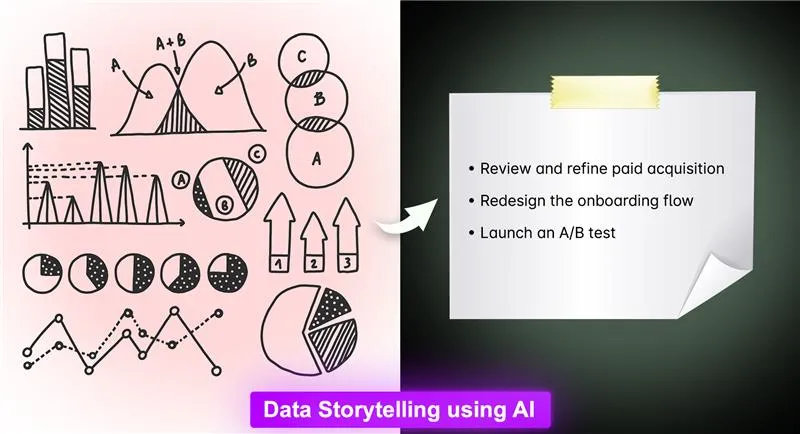
For example: Here are some actions that will improve the
- Review and refine paid acquisition targeting criteria this quarter
- Redesign the onboarding flow to improve early user engagement
- Launch an A/B test to reduce churn within the first 30 days
This shifts your role from someone who reports information to someone who drives outcomes.
Because in the end, insights create value only when they lead to action.
Conclusion
AI has made insight generation faster, easier, and accessible to almost everyone. But AI hasn’t reduced the importance of data storytelling. If anything, it has made it more critical.
When insights are abundant, clarity becomes the differentiator.
The professionals who stand out are not the ones who generate the most charts or use the most advanced models. They are the ones who can connect insights to business questions, explain them in simple terms, establish trust, and translate them into clear action.
Because decision-makers don’t act on data. They act on understanding.
Following these five steps ensures that your work doesn’t stop at analysis. It moves forward into influence.
In the end, the goal isn’t to show what the AI found. It’s to make sure something meaningful happens because of it.
Frequently Asked Questions
A. No. Focus on explaining what the insight means, why it matters, and what action should follow. Clarity and relevance matter more than technical depth.
A. AI provides outputs, not decisions. Storytelling connects those outputs to business context, impact, and action, helping decision-makers understand and respond confidently.
A. Starting with tools and methodology instead of the business problem and key insight. Executives care more about outcomes and recommended actions than technical processes.

I specialize in reviewing and refining AI-driven research, technical documentation, and content related to emerging AI technologies. My experience spans AI model training, data analysis, and information retrieval, allowing me to craft content that is both technically accurate and accessible.
Login to continue reading and enjoy expert-curated content.
