
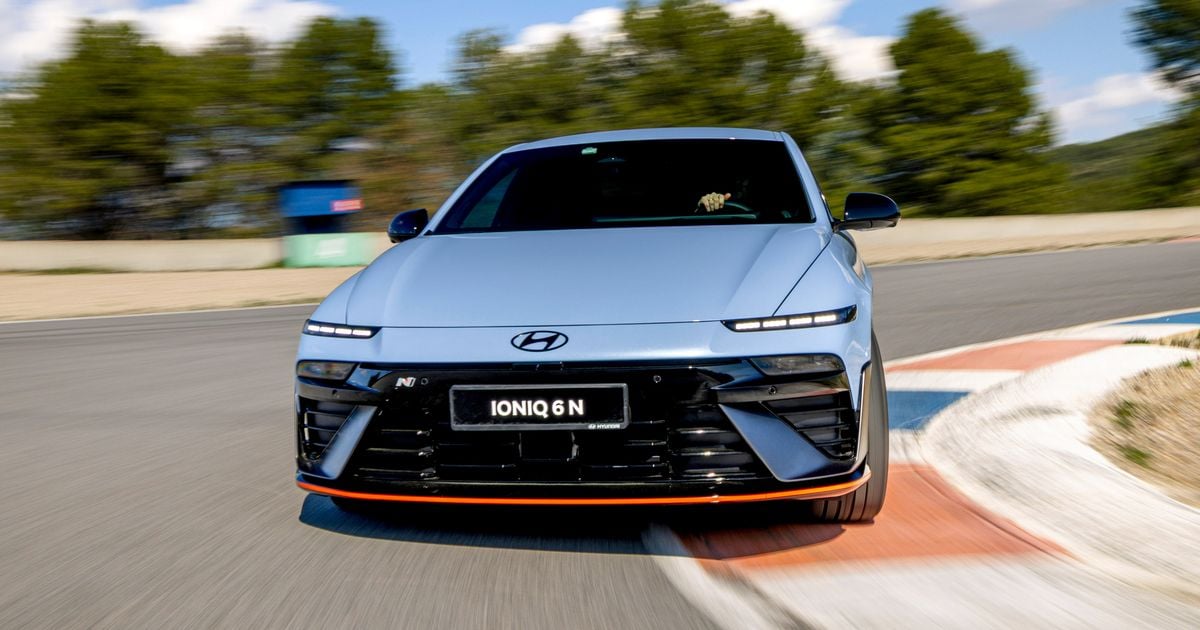

The new high-performance Hyundai Ioniq 6 N electric sedan matches the potent Ioniq 5 N electric SUV’s wicked power output but comes in a lower-slung package, one that makes it clear this is no ordinary electric vehicle (EV).

From the swollen wheel-arches and strip of red around the body kit’s base to the swan-neck rear wing affixed to the boot, there’s no mistaking the Ioniq 6 N’s remit.
Between the styling enhancements and the upgraded powertrain, driving range drops to 469km (versus the standard model’s 624km) but it still offers ultra-fast DC charging at up to 350kW.
What’s more important is what else lies under the Hyundai’s skin, as its team of engineers have tweaked it to deliver engaging performance not only in a straight line, but through the bends too. It serves as an antidote to those who think EVs can’t be fun to drive.
Does it live up to that? To find out, we got behind the wheel at the car’s European launch in Barcelona, starting out in the city and ending at the challenging Parcmotor Castellolí racetrack.
How much does the Hyundai Ioniq 6 N cost?
Hyundai Australia has not yet announced pricing for the Ioniq 6 N, but if other markets are anything to go by, it should be very similar to the Ioniq 5 N, which has a drive-away price of $123,242 (based on a North Sydney postcode). The car’s standard equipment level is good, but you will pay extra for some of the paint finishes.
To see how the Hyundai Ioniq 6 lines up against the competition, check out our comparison tool
Let us help you find your new car
Buy your new car without the stress. It’s fast, simple and completely free.
Great service from Travis and team, second time I have used this business would not hesitate to recommend them to anyone
Craig C.
Purchased a Ford Ranger in Sunshine Coast, QLD
CarExpert helped Craig save thousands on his Ford Ranger, now let us save you on your next new car.
What is the Hyundai Ioniq 6 N like on the inside?
Despite the extensive reworking of the exterior design of the Ioniq 6, less has changed inside the sedan, though it already had a decent setup, and there are some specific changes for the Ioniq 6 N.
Let’s start with the most important part: the steering wheel. Diameter-wise, this fully round multifunction tiller is just a touch on the large size for our liking, but it feels great in-hand and we like how it’s all proper buttons at work.
There is a lot going on when you look at it first, but almost everything is within thumb’s reach when you’re driving. You get a 12 o’clock marker, the left side includes a handy Drive Mode selector and on the right there’s a bright red NGB (N Grin Boost) button that releases maximum power output for up to ten seconds at a time.
All the usual cruise control, phone and media buttons are spread across the two horizontal spokes and below are two satellite buttons for different N modes.
The digital dashboard – comprising two 12.3-inch displays – is loaded with information, and this varies depending on what driving mode you’re using.
The native infotainment is fairly intuitive to use, and there’s the usual Android Auto and Apple CarPlay there too.
In keeping with the performance theme, there are sports seats up front, but these stop short of being overly track-focused; there’s enough lateral support and bolstering for more enthusiastic driving, but they aren’t a pain to get in and out of on a daily basis, unlike what you find in an Audi RS3 or BMW M3.
Those in the rear get more conventional seats, albeit with the same nice upholstery. There is what seems like acres of legroom, thanks partly to the car’s near-three-metre wheelbase.
The lower roofline does limit headroom a bit, but it’s not detrimental to the overall passenger experience, while the flat floor means even the middle rear seat occupant doesn’t come off too badly.
A separate boot lid rather than a liftback means the practicality is slightly limited, and overall capacity is just 371 litres, partly due to the additional structural bracing that can be seen in the rear.
| Dimensions | Hyundai Ioniq 6 N |
|---|---|
| Length |
4935mm |
| Width |
1940mm |
| Height |
1485mm |
| Wheelbase |
2965mm |
| Cargo capacity |
371L |
To see how the Hyundai Ioniq 6 lines up against the competition, check out our comparison tool
What’s under the bonnet?
There will be only one specification for the Ioniq 6 N when it goes on sale in Australia. The powertrain mirrors what is already available in the Hyundai Ioniq 5 N.
| Specifications | Hyundai Ioniq 6 N |
|---|---|
| Drivetrain |
Dual-motor electric |
| Battery |
84kWh lithium-ion |
| Power |
478kW |
| Torque |
770Nm |
| Drive type |
All-wheel drive |
| Weight |
2166kg |
| 0-100km/h (claimed) |
3.2 seconds |
| Claimed range |
469km |
| Max AC charge rate |
11kW |
| Max DC charge rate |
350kW |
The dual-motor setup comprises a 175kW motor on the front axle and a more powerful 303kW motor on the rear. In standard guise, the car produces a peak power output of 448kW, but the N Grin Boost function boosts that to 469kW for 10-second bursts.
To see how the Hyundai Ioniq 6 lines up against the competition, check out our comparison tool
How does the Hyundai Ioniq 6 N drive?
If you aren’t familiar with how Hyundai approaches the N variants of its electric vehicles, then it’s best to think of the Ioniq 6 N as a car with two personalities.
Our drive started in the city, and in this setting, in its default driving mode, the Hyundai is really no different to many other electric cars.
It navigates the streets easily, and the suspension is good at soaking everything up. In the normal drive setting, the power delivery is smooth and quiet. Even the 20-inch wheels don’t generate a huge amount of road noise, no doubt helped by the acoustically optimised glass in the front of the cabin.
You only have to prod the right pedal to get a sense for how much performance is on tap, but for the everyday stuff, such as joining a highway from the slip road, it feels like you’re barely tickling the Hyundai as the digital speedo ramps up the numbers. The surge of torque keeps your back pressed well into the sports seats.
Find some more interesting roads and, even staying in the same Normal drive mode, the long sedan manages to feel quite agile, leaving just enough body roll to feel what it’s doing and steering that telegraphs accuracy but reminds you that you’re still piloting some mass.
To get more from it, a switch to the sportier settings reveals a different character as the suspension noticeably firms up and the sound booms into the cabin. There are undoubtedly swathes of purists that will roll their collective eyes at what Hyundai’s engineers have done here by generating an engine-like sound and even adding pops and crackles on the ‘overrun’.
But the thing is, as is the case in the Ioniq 5 N, it’s fun. It puts a grin on your face, and that’s before you even start getting into it with the simulated gearshifts.
Whatever software and coding Hyundai has done works impressively well, right down to the feeling of getting a kick from behind as you pull the next ‘gear’ shift. The seemingly never-ending surge of torque that EVs provide means you’re pulling on that right paddle more quickly than you might expect. But if you don’t, it can run into an effective rev-limiter, which adds further laughter to the whole experience.
Utilising the full breadth of the N gizmos and gimmicks is best kept to the track (or anywhere other than a public road), especially the drift mode. This setting lets you set the car up to act a bit like a support coach and safety net for when you really want to hang the tail out. You can choose the level of initiation, drift angle and even wheel spin to make you look like a hero as the rear axle does its best to melt away your bespoke Pirelli P Zero rubber.
Keeping things tidier, the front-end turns in nicely, and that firmer suspension keeps everything well in check. Between the sound of the gear shifts, it can be easy to lose track of the fact that this is an EV. That swell of torque from both axles is impressive regardless of where it comes from.
Under heavier braking, there is a lovely consistency from the pedal, and as you bleed off as the apex approaches, there’s only a subtle sense of weight transfer rearwards as the power is reapplied. For a car tipping the scales at more than 2000kg, it feels quite rapid. And while not everyone is going to take one of these to a track day, it demonstrates just how much fun and how capable it can be on the right ribbon of road.
If there’s one thing the Hyundai isn’t on track, it’s energy efficient: we saw over 62kWh/100km during one session, in comparison to an average of a little over 20kWh/100km during our road driving.
To see how the Hyundai Ioniq 6 lines up against the competition, check out our comparison tool
What do you get?
2026 Hyundai Ioniq 6 N equipment highlights:
- 20-inch alloy wheels
- 12.3-inch digital instrument cluster
- 12.3-inch infotainment touchscreen
- Wireless phone charging pad
- High-performance adaptive dampers
- Launch control
- Electronic limited-slip rear differential
- Paddle shift regenerative braking
- Orange brake calipers
- Battery heating with pre-conditioning
- 64-colour ambient lighting
- Aluminium pedals
- Suede headlining
- Heated and ventilated front seats
- Heated outer rear seats
- Dual-zone climate control
- LED matrix headlights
- Heat pump
- Digital key
- Remote Smart Park Assist
- Surround View Monitor
Is the Hyundai Ioniq 6 N safe?
The standard Hyundai Ioniq 6 has a five-star rating from ANCAP, which was awarded back in 2022.
Standard safety equipment includes:
- Airbag – front passenger de-activation switch
- Airbags – front, centre, side
- Airbags – front thorax and pelvis, curtain
- Blind Spot Collision Avoidance Assist (BCA)
- Blind Spot View Monitor
- Remote central locking
- Childproof rear door locks
- Forward Collision Avoidance Assist – car, pedestrian, cycle
- Forward Collision Avoidance Assist – Junction (turning)
- Highway Drive Assist Level 2
- Intelligent Speed Limit Assist (ISLA)
- ISOFIX child seat anchor – rear outboard
- Lane Follow Assist (LFA)
- Lane Keep Assist (LKA) – Line and Road Edge
- Parking Collision Avoidance Assist – reverse, forward, side (PCA)
- Rear Cross Traffic Collision Avoidance Assist (RCCA)
- Rear Occupancy Alert
To see how the Hyundai Ioniq 6 lines up against the competition, check out our comparison tool
How much does the Hyundai Ioniq 6 N cost to run?
The Ioniq 6 N requires servicing every 24 months or 30,000km, whichever comes first.
| Servicing and Warranty | Hyundai Ioniq 6 N |
|---|---|
| Warranty |
7 years, unlimited kilometres |
| Roadside assistance |
2 years |
| Service intervals |
24 months or 30,000km |
| Capped-price servicing |
TBC |
| Total capped-price service cost |
TBC |
To see how the Hyundai Ioniq 6 lines up against the competition, check out our comparison tool
CarExpert’s Take on the Hyundai Ioniq 6 N
There is no shortage of EVs around now that have enough power and acceleration to rearrange your organs from a standing start, but so many of them remain one-trick ponies.
The Ioniq 6 N goes well beyond that to provide a capable and competent electric driving experience in the everyday commuting sense, yet has enough tricks up its sleeve to make a spirited drive on your favourite stretch laugh-out-loud fun.
It’s far too easy to be cynical about EVs such as this, but scratch the surface and you’ll find this is a seriously good – and seriously fun – EV that’s been built by car people for car people.
Interested in buying a Hyundai Ioniq 6? Let CarExpert find you the best deal here
Click the images for the full gallery
